Morocco, Part Two: Marrakech – Tizi n’Tichka – Aït Ben Haddou – Ouarzazate – Skoura – the City of Roses – Dades
We left Marrakech behind, and the mountains began to rise ahead. After the medina, traders, motorcycles and evening bustle of Jemaa el-Fna, our eyes needed time to adjust to so much distance. Houses thinned out, the road climbed, and another slope appeared around every bend. We were heading into the High Atlas, over the Tizi n’Tichka pass, on a route through Aït Ben Haddou, Ouarzazate and the City of Roses to Dades. It was one of those days when fatigue and curiosity race each other, and curiosity keeps winning.
A Road the Mountains Refuse to Let Run Straight
In my Atlas photograph, the road looks like a ribbon laid across bare slopes. It twists, disappears and reappears further down beside a few buildings that reveal the scale of the landscape. Driving through country like this, I often look back: what was beyond the windscreen minutes ago is now far below us, while another bend opens ahead.
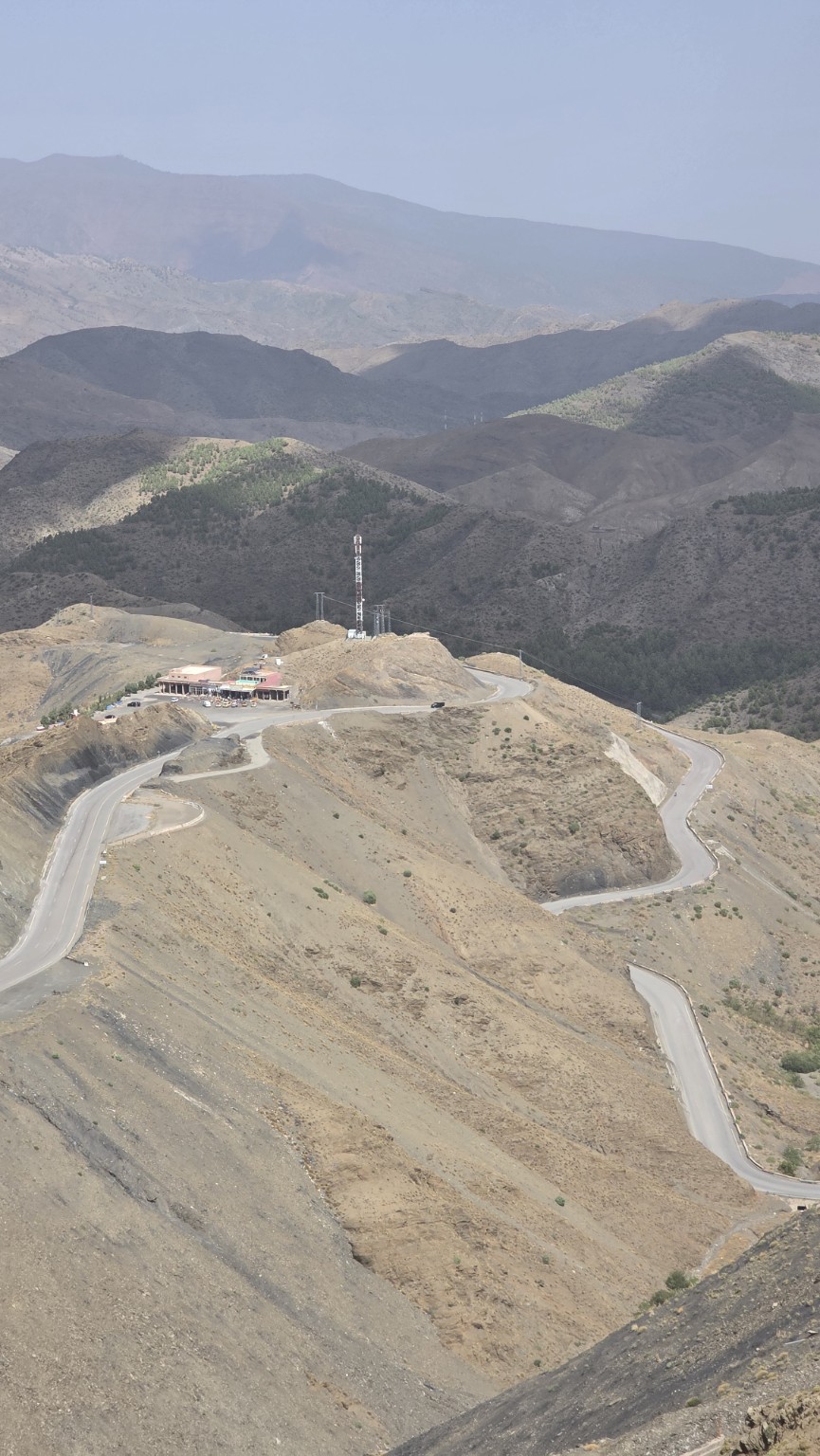
Tizi n’Tichka reaches approximately 2,260 metres above sea level. The road between Marrakech and Ouarzazate crosses here, an important connection between the great city north of the mountains and Morocco’s southern valleys. The view makes the altitude tangible: layers of mountains stretch towards the horizon, while settlements blend so closely with the earth that their straight walls sometimes reveal them first.
This landscape brings you face to face with Amazigh, or Berber, Morocco. Looking at villages on the slopes, I try to imagine the everyday lives we glimpse from our vehicle. What is winter like? How far away is the school? How much work does a little cultivated plot on a hillside require? To a traveller, it is a view; to someone else, it is home. That thought usually stays with me longer than taking a photograph.
Women Who Know the Value of Every Kernel
We stopped for a demonstration of argan oil production. In my photograph, a woman sits beside a hand-operated stone mill, with baskets and prepared kernels within reach. Behind her, other women have their own workstations and tasks. The scene provides a concrete answer to what lies behind a product we usually know only by its label.
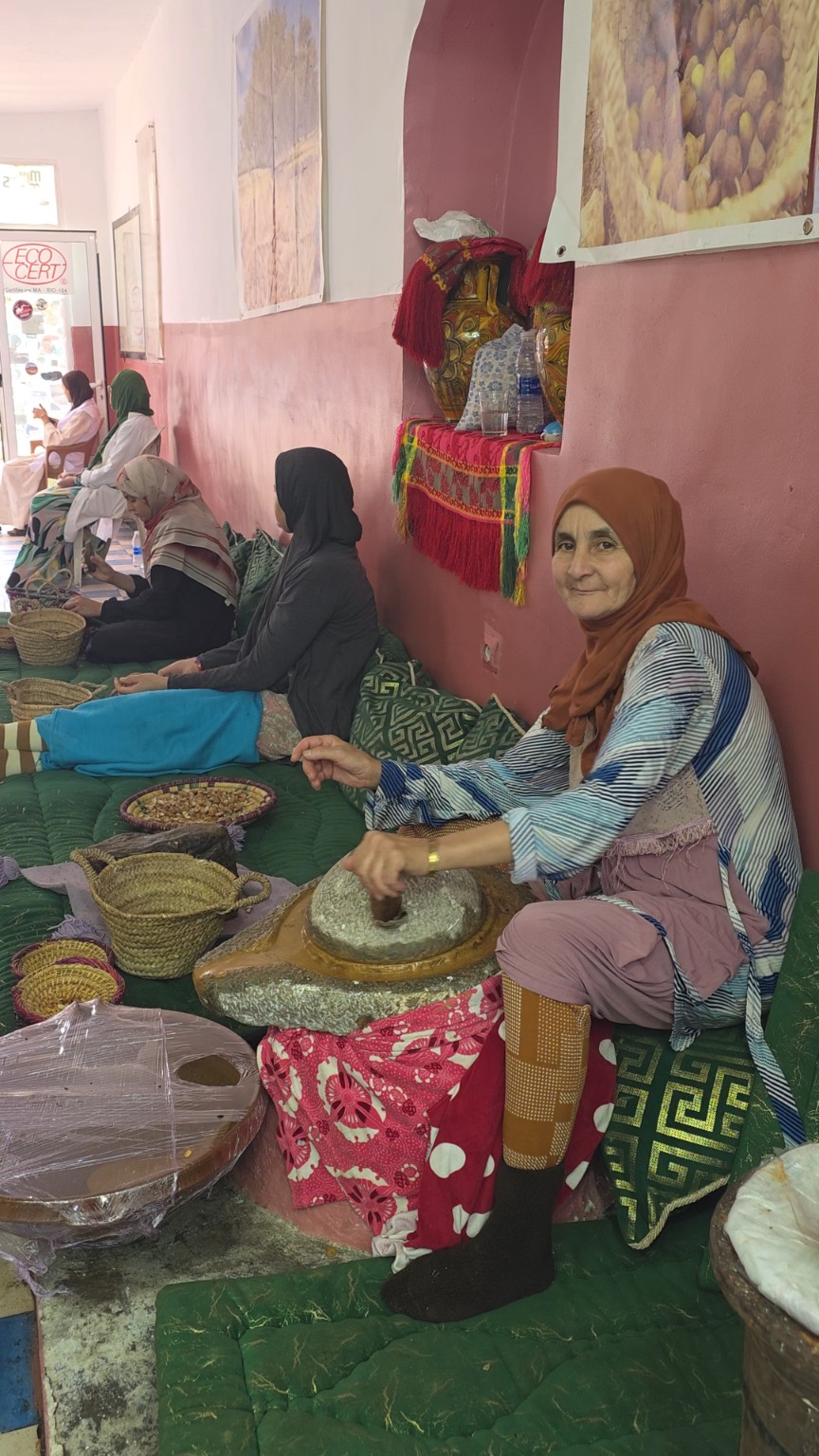
Argan is characteristic of south-western Morocco. The traditional oil-making process involves collecting and drying the fruit, removing the flesh, cracking the hard shell and processing the kernels. This knowledge has passed down through generations, especially among women. UNESCO inscribed it on its Representative List of the Intangible Cultural Heritage of Humanity in 2014.
There is also an important difference between culinary and cosmetic oil: kernels for cooking oil are roasted before pressing, producing its characteristic nutty aroma; cosmetic oil uses unroasted kernels. After a demonstration like this, a little bottle looks different. You begin to include in its price the patience, skill and work that cannot be seen on the packaging.
Aït Ben Haddou, the Highlight of Our Second Day
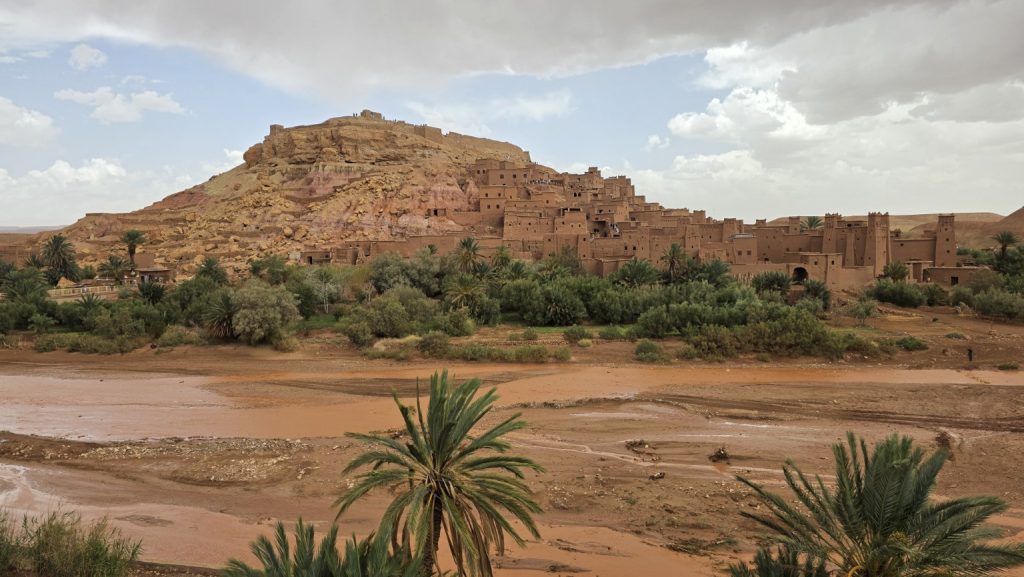
Then Aït Ben Haddou appeared before us. Earthen houses and towers climb a hillside, with greenery below and a broad riverbed at their feet. Clouds had gathered above the settlement in my photograph, making the warm walls stand out even more. This was the highlight of our second day, a place I had especially looked forward to, and it fulfilled every expectation.
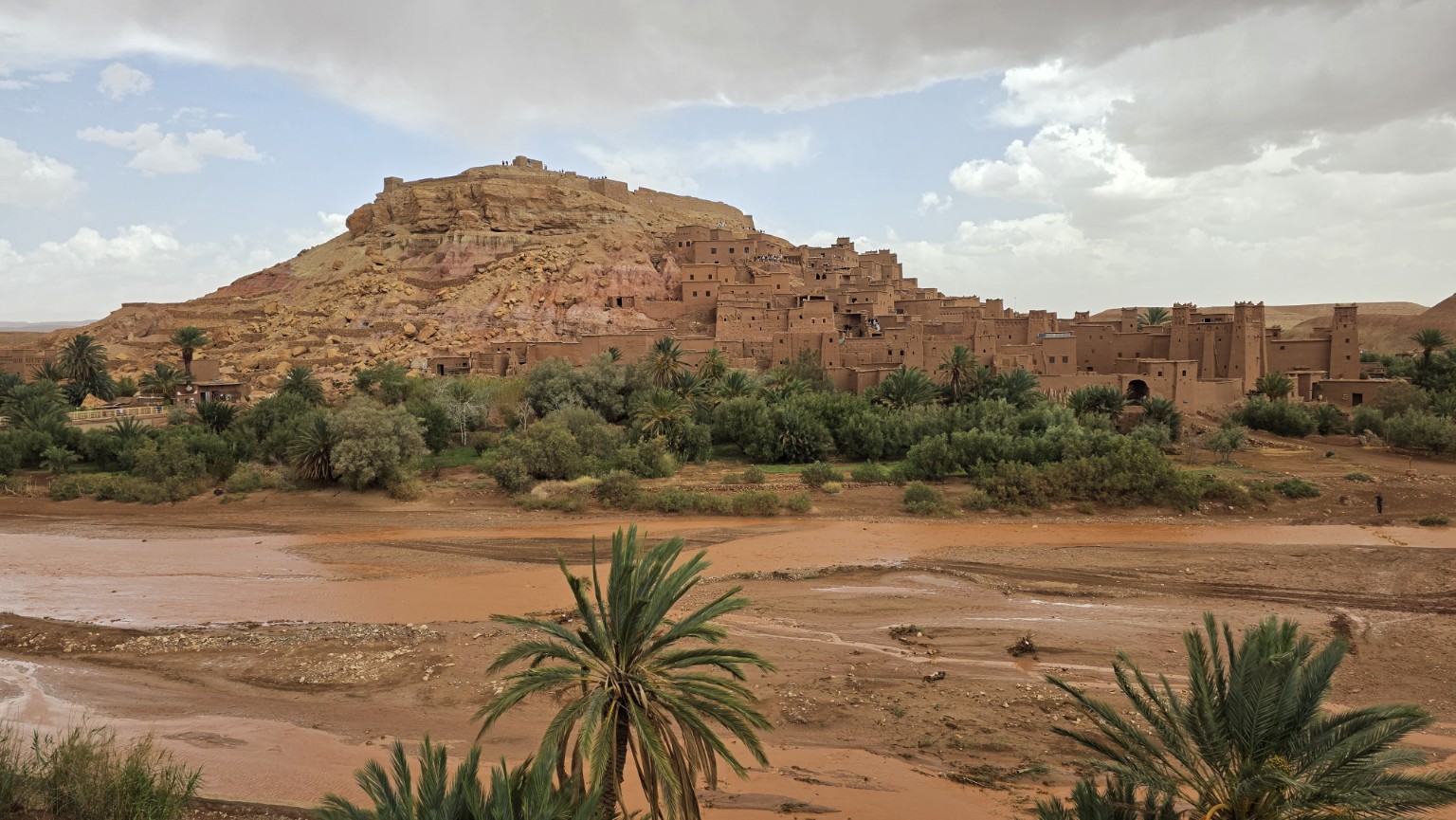
This is a ksar: a group of houses protected by shared defensive walls. It stands in the Ounila Valley and has been a UNESCO World Heritage Site since 1987. The oldest surviving buildings probably date no earlier than the seventeenth century, although they belong to a much older architectural tradition. The settlement’s beginnings cannot confidently be attributed to a single founder.
Its importance came from its position on a caravan route linking Marrakech with lands south of the Sahara, via the Draâ Valley and Tizi n’Telouet pass. The settlement had a mosque, a caravanserai, communal spaces and a hilltop granary, with Muslim and Jewish cemeteries nearby.
Knowing this makes its former life easier to imagine: a caravan arriving, animals needing water, goods to unload and travellers seeking somewhere safe for the night. We photograph the towers; to others they meant protection for property, food and family. The road brought income and news, but also danger, giving the settlement’s beauty very practical foundations.
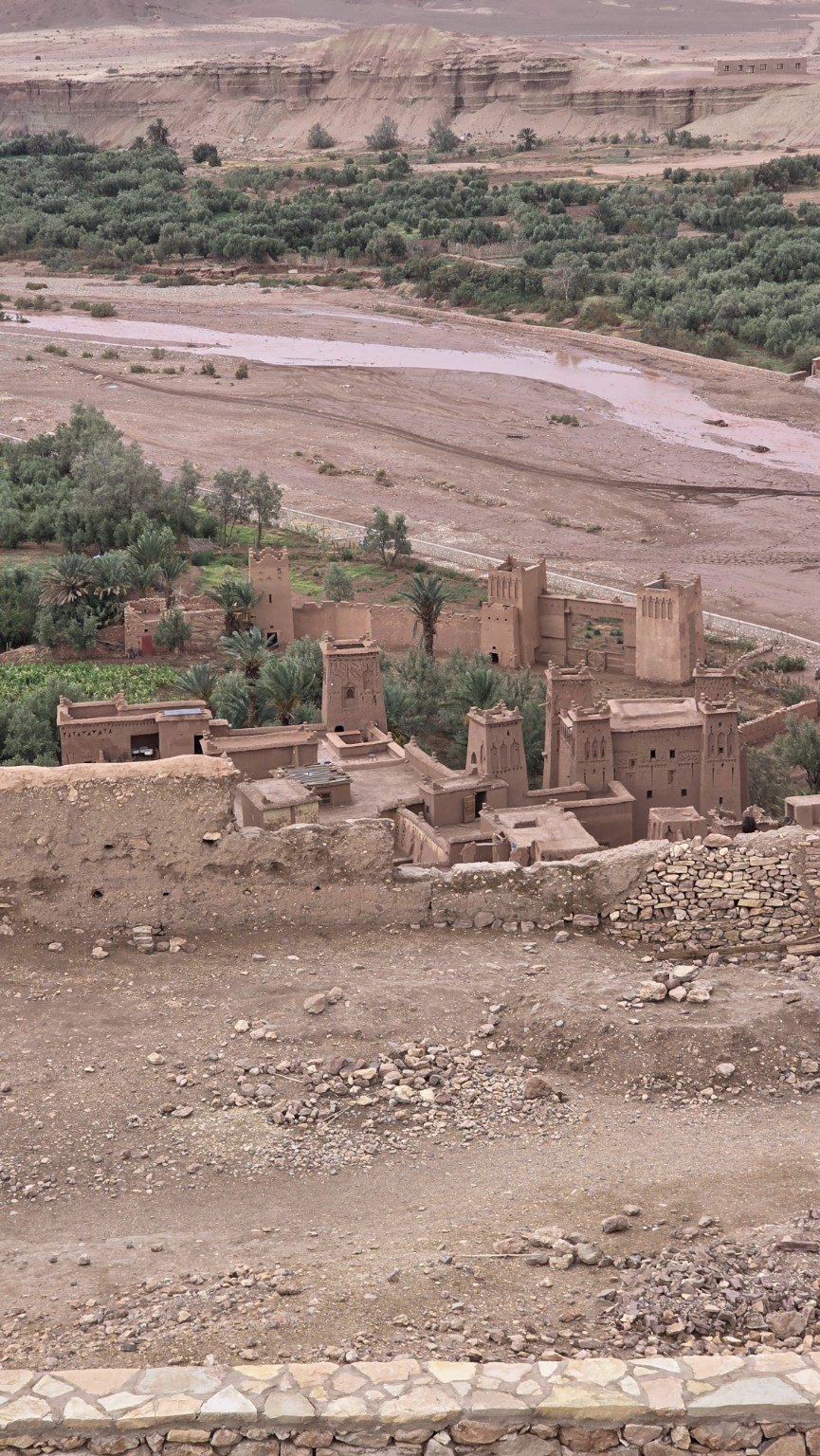
A closer look reveals decorated façades, corner towers and passages between buildings. From a distance, everything forms a coherent whole. That harmony attracts me most: the settlement contains countless details, yet none disturbs its relationship with the hillside.
Signposts to Gladiator and The Odyssey
I am particularly fond of one photograph from here. Alongside local place names, the wooden signs read “Game of Thrones”, “The Odyssey”, “Gladiator” and “Christopher Nolan”. Enough to make anyone smile: we had reached a historic settlement and found ourselves at a crossroads of cinematic worlds.
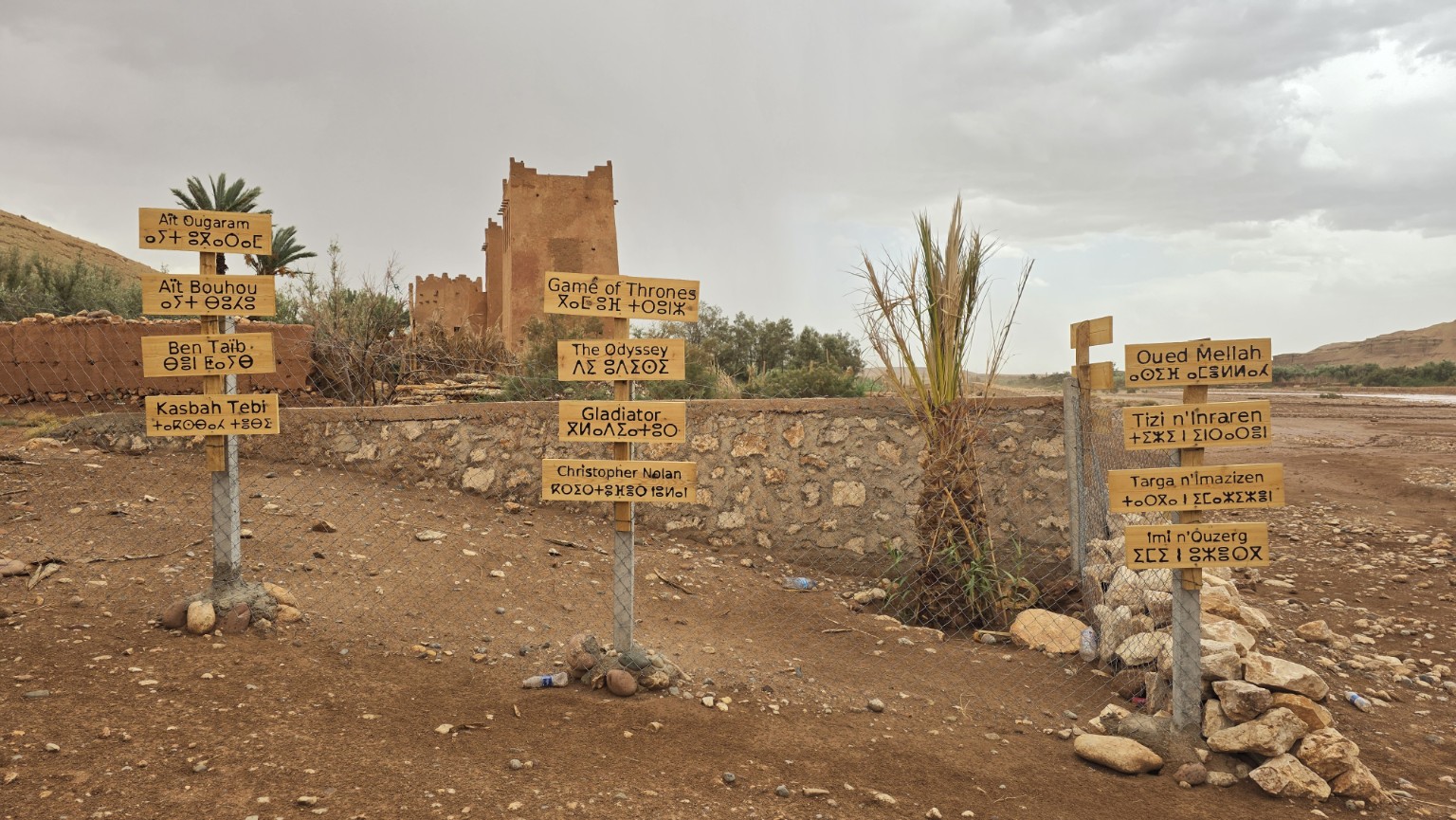
David Lean filmed parts of Lawrence of Arabia (1962) here, with Peter O’Toole playing the British officer T. E. Lawrence. Later came Ridley Scott with Gladiator (2000) and Russell Crowe. Aït Ben Haddou is also associated with Oliver Stone’s Alexander (2004), Alejandro González Iñárritu’s Babel (2006) and the third season of Game of Thrones, in which it represented Yunkai.
Gladiator II (2024) brought Scott’s crew back to the area. According to a report citing executive producer Ahmed Abounouom, an arena was built near Aït Ben Haddou for scenes set in the Roman provinces. Christopher Nolan found his Troy here for The Odyssey, with Matt Damon as Odysseus. Filming began in Morocco in February 2025, and production designer Ruth De Jong created a vast screen city using the existing landscape and buildings.
It is curious to think how often we have seen a real place without knowing its name. We followed a hero, a battle or an escape while these towers quietly lodged in our memory. Here, those scenes finally connect with geography.
A Break for tagine
Among my photographs is an open tagine: an earthenware pot, sauce, meat, prunes and flaked almonds. In a travel story, a photograph like this is almost as valuable as a panorama. It takes you back to the table, reminding you that between great sights you need to sit, eat and let the day slow down.
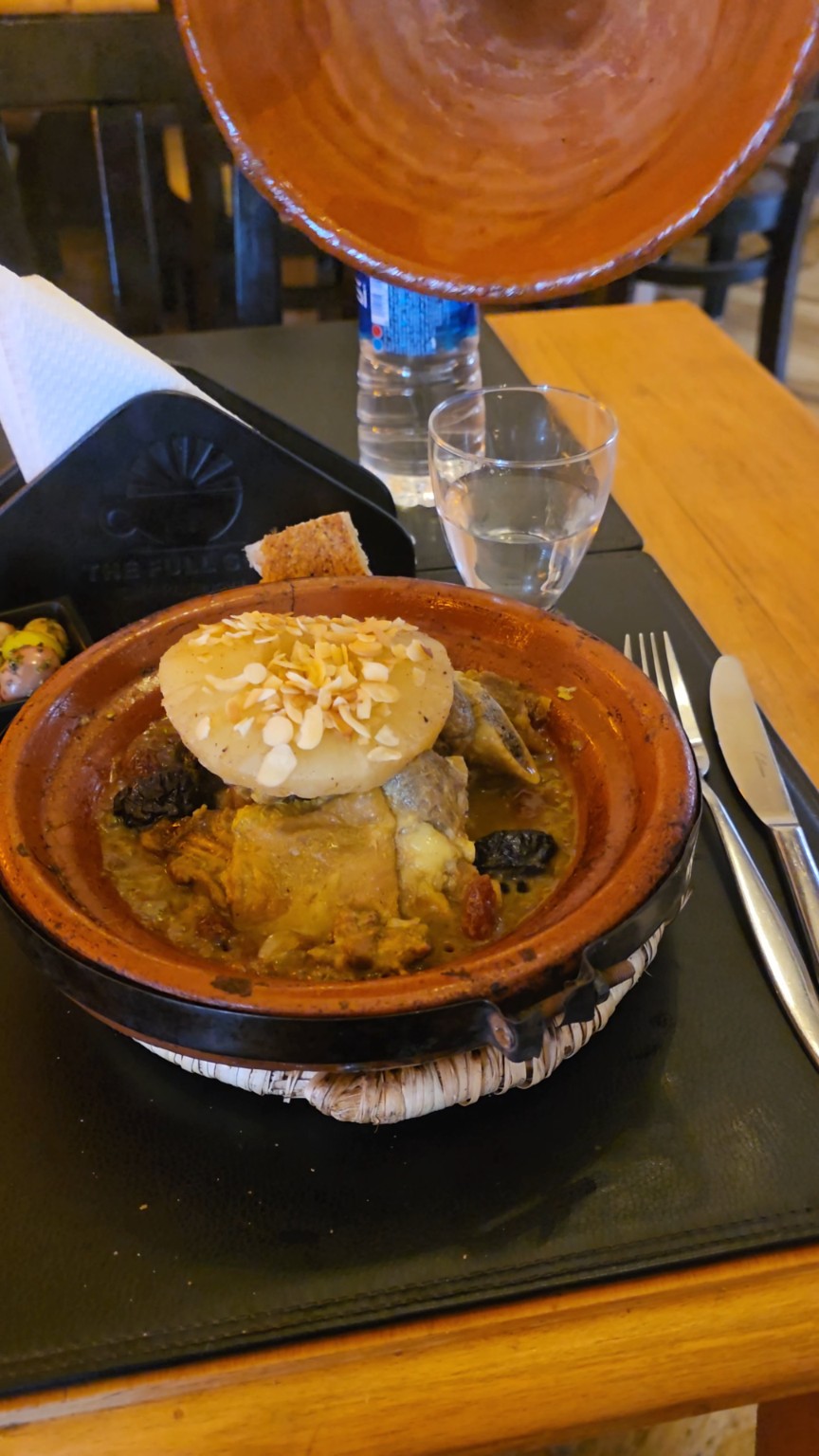
After the mountain road and caravan history, such a meal also brings you back to the simplest pleasures of travel. You do not have to be sightseeing every moment. Sometimes lifting a pot’s lid is enough.
Through Ouarzazate and into the Palm Groves
We continued through Ouarzazate, a city closely associated with the film industry and the Atlas and CLA studios. International productions have found landscapes, sets and highly experienced local crews here. Films shot in these studio spaces include Kingdom of Heaven, Kundun and Asterix & Obelix: Mission Cleopatra.
The city’s older history is represented by Taourirt Kasbah, associated with the Glaoui family, who controlled important routes in this part of Morocco. Its history includes Si Hammadi el Glaoui, brother of Marrakech’s powerful pasha, Thami el Glaoui. The French protectorate authorities began developing a modern military and administrative centre here in the late 1920s.
Further east lies Skoura, a large oasis on the road to Dades, with several thousand hectares of palm groves and kasbahs among the gardens. The best known is Amridil. I remember palms and dates, extensive plantations and greenery appearing amid much barer surrounding terrain.
An oasis is a carefully organised agricultural landscape. Date palms grow tallest, fruit trees beneath them, and vegetables, cereals or fodder crops close to the ground. The canopy moderates the heat, allowing lower crops to thrive. The date palm belongs to a whole system of life here: food, work, trade and the shade in which so much else grows.
The Scent of Roses in Kelaat M’Gouna
In Kelaat M’Gouna, the City of Roses, we stopped for a demonstration of rose products. After argan, this was another local story linking cultivation and processing with cosmetics and trade. The town is the centre of the Valley of Roses, known for rose water and fragrant products.
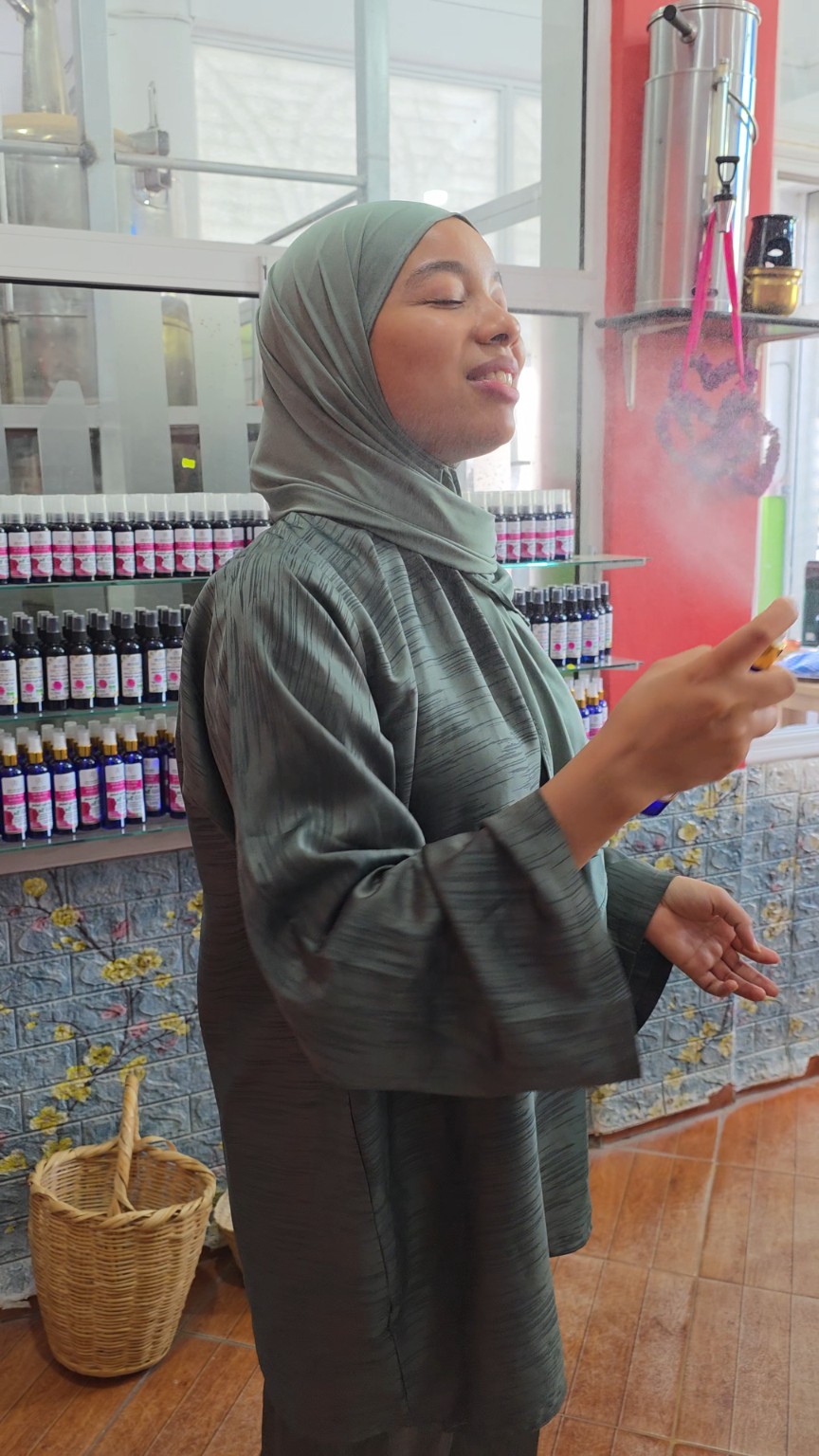
My photograph catches the moment a fragrance is sprayed, rows of bottles behind our hostess. Details like these bring personality back to a long day: alongside place names and historical facts, you remember people demonstrating their work, their gestures and the way they tell you about it.
Towards Dades, between Red Cliffs
On the last stretch, the landscape took the lead again. In the photograph, warm light falls on the rocks as the road bends between them. After so many different scenes, the image captures the feeling of travelling on: another bend, a little more driving, then rest.
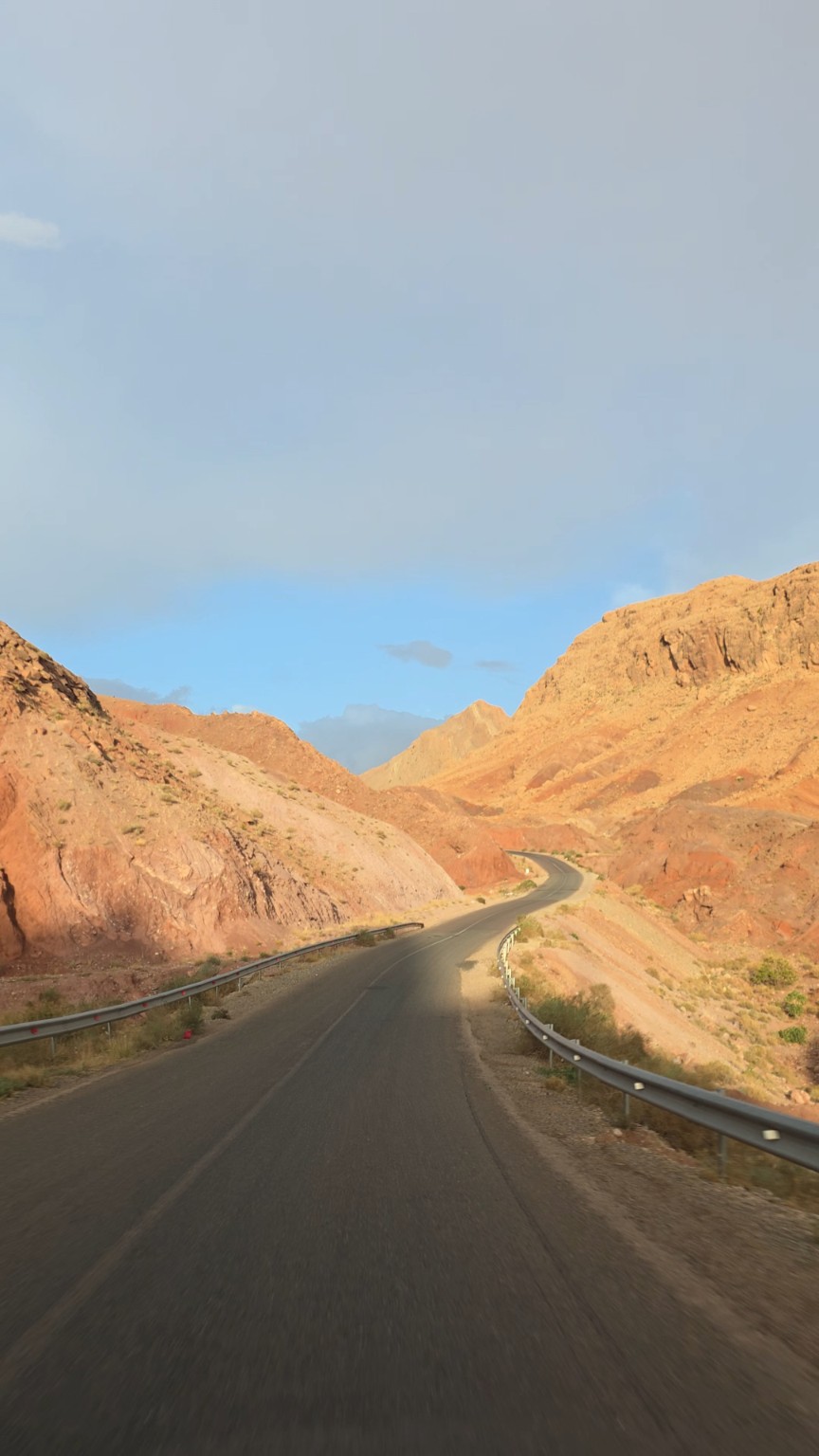
We ended the day in Dades. The name refers to the river and valley; the wider area is known for earthen kasbahs, cultivated plots and rocky landscapes that become increasingly dramatic towards the gorges. After a mountain pass, two demonstrations and Aït Ben Haddou, it was pleasant finally to slow down.
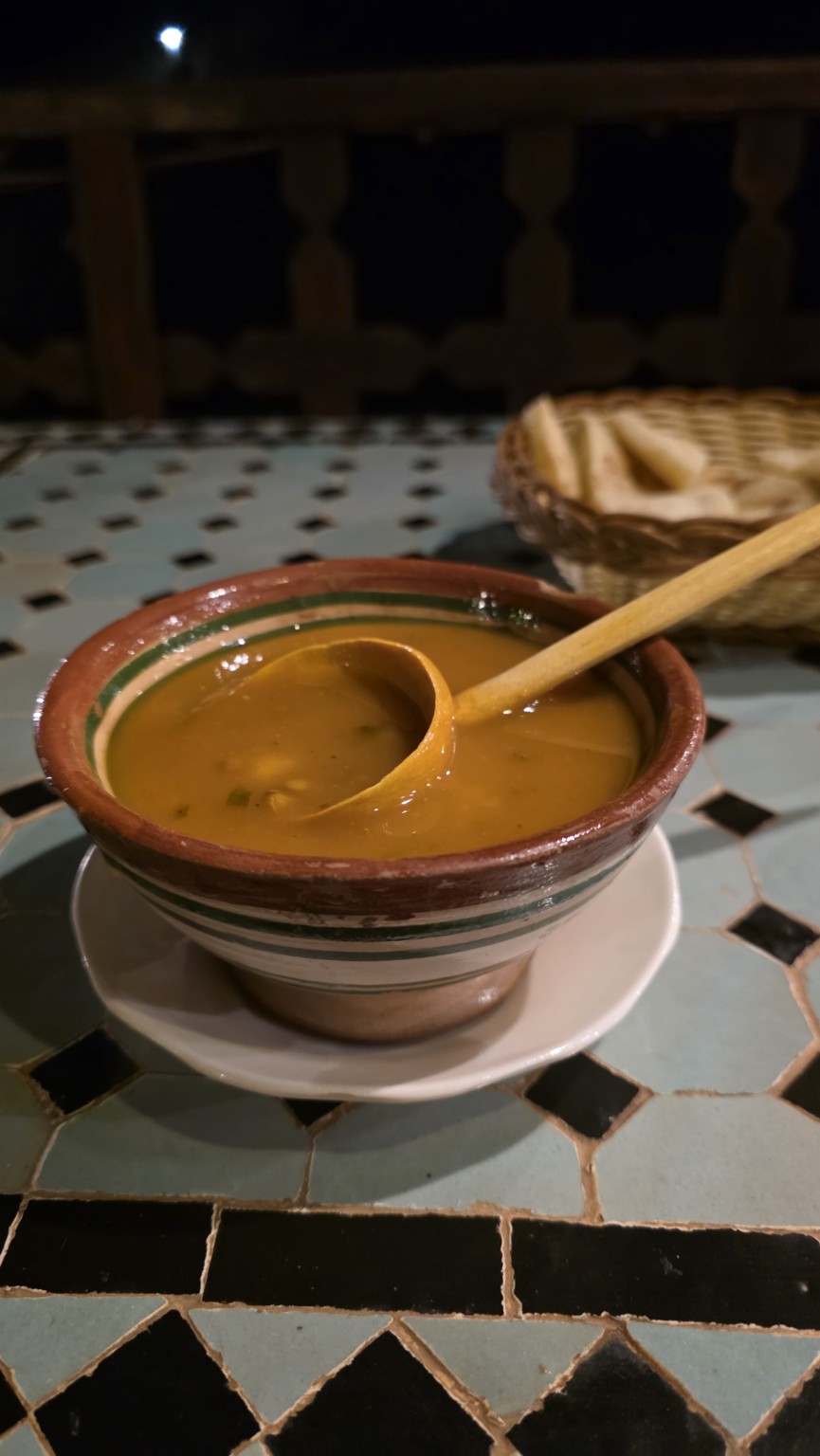
Hot soup awaited us in Dades. After all the kilometres, climbs, sightseeing and new impressions, sitting down and accepting a bowl of something warm was exactly what we needed. The photograph preserves a ceramic bowl, a wooden spoon and bread; my memory preserves the comfort of knowing we did not have to go anywhere else that day.
When I return to those photographs, I pause first at the panorama of Aït Ben Haddou. Then my eye moves to the woman at the stone mill, the film signs, the road and the table. That is how I remember the day: great views and small encounters joining into one story. We left Marrakech in the morning; by Dades, we had discovered a Morocco the city alone could never have shown us.
Previous instalment in the Morocco series: Marrakech – A City Where You Can Lose Your Way and Find a Story.
Next instalment: From Canyons to Dunes: Following Hospitality towards the Sahara.