Seven Days in Morocco — Part Three: Dades – Todra – Melaab – Erfoud – Merzouga
From Dades, where we had finally sat down to hot soup the previous evening, we continued towards Merzouga. A day of canyons, palm groves and increasingly open country lay ahead, ending with our first great dunes. Before we reached the desert sand, though, something happened that has stayed with me as vividly as the day’s magnificent scenery: Mustafa, our guide and my host in Morocco, invited us to his home. There I ate the best couscous of my life. When I try to tell the story of that day, I can never decide whether to begin with the road climbing above the gorge or the large platter that arrived on the family table.
Dades: Bends Best Understood from Above
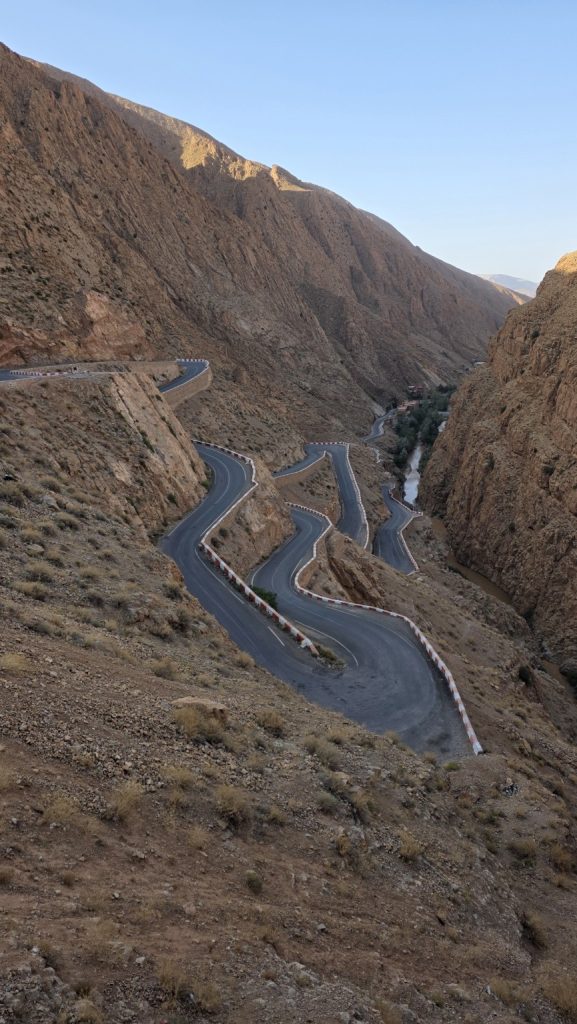
Before we continued to Todra, Dades showed us its famous winding road. These are the hairpin bends that, in photographs, look as though someone has folded the tarmac several times and squeezed it between the cliffs. The stretch is often called Tisdrine, or Tissadrine, and lies in the Dades gorge area.
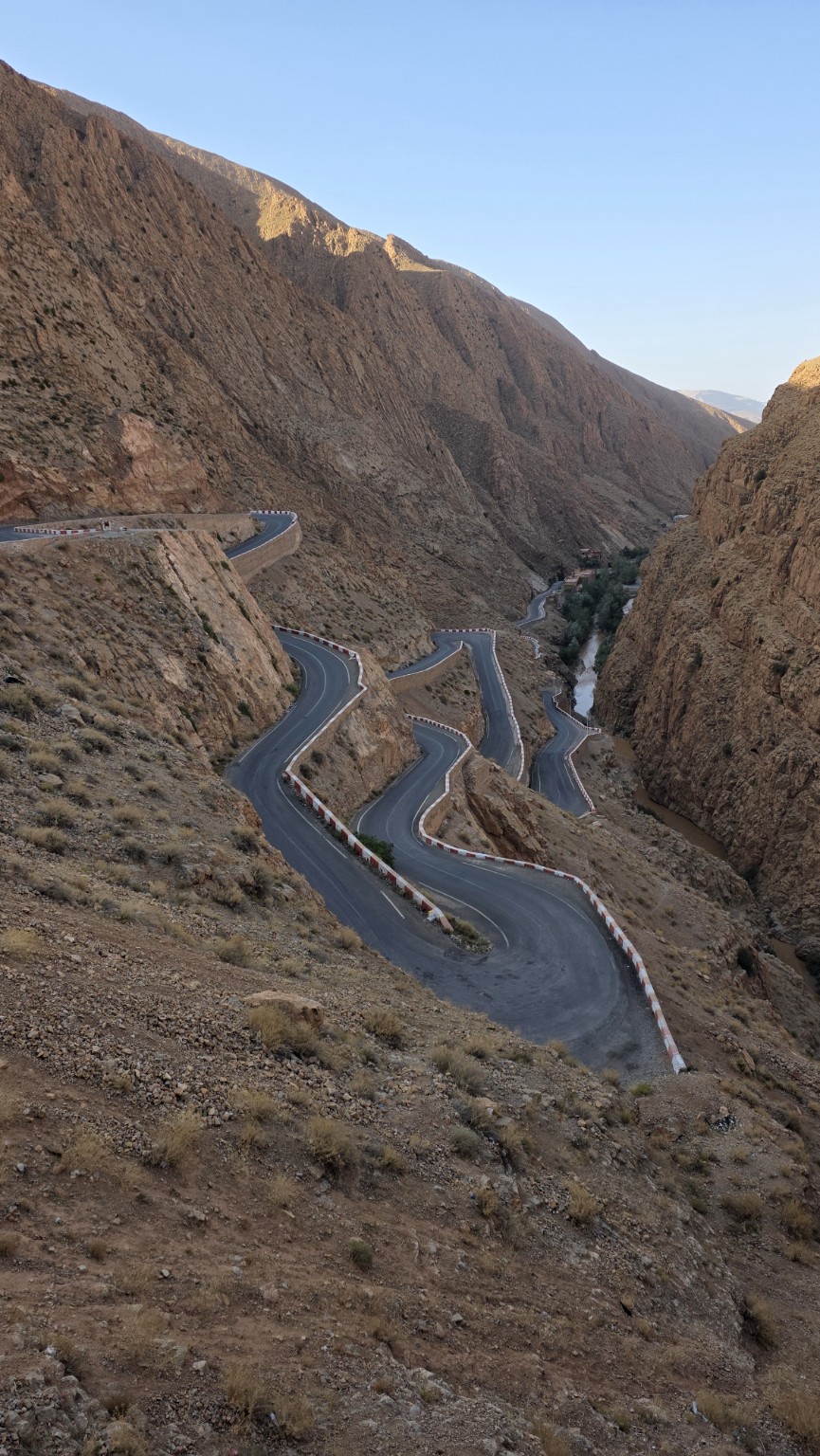
As you drive, you see the bend you are negotiating and the rock ahead. Only from above can you take in the whole route. The road doubles almost back over itself, red-and-white kerbs marking each fold, while far below the river and a narrow ribbon of greenery continue along the valley. It is the sort of view that later has you tracing the road with a finger across a photograph, trying to remember where you were just moments earlier.
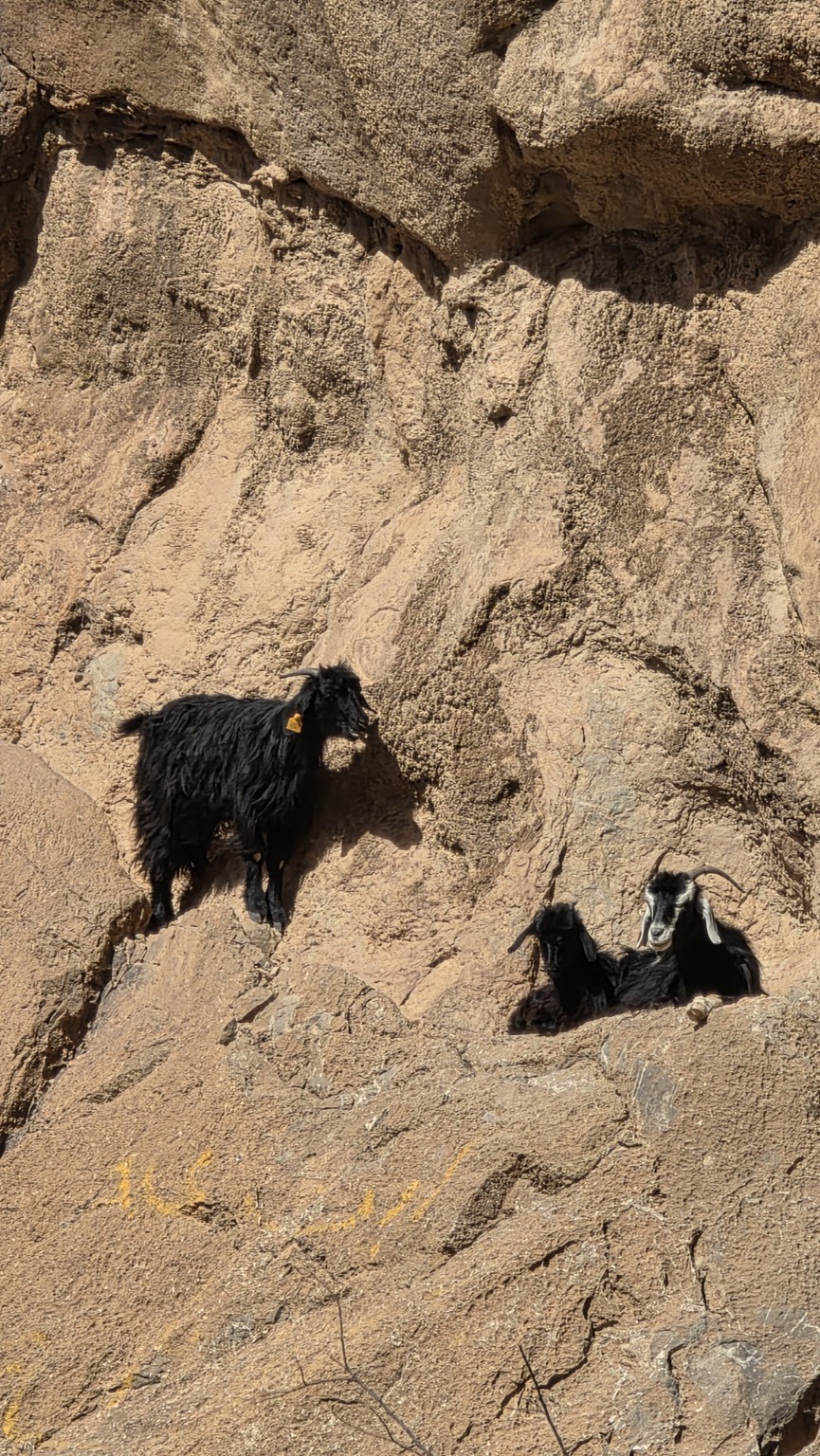
Another photograph shows goats perched on rocky ledges with an ease that feels almost insulting. We look for firm footing and watch every step; they find somewhere to rest on a near-vertical cliff. Alongside the grand panoramas, scenes like this bring a little humour to the journey.
Todra: Water beneath Towering Walls
We continued towards Tinghir and the Todra Gorge, whose name also appears as Todgha or Toudra. In a traveller’s memory, Dades and Todra can merge into one long story of rock and winding roads, but they are separate valleys and gorge systems. The approach to Todra passes through the Tinghir area, past settlements and palm groves, towards a passage enclosed by towering cliffs.
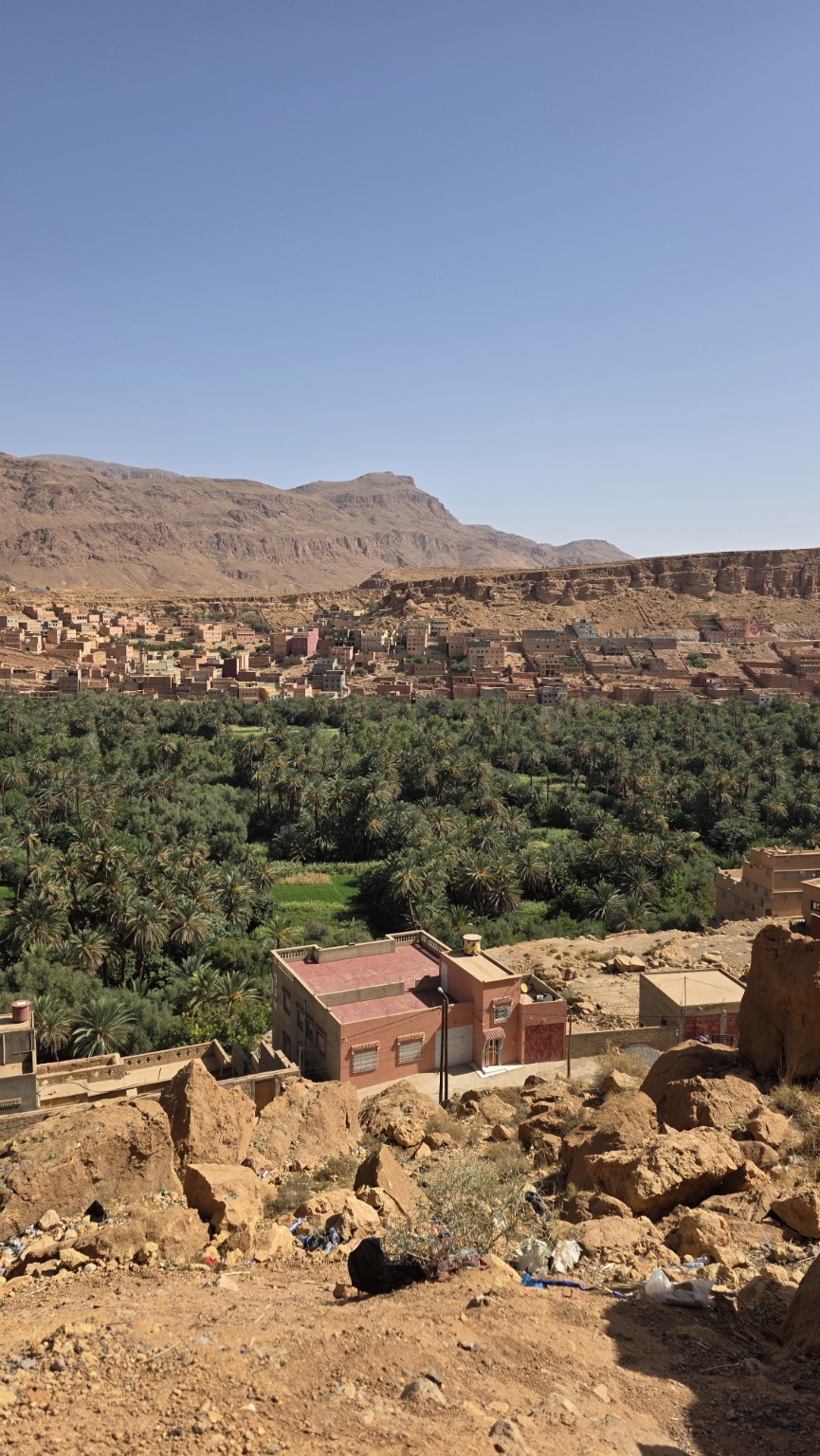
That relationship between greenery and bare rock accompanied us for much of the journey. Palms, gardens and houses cluster in the valley, while an entirely different terrain begins just above them. Water determines far more than the appearance of the landscape here: it decides where land can be cultivated and where people build their homes. A palm grove becomes more interesting once you stop seeing it simply as a pleasing patch of green. It is a working, living landscape, maintained from generation to generation.
Todra Gorge cuts through limestone in the eastern High Atlas. Over vast stretches of geological time, the river carved a passage whose scale becomes clear only when you stand beneath its walls. On a map, the river is a thin line; face to face with the cliff, you begin to wonder how long water needs to accomplish such a task.
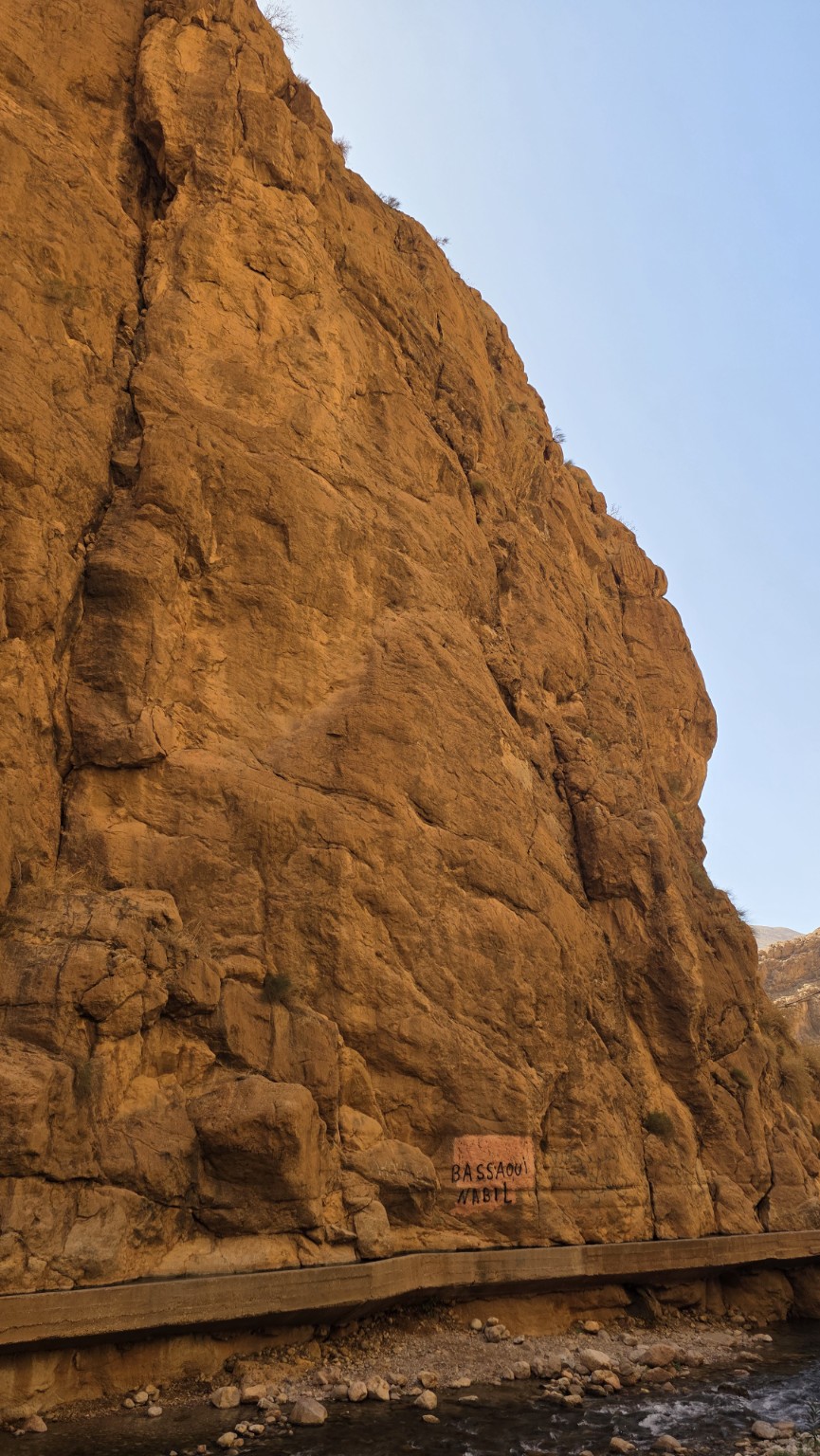
In the photograph, the great rock face draws your eye first. Only then do you notice the water and narrow passage at its foot. There is no need to make an effort to feel small here: you only have to look up. After several days of Moroccan ramparts, palaces and earthen towers, we were standing before a structure for which nobody had drawn a plan.
Melaab: Desert Clothing and an Unexpected Motorcycle
Further along the road to Merzouga, we stopped in Melaab for desert clothing. I put on a blue robe, wrapped pale fabric around my head and ended up posing on an old motorcycle. Behind me were a tent, palms, a teapot and a low table; in front of me, handlebars taking our desert preparations in an entirely unplanned direction.
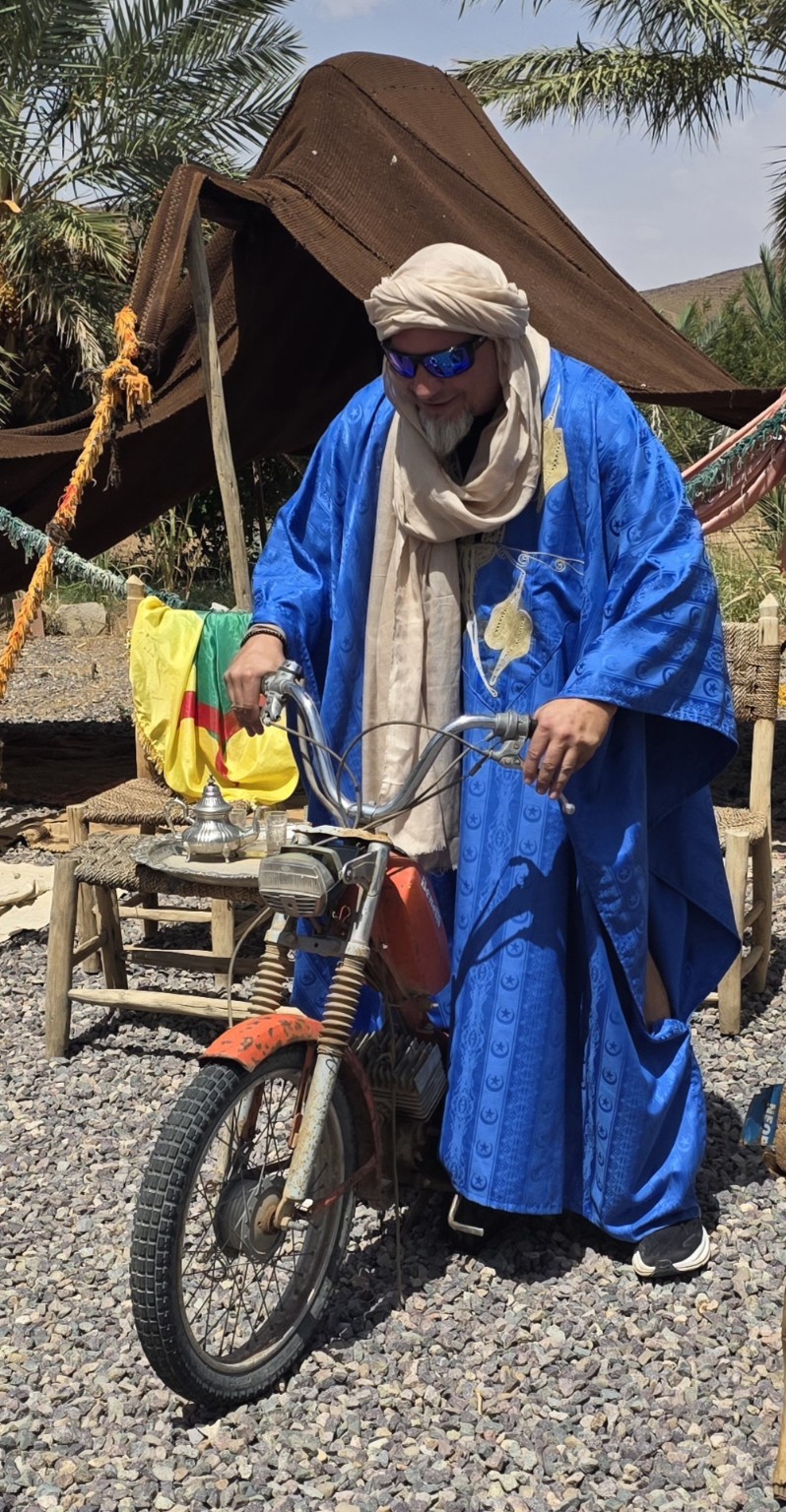
I like photographs like this because they capture the relaxed side of travel. A whole day cannot consist of history, geography and serious contemplation of the scenery. Sometimes you put on something you would not normally wear, stand beside an unusual object and let a memory take shape that will make you laugh later.
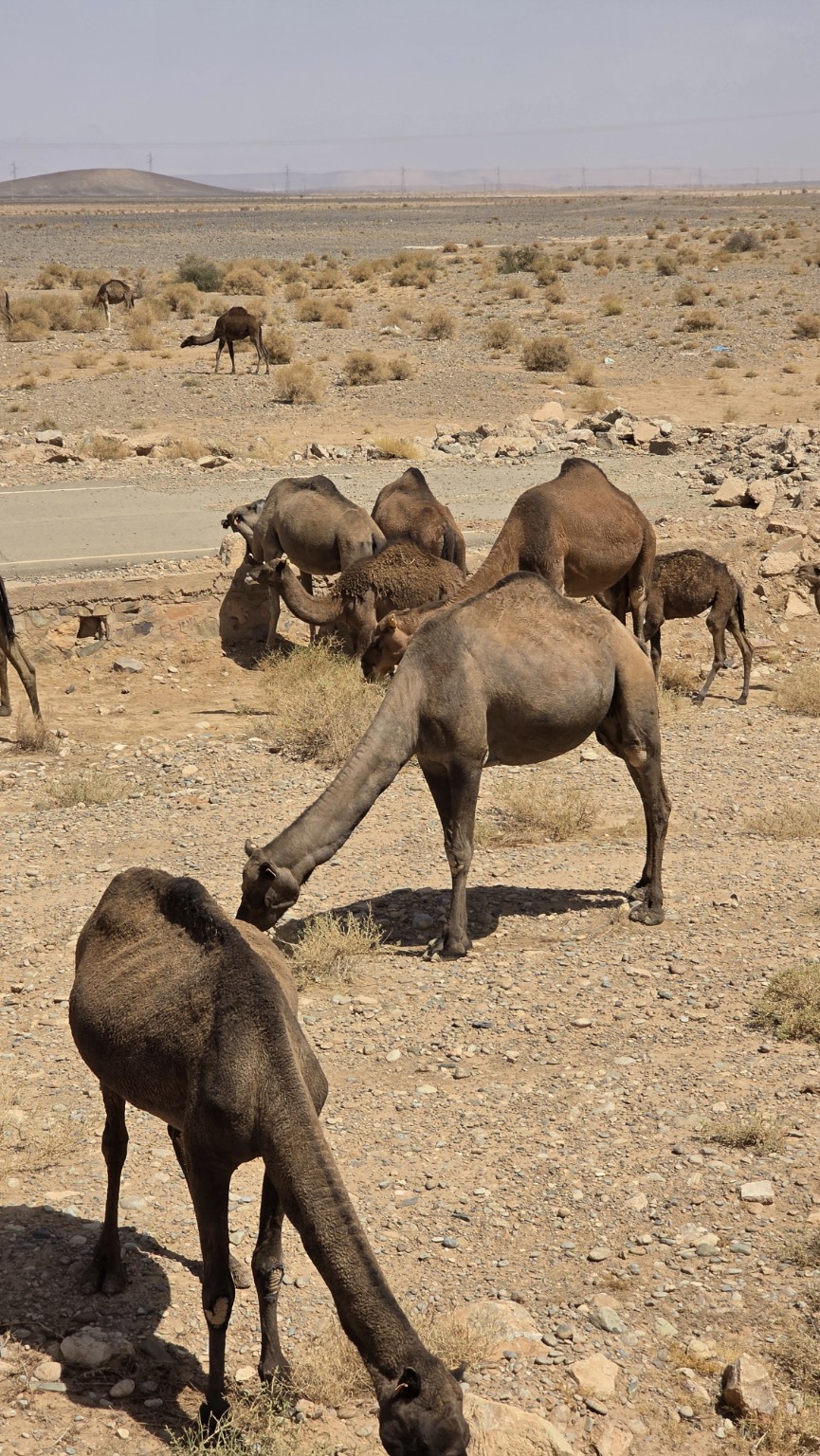
As we travelled on, the country opened out. Dromedaries, the one-humped camels we associate so closely with the Sahara, appeared in the frame. In the photograph they graze beside the road on stony ground with sparse vegetation. The sight challenges the idea of a desert made entirely of dunes: before reaching the sand, we had crossed kilometres of rock and gravel.
Erfoud: When Your Guide Opens His Home
We reached Erfoud, where Mustafa took us to his home. I knew him as someone who welcomed travellers, led groups and made sure everything ran smoothly. Here I got to know him in a setting that belonged to his personal life: among his family, in his own home.
The photograph shows a room with a red carpet, seating and cushions along the walls, and a low round table in the middle. A teapot, glasses and refreshments are ready for guests. After so many kilometres and stops, it felt good to sit down in a home to which someone had invited us.
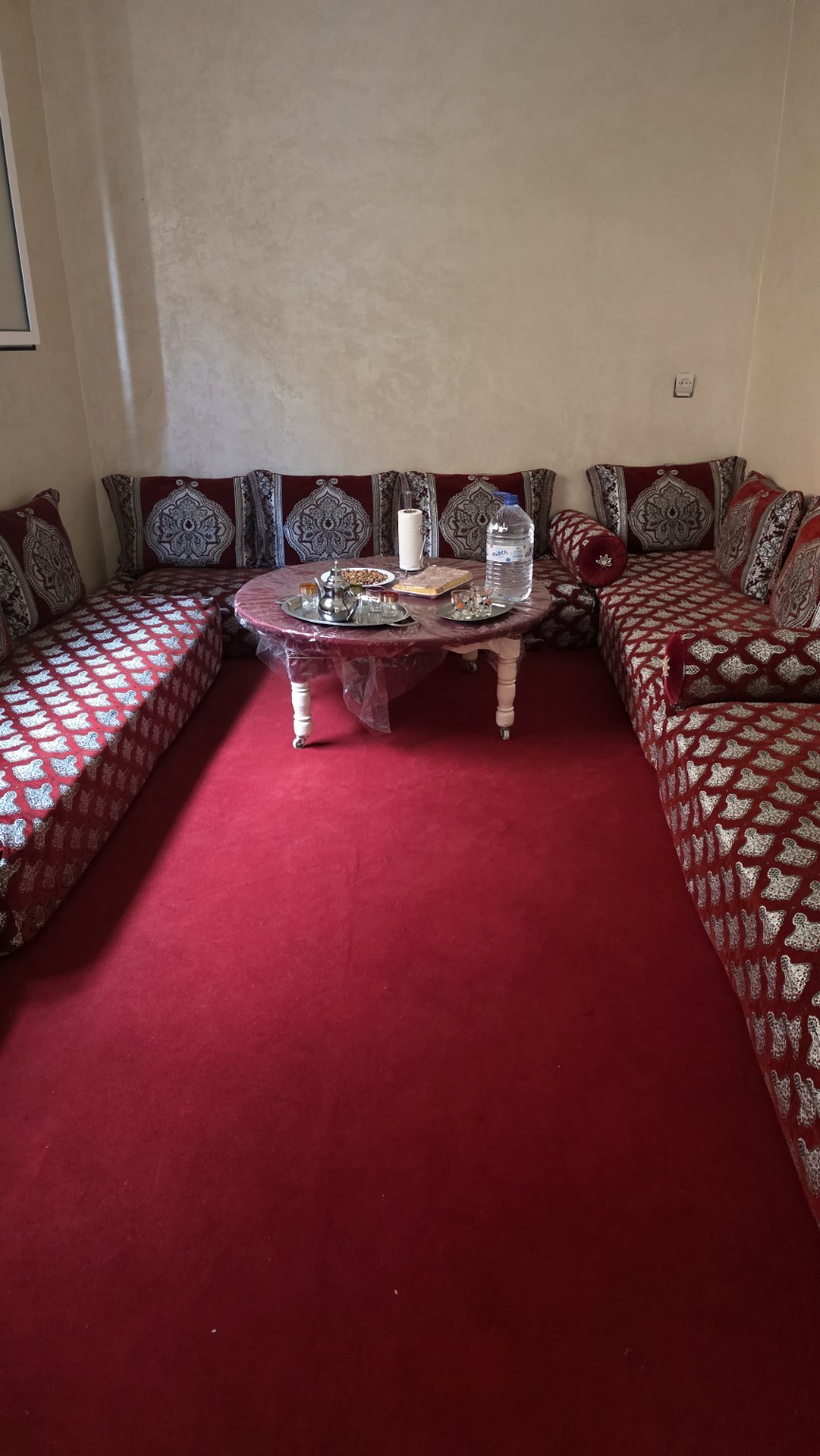
The welcome was wonderful. Encounters like these hold a special place in my travels because afterwards I cannot separate them from the country I visited. When I say Morocco, I also mean this room: the time someone made for us, the food prepared and the feeling of being welcome. Then the couscous arrived.
The Best Couscous I Have Ever Tasted
A large platter held the fine grains, topped with vegetables, chickpeas and onions in sauce. Orange pieces of pumpkin and carrot, the green of courgettes: everything was arranged so appetisingly that looking at it made me hungry. The photograph preserves its appearance; I remember the taste well enough to say without hesitation, even now: it was the most delicious couscous I have ever eaten.
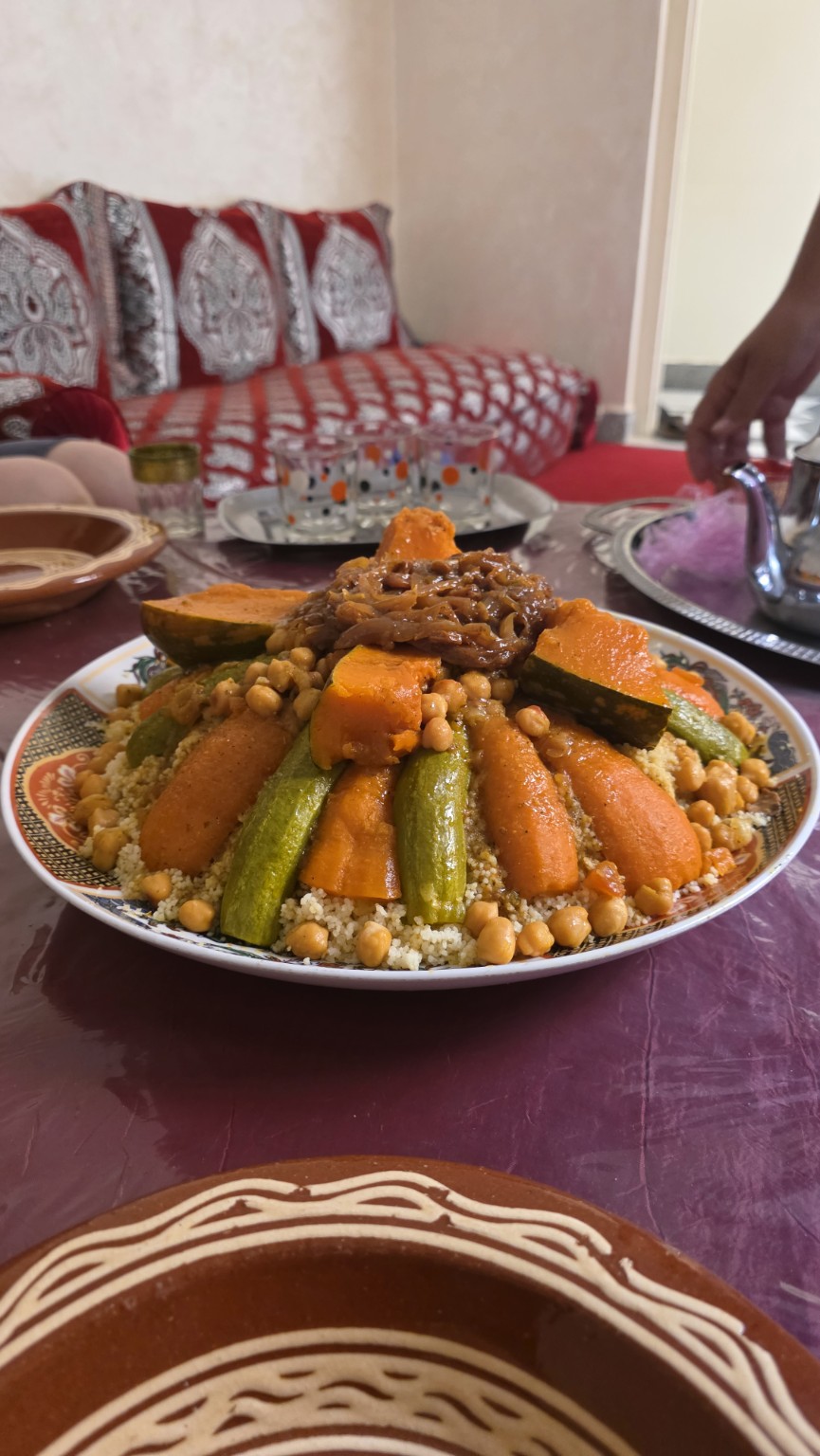
Couscous has deep roots in North African cooking. Traditionally, grains are formed from semolina and steamed; the vegetables and meat served with them vary by region, season and occasion. Algeria, Mauritania, Morocco and Tunisia jointly nominated the knowledge and practices surrounding its preparation and consumption for UNESCO recognition. In 2020, they were inscribed on the intangible cultural heritage list. Sharing food, togetherness and hospitality are central to the tradition.
At that table, it was easy to understand why. The meal was placed before us, our hosts had welcomed us into their home, and the journey gained something that could never be added in advance to a list of sights. We had looked around many places, but we came to know this part of Morocco sitting down.
Merzouga: Thirty Minutes beneath the Sand
After lunch, we continued to Merzouga, a settlement beside the sand dunes of Erg Chebbi. Merzouga is where many travellers set out for the dunes; Erg Chebbi is the name of the sandy expanse itself. That day brought our first encounter with it. A longer stay in the desert awaited us the following day.
First, I decided to try a sand bath. I lay down in the sand and stayed there for thirty minutes. In the photograph, only my head emerges, sheltered by a cloth, while a man stands beside me watching this unusual scene. Looking at it, my first impulse is to laugh at myself. That morning I had watched a road climbing the cliffs; now I was lying beneath a dune, waiting for half an hour to pass.
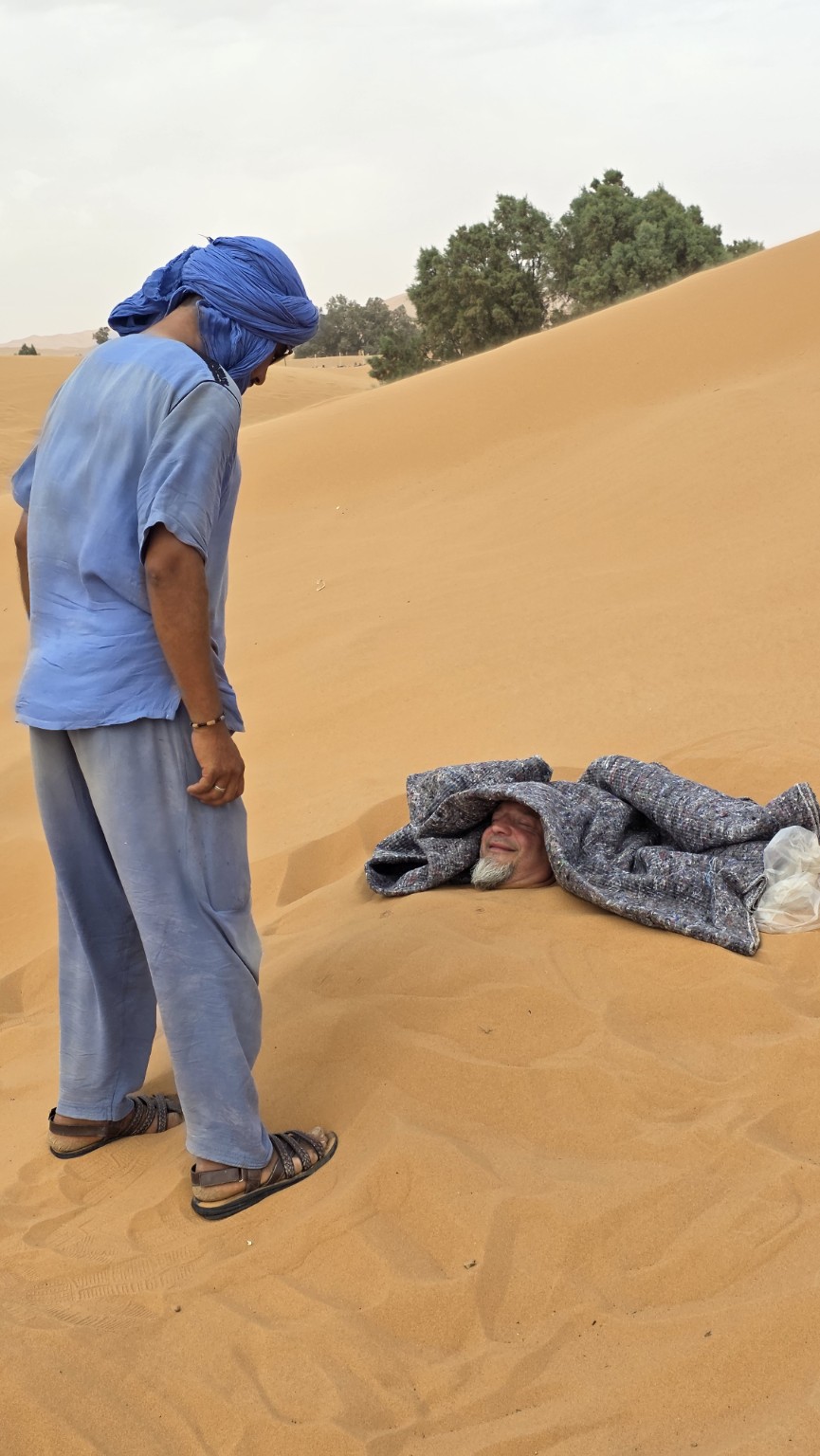
What I had been observing from a vehicle or beneath my feet now surrounded me completely. The sand was no longer a distant surface on the horizon. It was warm, heavy and very real. Of all the ways to get acquainted with a desert, I had chosen to begin by lying in it.
Aziz and Our First Dunes
Aziz, a guide in Merzouga, then showed me the first dunes by jeep. After cliffs, settlements and long stretches of road, our view finally opened onto a landscape of sandy slopes and ridges. Here began the image of the Sahara I had seen so often in photographs.
That was enough for one day. We had come from Dades, passed between great cliffs, dressed for the desert, eaten lunch at Mustafa’s home and reached the sands of Erg Chebbi. Tomorrow we would give them a whole day.
As I remember the journey, alongside those first dunes I see that large platter in Mustafa’s home again. The desert had been our destination, but his home became one of the places that makes me want to return to Morocco.
Previous instalment: Across the Atlas to the City That Became Troy.
Next instalment: At the Edge of the Dunes: Tea, Stone and Song.