An Evening Arrival and a Familiar Face
I landed in Marrakech in the evening. Mustafa was waiting at the exit: my host and guide when I travel through Morocco, and the man I entrust with my groups. A familiar face is a lovely way to begin a journey. Suddenly, you stop worrying about which way to turn, whom to contact and how everything will work. You have arrived, Mustafa is here, and we can set off.
In Marrakech, you quickly understand one thing: there is the medina, and there is life outside it. The city of broad avenues, hotels and modern shops has its own rhythm. As soon as you enter the old walls, though, the way you walk, look and listen changes. Someone approaches with an offer; a motorcycle sounds behind you; a delivery stops in your path. You have to move aside. Then a little further. You have only just arrived, and already you are involved.
Medina – You Might as Well Put the Map Away
In the medina, your eyes keep wandering. You set off towards a landmark, but a doorway, workshop or passage draws you a few steps further. Then another. Before long, you are no longer quite sure whether you have passed that shop already or everyone sells similar lamps.
The Almoravids founded Marrakech in the second half of the eleventh century. Traders, goods and news passed through along routes connecting regions across the Atlas and Sahara. That commercial past remains visible in the life of the medina. The street is a place of work, trade and encounters, while private life generally stays behind walls. A modest entrance may conceal a courtyard with water and greenery. Walking past, you constantly feel you are seeing only a small part of what the city holds.
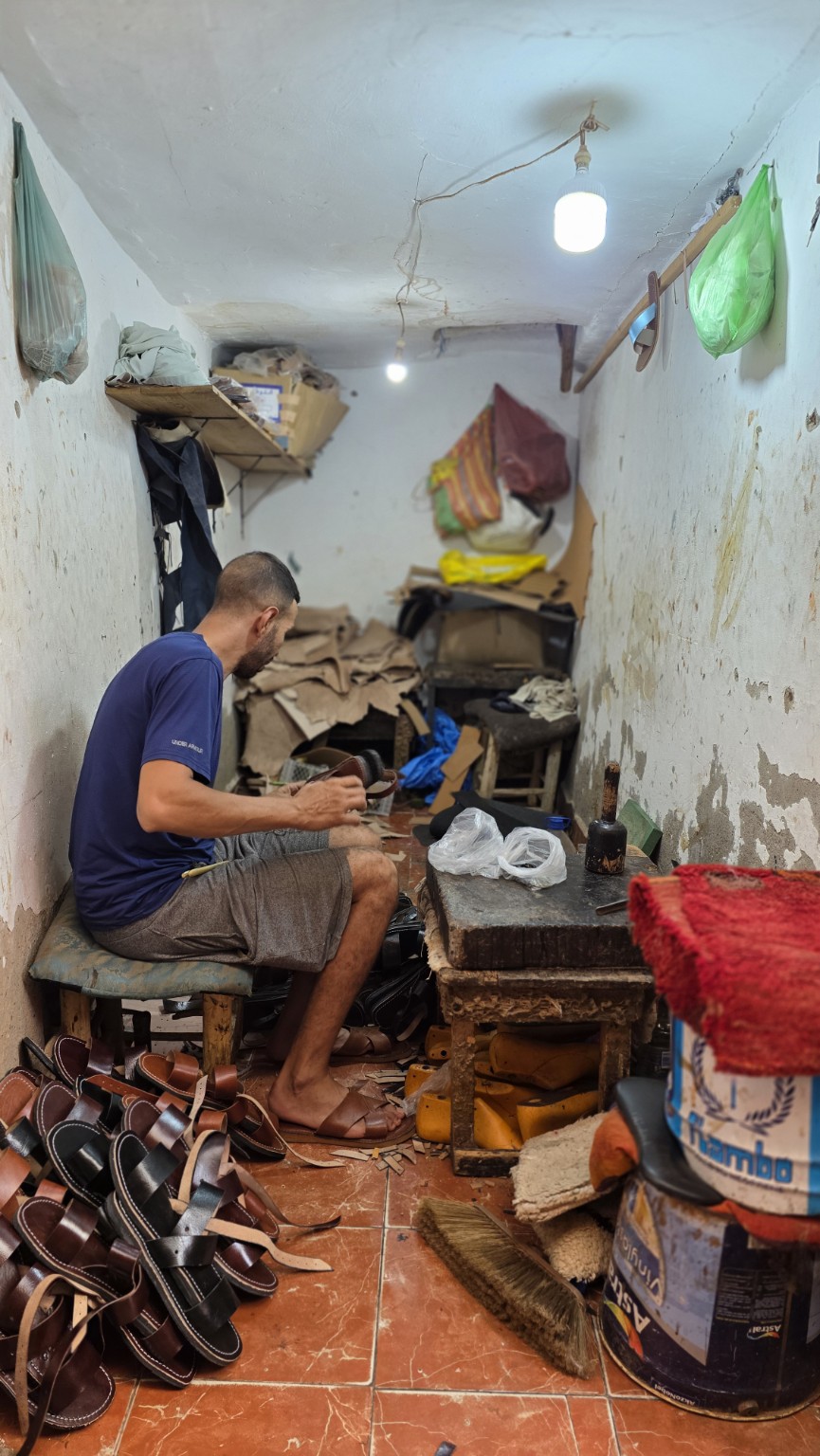
That is why I find the medina more interesting when I slow down. I notice a man at his workbench, the tools within reach, two traders talking across a passage. Marrakech is so alive here that someone’s everyday life constantly interrupts your sightseeing.
Riads – Courtyards Hidden from the Street
In the medina, it is worth looking beyond the doors. From the street you see a wall, an entrance and perhaps a modest sign; inside, a small world opens up. A riad is a traditional Moroccan house arranged around an internal garden or courtyard, with rooms opening onto it. The layout protects privacy and provides shelter from the bustle outside. Many now welcome guests, turning former family spaces into part of the traveller’s experience of Marrakech.
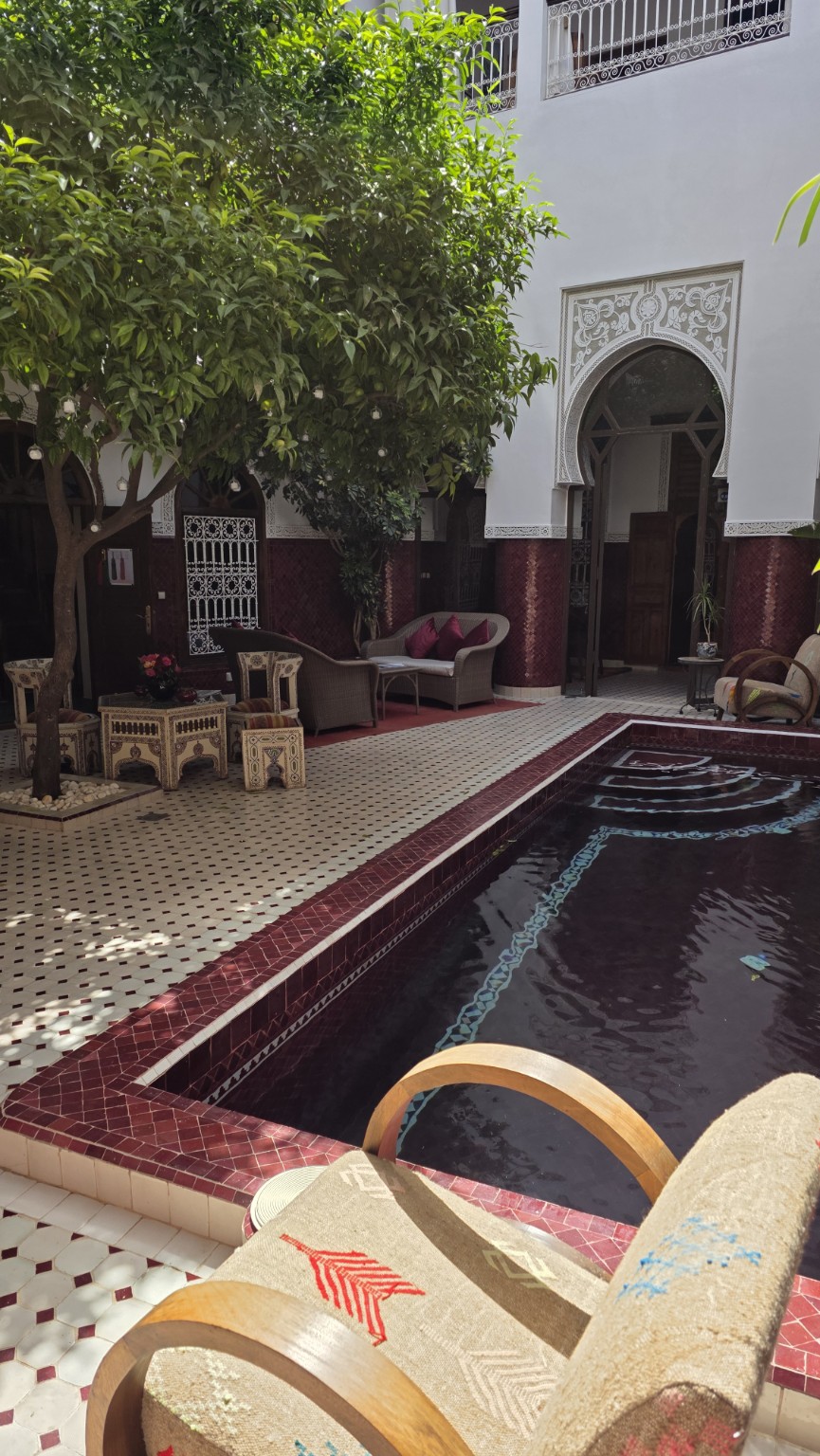
In my photograph, greenery, shade and a pool fill the courtyard. Chairs and low tables surround it; decoration frames the doors, and a balustraded gallery runs around the upper floor. After narrow passages full of people, it immediately invites you to sit down. Here the inward-looking architecture makes sense: its finest view belongs to those who enter. While the city carries on beyond the wall, beneath the trees there is room for conversation and rest.
Jemaa el-Fna – A Square That Comes Alive at Dusk
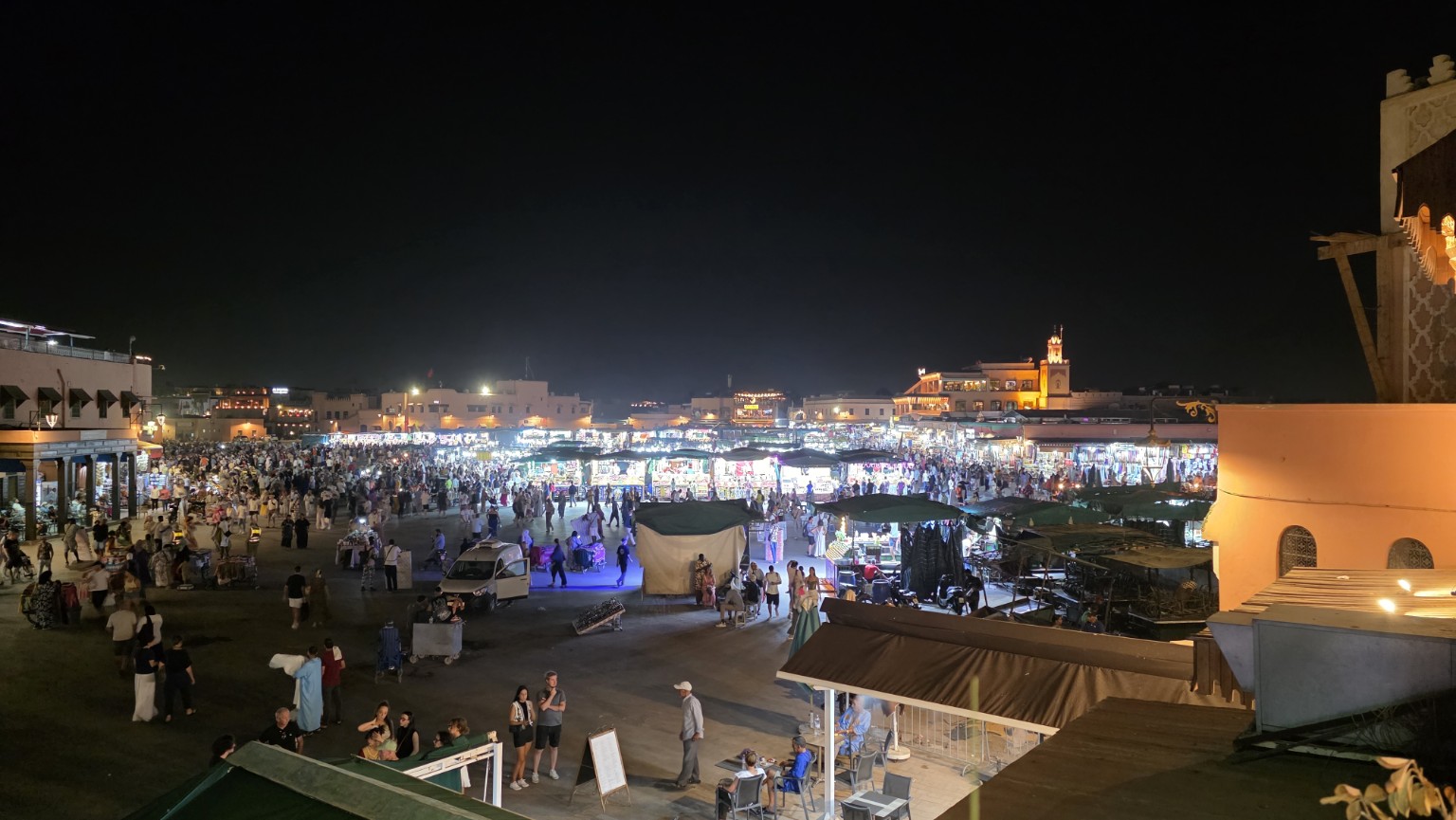
At Jemaa el-Fna, space finally opens up, but your eyes struggle to settle. Juice sellers, passers-by, music, gatherings of people, food being prepared. As evening approaches, more voices fill the square, and smoke begins to rise above the stalls. You can set out to cross it in a straight line and end up somewhere quite different from where you intended.
Storytellers, poets and musicians have gathered here for centuries. People would form a circle around them and the story would begin. As a writer, I love that image: someone standing before an audience with only their voice, memory and ability to hold attention. If the story falters, the listener simply leaves. It is hard to imagine a more honest review.
This culture of gathering and passing on stories earned the square UNESCO recognition as intangible heritage. Today, phones, tour groups and everything that popularity brings are here too. Still, it is worth lingering towards evening. Order something, find a good vantage point and let the square come alive before you.
Koutoubia – Looking towards the Minaret
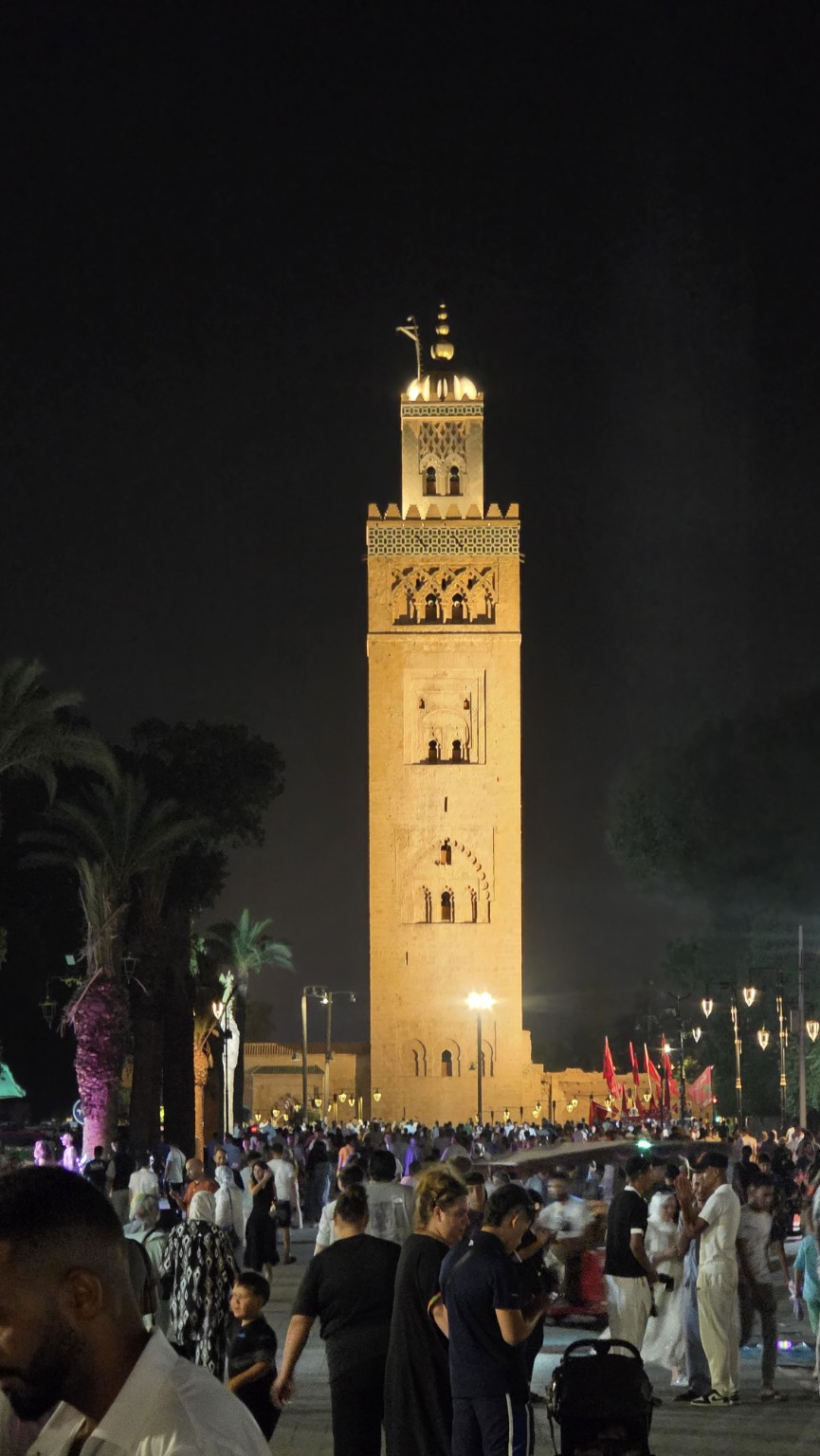
After all the turns in the medina, something that stays still is welcome. The minaret of the Koutoubia provides just such a landmark, rising above the roofs and restoring your sense of direction.
The mosque dates from the twelfth century, the Almohad period. Its square minaret looks harmonious from afar; closer up, arches, reliefs and ceramic details draw the eye. Non-Muslim visitors view it from outside, including the surrounding grounds and gardens. There you can pause and study the building without constantly dodging passers-by. After the crowded streets and shops, the respite is welcome.
The Souks – Just Looking, for Now
“I’m just looking” is a perfectly possible way to enter the souks. How long that lasts depends on you and the seller.
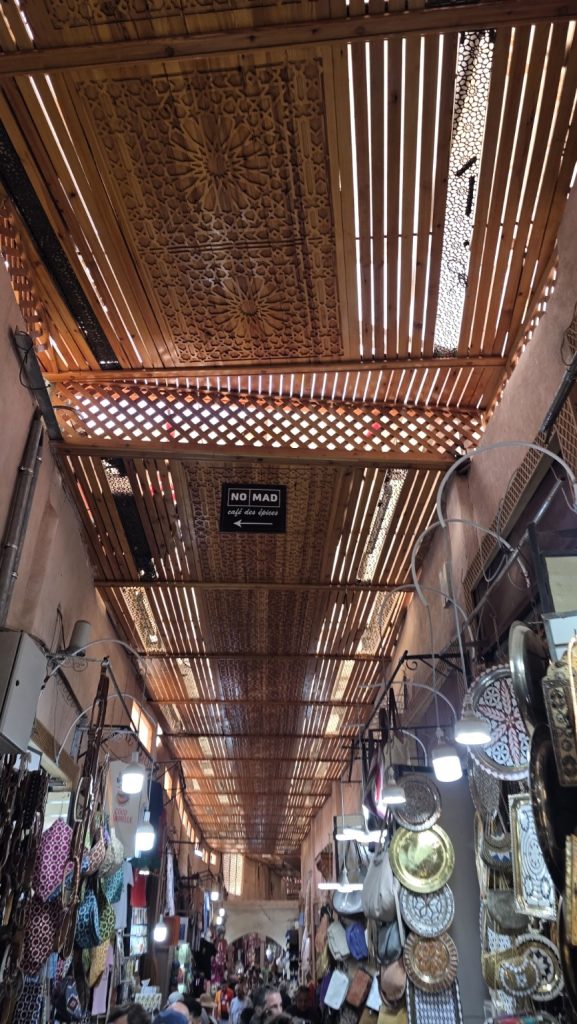
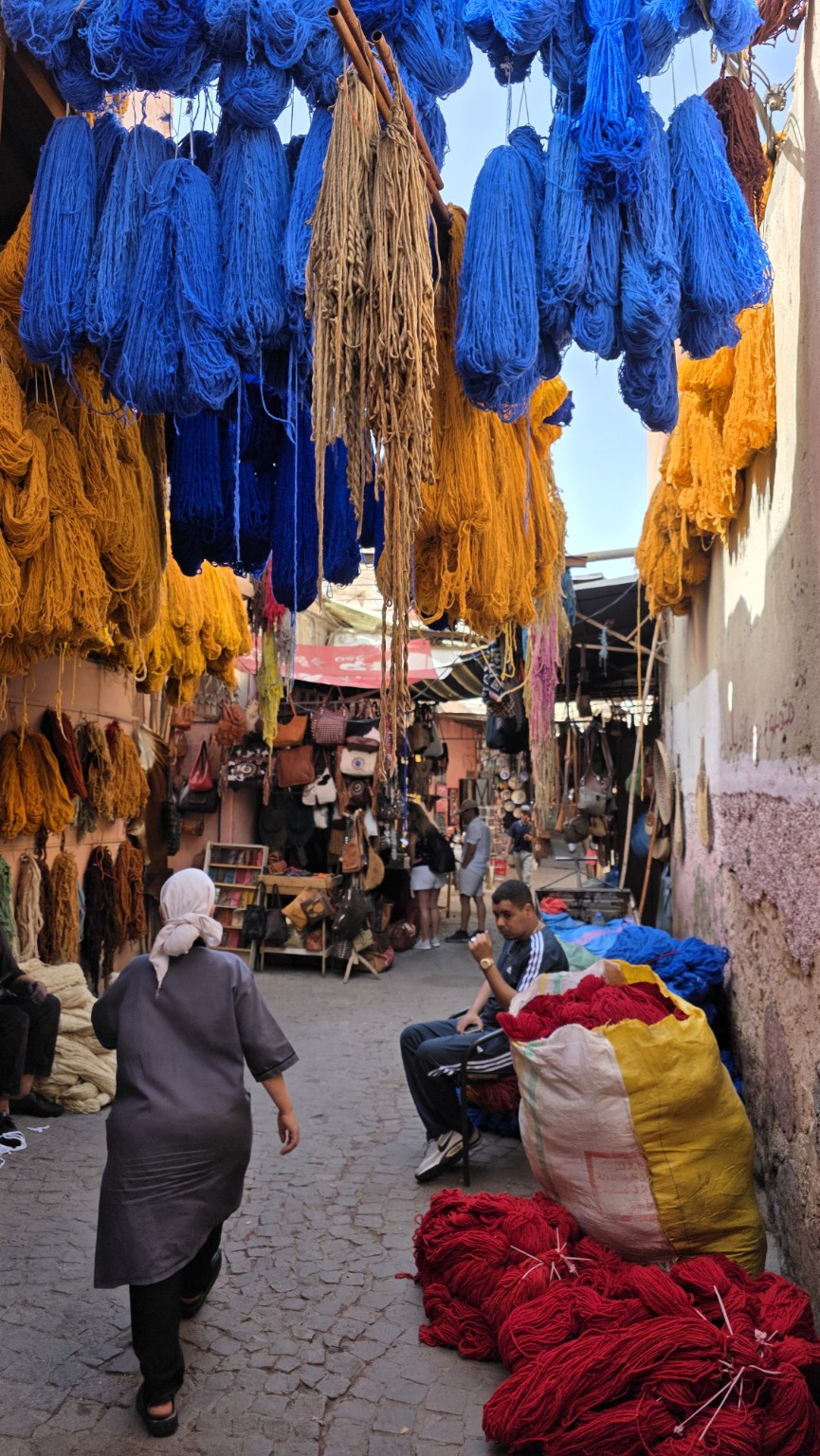
The souks form a network of shopping passages and workshops. Leather bags and slippers hang in one area, metal lamps gleam in another, and further on come carpets, ceramics and spices. Souk Semmarine is one of the main shopping arteries, but interesting side passages keep drawing you away. Goods hang, stand and spill beyond shopfronts. You look up, then nearly trip over what is displayed below.
Bargaining has its own progression. You ask the price, receive an answer and show that you had expected less. The conversation continues. Sometimes that small negotiation becomes a memory in itself, especially when you leave with something you had not known you needed half an hour earlier.
Alongside finished objects, I am drawn to workshops. Watching a craftsman work metal or stitch leather gives the goods in the shop another significance. You start examining joints, seams and tiny irregularities that reveal the maker’s hand.
Bahia and Ben Youssef – Growing Quiet beyond the Door
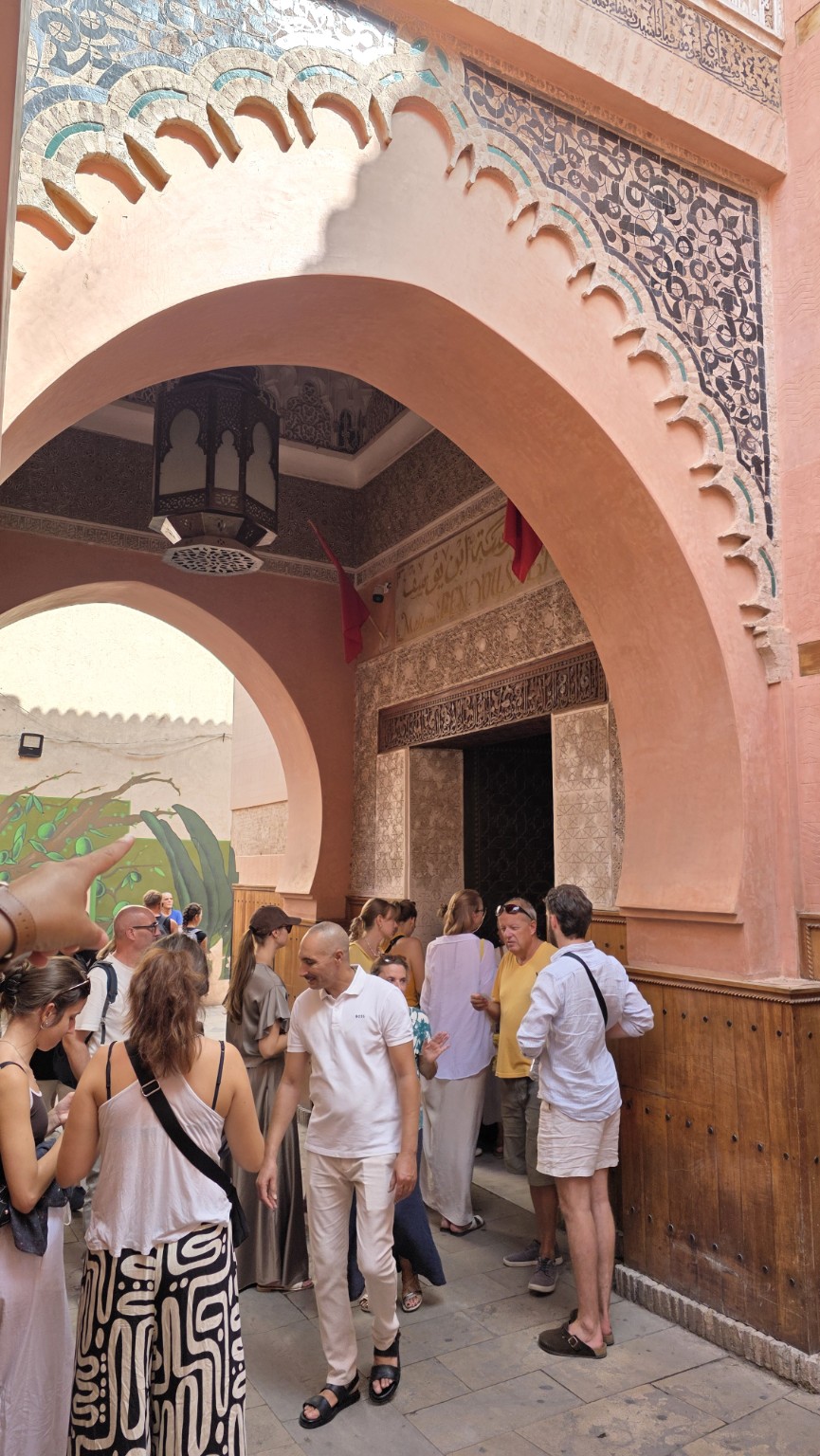
At Bahia Palace, you find yourself looking up at a ceiling, down at a mosaic, then pausing before a door. Painted cedarwood, carving and ceramic patterns demand a closer look. Associated with the grand viziers, particularly Ba Ahmed, the palace shows how power could be expressed through the splendour of one’s home.
In places like this, my thoughts always turn to the craftspeople. How long did one ceiling take? How many attempts were needed to align a pattern? The patrons’ names remain in history, while the work of those who made everything surrounds you.
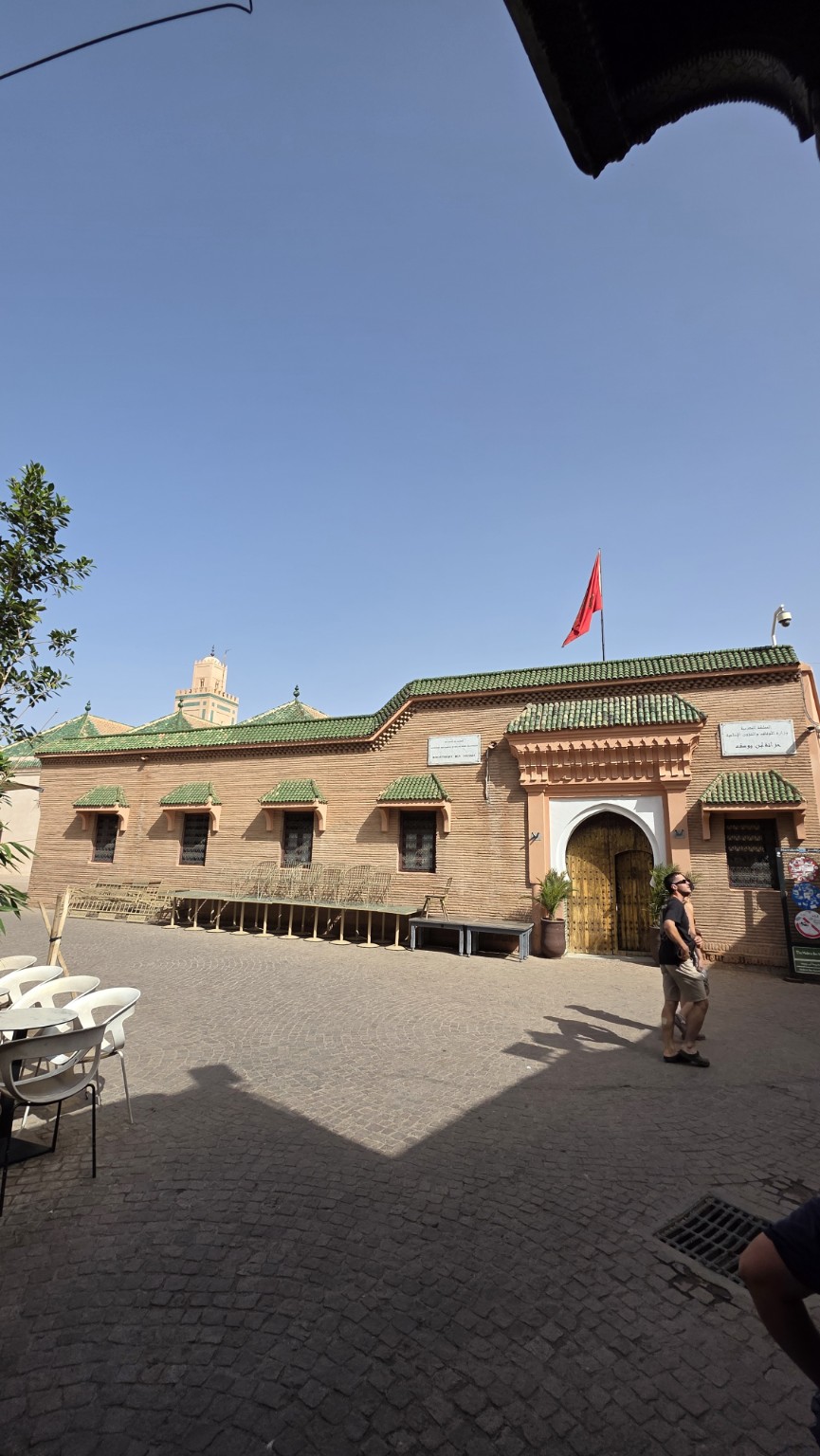
At Ben Youssef Madrasa, the same precision served a different purpose. The former Islamic school acquired its present historic form in 1564–1565, under the Saadian sultan Abdallah al-Ghalib. The central courtyard and pool are richly decorated, while the students’ rooms are small and simple. Those rooms bring me back to the people who lived here. Photographing the splendid courtyard is easy; inside a room, you begin to wonder about an ordinary student’s day, what a young man brought from home and how long he waited to see his family again.
Bab Debbagh – The Other Side of a Leather Bag
The tanneries near Bab Debbagh stay in your memory through your nose too. Their powerful smell announces the work in unmistakable terms.
Rows of open vats attract the photographer’s eye, but hard labour takes place among them. Hides are soaked, lifted, cleaned and moved. What will later become a soft bag or pair of slippers is still undergoing demanding processing here. Afterwards, you look at the finished product differently.
The tanneries are an important part of Marrakech’s craft identity, linking the processing of raw hides with workshops and shops in the souks. Knowledge survives through daily work, in conditions a visitor observes briefly but a worker inhabits all day. That is why I want people, as well as vats, to remain visible in my photographs.
They should not be confused with the large, colourful tanneries of Fez, whose photographs often symbolise Morocco. In Marrakech, the emphasis is on preparing and tanning hides, with additional dyeing also carried out elsewhere. We will reach Fez later. Here, it is worth pausing at a craft that gives the city much more than a photogenic view.
Tagine, Couscous and Marrakech in an Earthenware Jar
After all that, it is only natural to start paying closer attention to where you might eat.
You recognise a tagine by its earthenware pot and conical lid. The name refers to both the vessel and the dish cooked inside. Meat or vegetables simmer slowly beneath the lid, with steam condensing and returning to the ingredients. Chicken with olives and preserved lemon, lamb with dried fruit, combinations of vegetables: every new tagine is a reason not to assume too soon that you know it already.
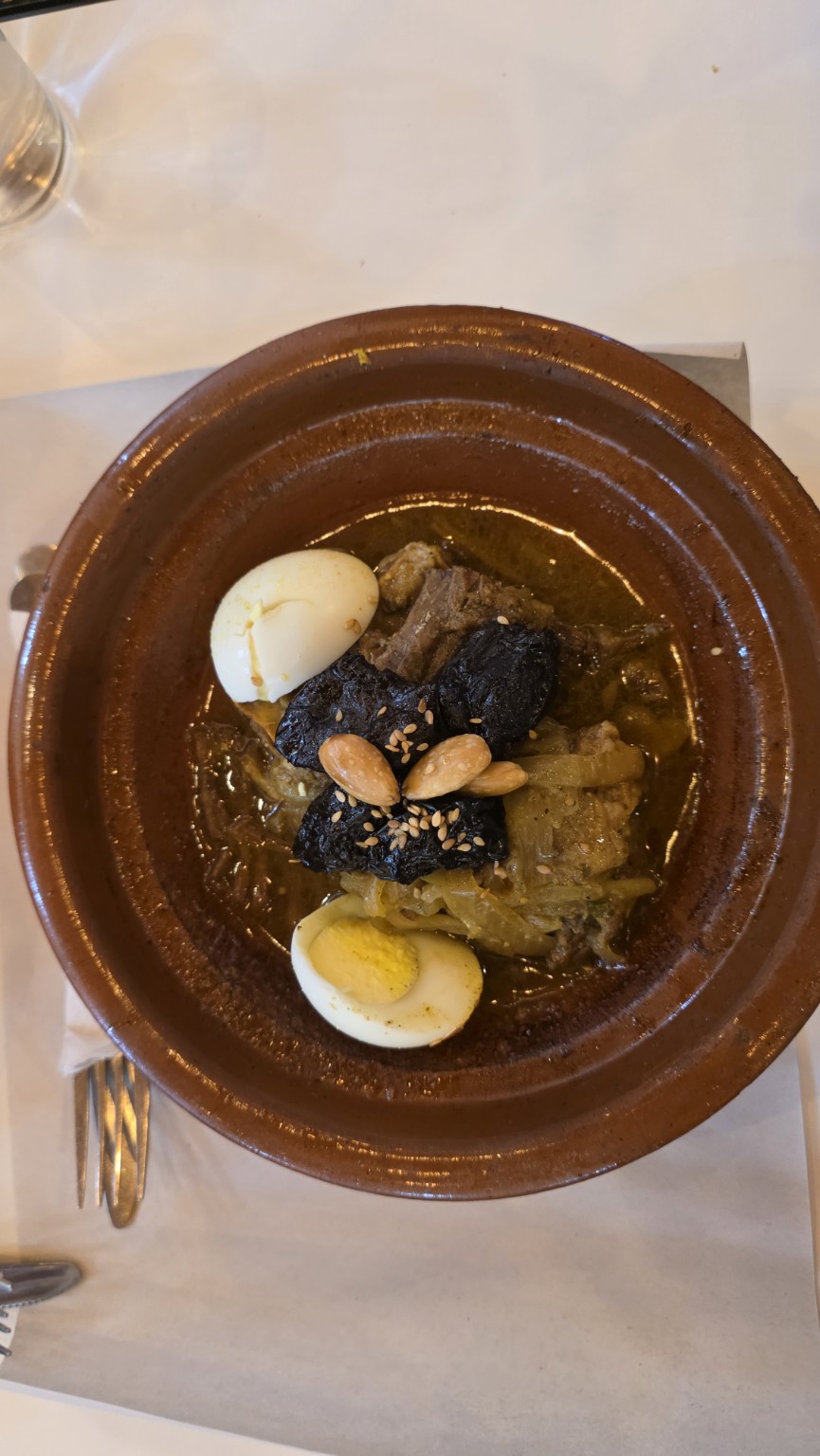
Then there is couscous, made from tiny grains of semolina and often served with vegetables and meat, traditionally associated with Fridays and family gatherings. Marrakech also has tanjia, a speciality with a similar name but a different preparation. Meat and spices are placed in an earthenware jar and cooked slowly for hours, traditionally using heat from a hammam furnace.
Mint Tea and the Ritual of Pouring
Alongside the food, one drink accompanies you almost everywhere in Marrakech: mint tea, or atay. It is offered in cafés, riads, shops and homes, during conversation, after meals or as a welcome. Essentially, it is green tea with fresh mint and sugar, served hot in small glasses. Travelling here, you quickly realise how deeply it is woven into Moroccan hospitality: an invitation to tea is often an invitation to sit and stay a little longer.
A distinctive part of this small ritual is pouring from a height. The pot rises above the glass, and a thin stream of tea creates a layer of foam. Hosts perform the movement so calmly that it looks easy, until you pick up the pot yourself. That is what Mustafa taught me: how to hold it and direct the stream into a small glass while raising my hand. The video below captures our little lesson in serving Moroccan tea.
Majorelle Garden – A Rest outside the Medina
I have left the Majorelle Garden, outside the medina, until last. After a day of people, objects and passages constantly replacing one another before your eyes, you begin to look differently here. You linger over a leaf, the shade of bamboo or the colour of a wall.
The French painter Jacques Majorelle created the garden. Yves Saint Laurent and Pierre Bergé bought it in 1980, saving it from planned development. Its famous intense blue has remarkable power amid the greenery. In photographs you recognise it immediately; in person, you see how much its effect depends on the surrounding plants, light and colours.
There are many visitors. Even so, among palms, cacti and water, you can find a moment to let your impressions settle. Since our evening arrival and Mustafa’s welcome, Marrakech has branched into many little stories. Some smell of spices, some of leather; some hide behind doors, while others call out loudly in the square.
Ahead lies the journey across the High Atlas to Aït Ben Haddou and Dades. From Marrakech I also take a practical memory: it is wise to watch where you are going, but a shame to miss everything happening to either side.
Next instalment in the Morocco series: Across the Atlas to the City That Became Troy.