With the group I led on a March trip for International Women’s Day, through Buda and Pest to an evening cruise on the Danube: the story of a city of kings, coffee houses, hidden sculptures and illuminated riverbanks.
I came to Budapest in March with a group I was leading on a trip for International Women’s Day. Our photographs preserve plenty of smiles, raised hands and clear skies, but they also bring back two very different views of the city: by day, from Buda’s stone terraces, and by evening, from a boat on the Danube. The same buildings and the same river feel entirely different once the lights come on.
What interests me about Budapest is the constant meeting of great history with something familiar and everyday. At one end of a walk stands a royal palace; at the other, a little girl sits on a railing beside the river. Between them lie churches, bridges, coffee houses and entrances to old courtyards. I enjoy connecting these scenes with the people who shaped the city, but when travelling with a group, our small shared memories matter just as much. I will remember Heroes’ Square both for its monuments and for the people who stood before them for a photograph that day.
This walk takes in Budapest’s main sights, with historical detours wherever the story asks us to pause. As in my article about Prague, I connect the places into several areas so that the city can be explored without rushing. Buda, central Pest, Andrássy Avenue and City Park all deserve time, and the evening is worth saving for the Danube. Our night cruise was one of the finest experiences of the trip.
Three Towns and One River
Budapest became a unified city in 1873 through the merger of Buda, Pest and Óbuda, or Old Buda. Its name is therefore a little geographical summary, although the third member of the union is missing from it. Buda occupies the hilly right bank of the Danube, Pest the flatter left bank, while Óbuda lies farther north on the Buda side. These differences in terrain long shaped different ways of life: the fortified town and royal centre developed on the heights, while trade, transport and, later, broad avenues spread across the plain.[1]
That provides a useful key to exploring the city. In Buda, we climb, walk through the old quarter and seek views towards the river. In Pest, we follow long streets, cross squares and peer into passages between large apartment buildings. Their history does not fit a simple division between old and new. Pest also has deep roots, and much of what looks ancient in Buda results from later restoration. In Budapest, it is always worth asking how old a building is and how many times it has been recreated.
↑ Back to ContentsKings, Reformers and the Making of a Great Capital
Béla IV is important to the history of Buda’s hill. After the Mongol invasion in the thirteenth century, he encouraged the construction of safer fortified centres. Different rulers expanded the royal complex in later centuries, and Matthias Corvinus holds a special place in its cultural history. His fifteenth-century court was associated with Renaissance ideas and Italian artistic influences. His celebrated Bibliotheca Corviniana reminds us that political power then rested on books, learning and the projection of royal prestige as well as armies and walls.[2]
The nineteenth century brought another great turning point. István Széchenyi became a key figure in modernisation, and we will encounter his legacy at the Chain Bridge. The city developed rapidly after the Austro-Hungarian Compromise of 1867. Unification in 1873 and the millennium celebrations of 1896, marking a thousand years since the arrival of the Hungarians in the Carpathian Basin, belong to the era that produced much of monumental Budapest.[1]
On this walk, we therefore often encounter buildings intended to show how Hungary viewed its own history and future. Parliament, the Opera House, avenues and monuments were created during an age of exceptional ambition. Even the underground railway carried the same message: the capital wanted to be modern, great and European.
Buda Castle – A Palace Rebuilt by History
We begin at Buda Castle, the royal palace on the southern part of Castle Hill. It helps to clarify the names immediately: the palace is the large complex recognisable by its dome, while the Castle District also includes the streets, squares, churches and houses to its north. Allow several hours for the whole area. Simply reaching the terrace and photographing the panorama leaves much of its story undiscovered.
From a medieval royal seat through Ottoman rule and Habsburg alterations to destruction in the Second World War, the palace continually changed its form. The view today does not represent one untouched historical moment. Traces of earlier periods lie beneath later buildings and restored spaces. The complex houses the Hungarian National Gallery and the Budapest History Museum, so the walk can continue through art or the city’s past, depending on what appeals to us.[3]
Spend some time outside the palace. From here, the position of the royal city becomes clear: the river lies far below, the crossings are visible and the whole Pest riverfront opens out almost like a plan. Then continue into the old streets of the Castle District. Beyond the palace’s monumental spaces lie lower houses, entrances and quieter corners, close enough to explore on the same walk but with an entirely different sense of space.
↑ Back to ContentsMatthias Church – Weddings, Coronations and Ottoman Centuries
Matthias Church welcomes us on Trinity Square. Its official dedication is to the Assumption of the Blessed Virgin Mary, but the royal name has prevailed in everyday usage. Matthias Corvinus’s weddings are associated with the church, while Franz Joseph and Elisabeth, better known as Sisi, were crowned Hungarian monarchs here in 1867. Hungary’s last royal coronation, that of Charles IV and Zita, took place in 1916.[4]
The church’s history on this site reaches back to the Middle Ages, but its present appearance owes much to the nineteenth-century restoration by architect Frigyes Schulek. Under Ottoman rule, it served as a mosque. Later periods changed the interior and exterior again, leaving a building in which religious and political history overlap at almost every turn.[5]
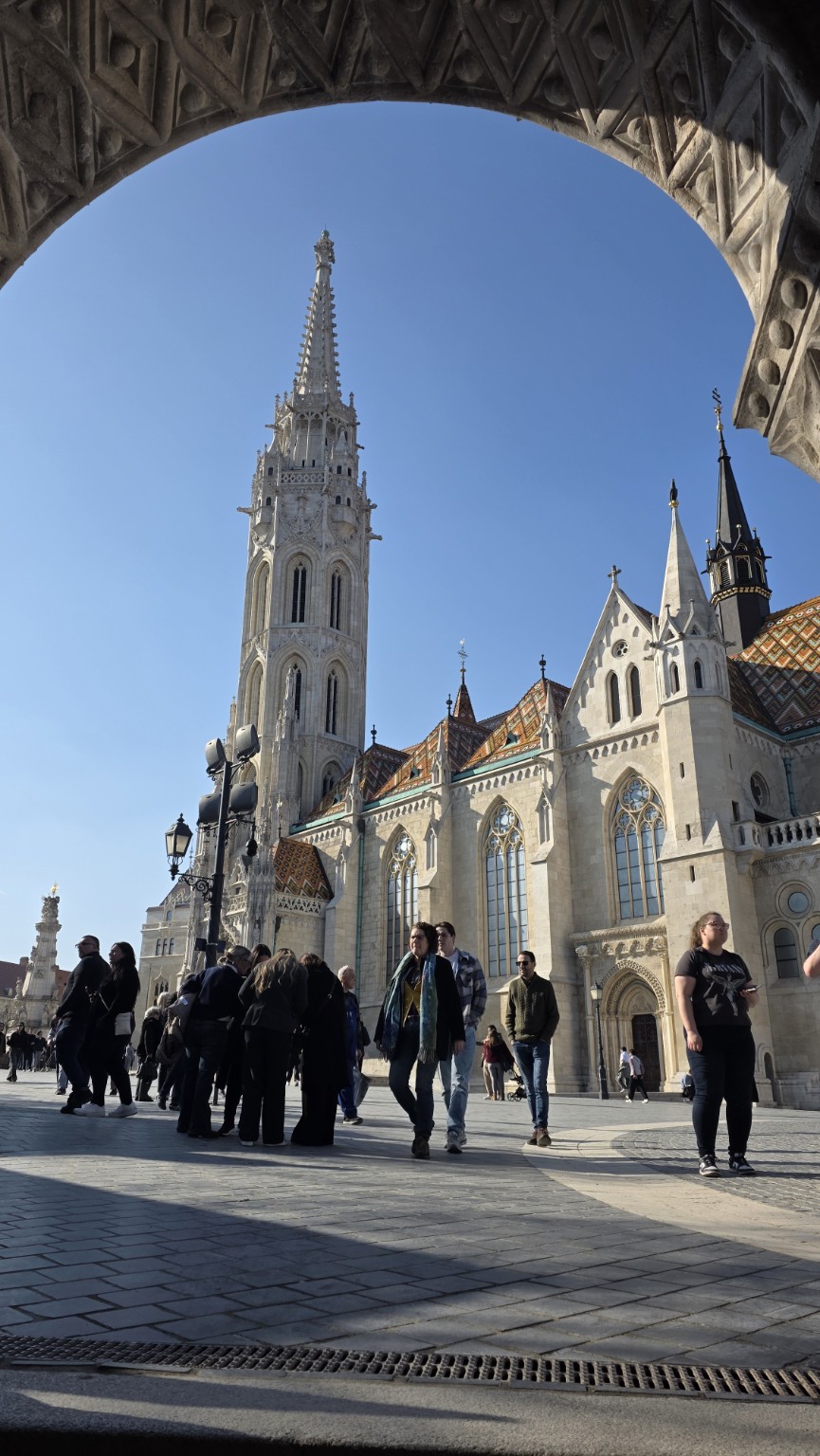
Outside, the tower and colourful Zsolnay ceramic roof tiles draw the eye; inside, painted walls, patterns and colours take over. That surprise alone makes it worth entering: the façade prepares us for Gothic height, while the interior holds us with its richly decorated surfaces. Back on the square, our eyes are already drawn towards the white towers behind the church.
The Fisherman’s Bastion – A View That Explains the City
The Fisherman’s Bastion, or Halászbástya in Hungarian, looks as though it stood here awaiting medieval sieges. Its present terraces, arcades and towers, however, were built around the turn of the twentieth century to Schulek’s design. They landscaped the area beside the restored church, creating a grand promenade on the site of older defences. The name is associated with fishermen and the former fishing quarter below the walls; the familiar account of the fishermen’s guild defending this section is better understood as a tradition than the only certain explanation.[6]
Pest opens through the arches, with Parliament on the opposite bank. Move between several viewpoints and notice how the composition changes: now the river dominates, now the great dome, now the bridges. Nearby stands an equestrian monument to St Stephen, Hungary’s first king. The view gains a historical frame, from the early kingdom to a capital whose monumental skyline largely took shape much later.
The biggest mistake here would be to take a photograph and immediately turn back. Walk along the terraces, around the church and a little farther among the houses. The Fisherman’s Bastion is best experienced as part of a walk through old Buda.
The Chain Bridge – Before Budapest Existed
We descend towards the Chain Bridge, the first permanent bridge connecting Buda and Pest. It opened in 1849, almost a quarter of a century before the city’s unification. Its full name honours Széchenyi, one of the project’s principal champions. William Tierney Clark designed it, while Adam Clark supervised construction; their shared surname can be misleading, but they were not related.[7]
A permanent crossing transformed daily life, trade and connections between the banks. The bridge became a powerful symbol of modernisation. Its history also includes wartime destruction: retreating German forces blew it up in 1945, and it was rebuilt after the war. As we walk between the stone towers and the familiar lions at its approaches, we can imagine how different life was when crossing the river depended on less reliable links.[8]
A different rhythm awaits us on the Pest side. From the bridge, routes open towards the basilica, central squares and Parliament’s riverfront. I would begin by following the river north: the building we saw in the panorama from the Fisherman’s Bastion can finally be explored close up.
↑ Back to ContentsParliament – A Nation Told through Architecture
The Hungarian Parliament Building, or Országház, is almost impossible to take in at a glance when standing beside it. Rows of windows, spires, statues and the enormous dome look different here from across the river. There we see the harmony of the whole; here, its intricate detail. Architect Imre Steindl designed a predominantly neo-Gothic building incorporating other historical styles. Its dome reaches 96 metres, and the interior preserves the Holy Crown, one of the most important symbols of Hungarian statehood.[9]
Before a building like this, it is worth recalling the age in which it took shape. Austria-Hungary had a complex political structure, and the Hungarian half of the monarchy built institutions in its capital to express historical continuity and political confidence. Parliament addresses both river and city as the public face of the state. If we can enter, the ceremonial interior continues that story; if we remain outside, walking around the square and back to the river reveals how many impressions a single building can create.
Shoes on the Danube Bank – A Place to Pause
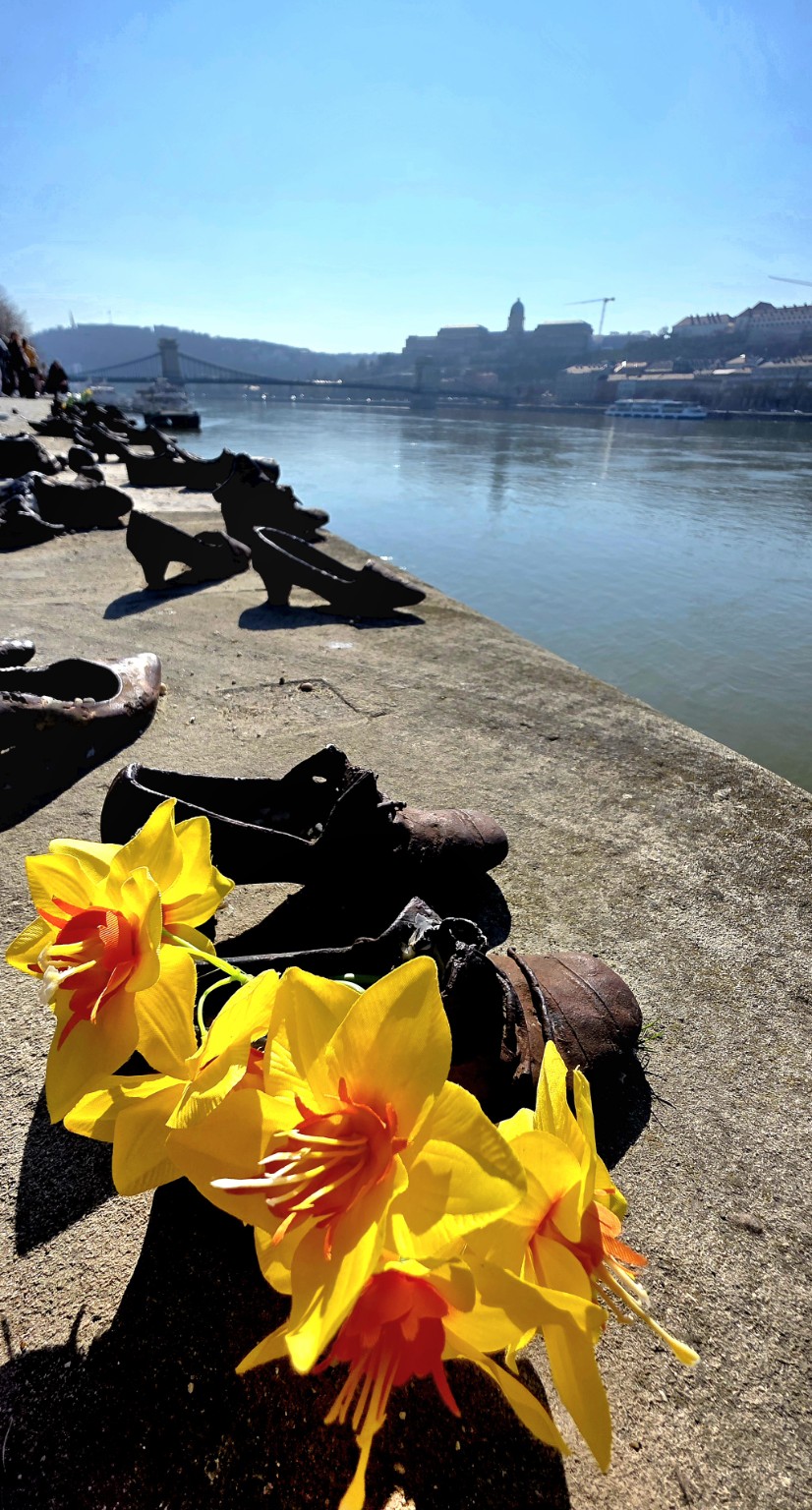
South of Parliament, at the very edge of the riverbank, stands the Shoes on the Danube Bank memorial. Iron shoes belonging to men, women and children recall people murdered beside the river by members of the fascist Arrow Cross movement during the final months of the Second World War. The victims, including many Budapest Jews, were forced to remove their shoes before being shot. The memorial was created by Gyula Pauer and Can Togay.[10]
The place is painful precisely because of its simplicity. Within the grand panorama of palaces and bridges, we suddenly see something belonging to an individual: a shoe that might once have stood outside someone’s front door. Leave time and silence here. This history continues later in the Jewish Quarter, but already on the riverbank it becomes clear that Budapest cannot be understood only through its most glittering years.
St Stephen’s Basilica and the Streets of Pest
From the riverbank, we return through the streets towards St Stephen’s Basilica. It is dedicated to Hungary’s first king, whose role in establishing a Christian kingdom is fundamental to the country’s understanding of its beginnings. Construction lasted decades and involved several architects, including József Hild and Miklós Ybl; the church was consecrated in 1905. It preserves the relic known as the Holy Right, venerated as Stephen’s right hand.[11]
The approach along Zrínyi Street gradually reveals the façade, before the space opens suddenly onto the square. After Buda’s climbs, flat Pest comes into its own: long views, more regular rows of façades and large public spaces. Enter the basilica for its interior, while climbing to the viewing terrace provides a different perspective from Buda. We are now among the roofs of the city we previously saw across the river.
Another kind of sightseeing begins in the nearby streets. We are no longer searching for the highest dome; our attention is caught by someone standing almost at our own height, as though he has just stepped out for a short patrol.
A Policeman, a Newspaper Seller and a Girl on a Railing
At the junction of Zrínyi and Október 6 streets stands the familiar bronze policeman, by sculptor András Illyés. With his moustache, rounded belly and old-fashioned uniform, he belongs to an imagined scene of early-twentieth-century city life. Installed in 2008, he shows how a recent sculpture can become so well loved that it feels like a long-standing resident of its street.[12]
On Hild Square, we meet the newspaper seller, the sculpture Rikkancs by Lajos Szőke. The figure holding newspapers might linger in memory as a postman or delivery boy, but he represents a street newspaper vendor. He suits a city where newspapers and coffee houses once played an important part in public life: news could be bought on the street, read at a table and immediately turned into debate.[13]
From here, we can head down towards the Danube Promenade and the Vigadó, where the Little Princess, or Kiskirálylány, waits on a railing beside the tram tracks. László Marton’s work depicts a girl wearing a crown, sitting so casually that she almost invites a passer-by to sit beside her. Unlike royal horsemen, she does not ask us to look up. We need only stop beside the railing, notice her small face and look towards Buda behind her.[14]
These sculptures give the city an intimacy that grand buildings alone cannot create. We remember the dome and bridge, but later it is often that policeman or little girl who comes back to mind. They should be distinguished from the even smaller figures waiting on railings, walls and other unexpected surfaces.
Kolodko’s Miniatures – A Search That Changes the Walk
Sculptor Mihály Kolodko, born in Uzhhorod, is known for the small bronze sculptures scattered around Budapest. Some relate to popular culture, some to city life, while others carry historical or political messages. One familiar example is the little worm Főkukac on the Buda riverbank, a character from a Hungarian cartoon. Size matters: it is possible to walk straight past without any indication that an artwork has just been missed.[15]
Searching for Kolodko’s figures changes how we look at the city. We begin examining railings, ledges and low walls, noticing details we would otherwise overlook. The search can become part of an ordinary walk or take up an afternoon of its own. Use an up-to-date map: miniatures can be moved, damaged or removed, so an old photograph alone does not guarantee that we will find them in the same place.[16]
The policeman, the Little Princess and Kolodko’s figures belong to different artists and different stories. What they share is the chance to encounter art in passing, between two much better-known addresses.
↑ Back to ContentsGerbeaud – Civic Budapest at the Table
It is not far from the Danube Promenade to Vörösmarty Square and Café Gerbeaud. The business began in 1858, when Henrik Kugler opened a confectioner’s shop on another city square; he moved to the present location in 1870. Swiss confectioner Émile Gerbeaud later took over and expanded the business, making his surname one of Hungary’s best-known names in confectionery. Chocolate products, cat’s-tongue chocolates and cognac-soaked cherries are associated with his work.[17]
Sit down at Gerbeaud with time to spare. Wood, marble, chandeliers and the manner of service evoke a civic culture in which going for coffee was part of the social calendar. Here, we can understand why a coffee house in a Central European city sometimes becomes a landmark on a par with a museum. It preserves a way of inhabiting public space: remaining at a table, talking and watching life on the square.
Try something from the confectionery tradition. Zserbó, the cake associated with Gerbeaud’s name, combines layers of pastry with walnuts, apricot jam and chocolate. In a single slice, we find familiar Central European flavours with a local signature. After a long walk, that is reason enough to let the sightseeing schedule wait.
Váci Street and the Great Market Hall – From Shop Windows to Paprika
From Vörösmarty Square, we can follow Váci Street south. Amid its tourist bustle, it is easy to overlook the buildings themselves, so look above the shop windows occasionally. At the end of this section, near the Liberty Bridge and Fővám Square, we reach the Great Market Hall, or Nagyvásárcsarnok. It opened in 1897 and was designed by Samu Pecz.[18]
The iron structure alone is a reason to enter. Stalls, produce and signs line the space beneath the high roof, and our visit finally includes what sustains the city day by day. Paprika, cured meats, vegetables and prepared food offer a different view of Hungary from palace façades. The market has a strong tourist side, but it is still worth examining what is sold, comparing the stalls and stopping where something hot is being prepared.
This is a natural end to a walk through central Pest. Save Andrássy Avenue for another outing, or take public transport back towards the centre, rather than trying to squeeze every neighbourhood into one afternoon.
Andrássy Avenue and the Opera House – The City Takes the Stage
Andrássy Avenue reveals a different Pest: broad, orderly and grand. Its palaces and villas testify to nineteenth-century urban ambitions, and together with the underground railway it forms part of a UNESCO World Heritage Site. Walking towards City Park reveals how the dense centre gradually opens into the avenue’s more spacious stretches.[19]
The main stop along the first section is the Hungarian State Opera House. Miklós Ybl designed the neo-Renaissance building, which opened in 1884 in the presence of Franz Joseph. Outside it is stately and restrained; inside, its staircases, painted decoration and auditorium reveal how much a cultural institution could contribute to a city’s prestige.[20]
The Opera House deserves a performance or a tour. It is best understood by imagining audiences arriving for an evening, meeting on the staircase and gathering to hear music while also seeing themselves reflected in their city. Afterwards, we can continue on foot or find the stairs leading down to one of this route’s most interesting experiences.
The Yellow Metro – A Journey into History
The yellow M1 line, known as the Millennium Underground Railway, opened on 2 May 1896. It is the oldest underground railway in continental Europe. In the usual comparison of European metros, it is described as the second after London; “the first on the continent” states its special historical place most clearly. Built for the millennium celebrations, it linked the centre with the main event grounds and visibly demonstrated the city’s technical progress.[21]
The descent is short, and the historic stations are small and shallow beneath the street. That is the first surprise. Instead of enormous underground halls, we enter relatively intimate spaces, with wall finishes, columns and signs preserving the old line’s character. Today’s trains are not the original vehicles from 1896, but the scale of the stations and their relationship with the street convey how different early underground travel was.
Here, a metro ride becomes a way of discovering history. With Andrássy Avenue above us, we follow a route belonging to the same period of urban ambition. The Opera House, Heroes’ Square and City Park cease to be separate points on a map: they are connected by a transport solution intended to bring a new future closer to the city’s residents.
Ride a few stops and walk part of the route. At Deák Square, the Millennium Underground Museum occupies part of a former tunnel, where old vehicles and exhibits complement the experience of travelling on the line. An ordinary transport choice thus becomes a full part of exploring the city.[21]
↑ Back to ContentsHeroes’ Square, City Park and Thermal Budapest
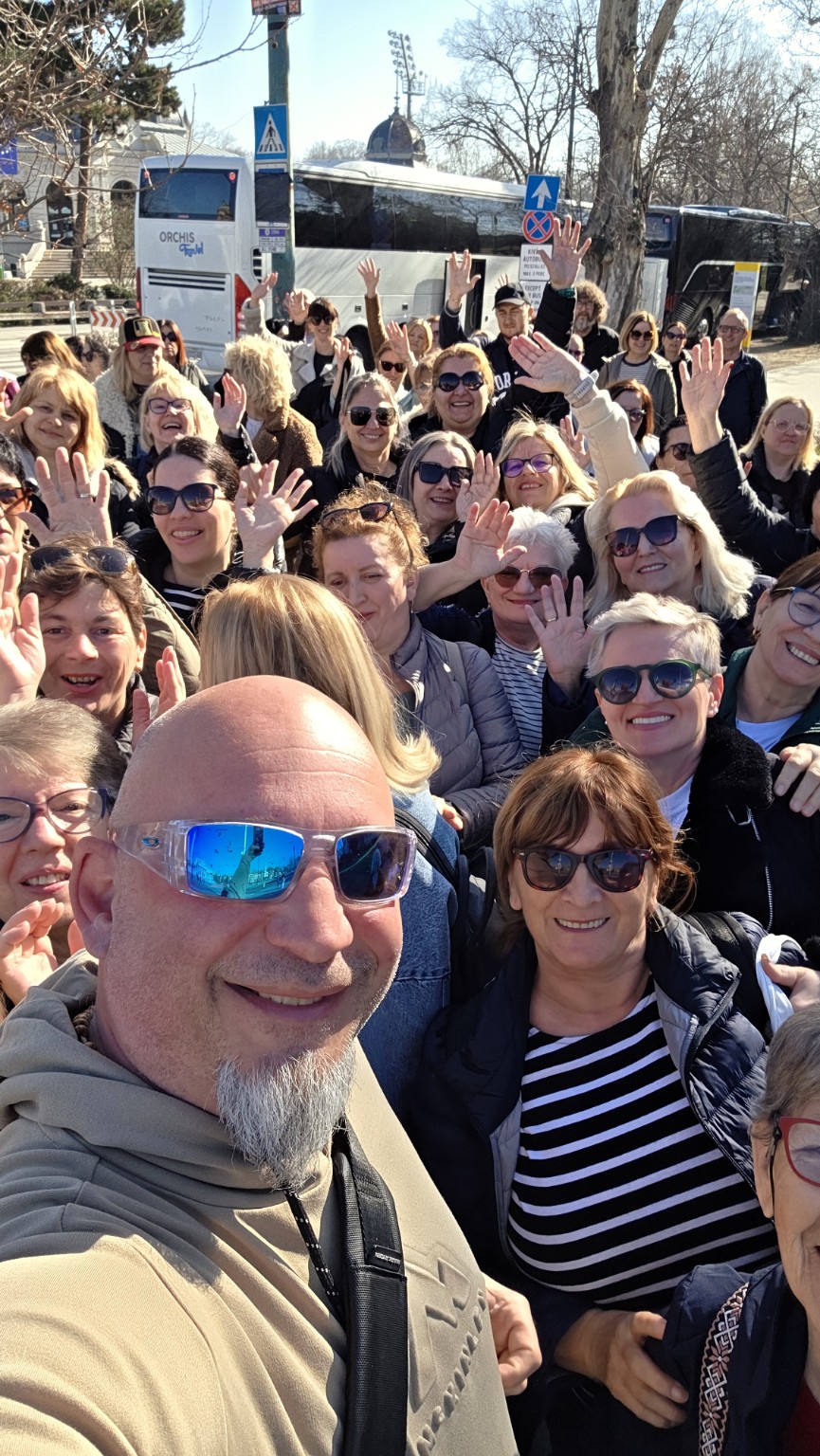
We stopped for a group photograph in Heroes’ Square. Behind us were the monuments and colonnade; above, a clear March sky; before the camera, smiles and waving hands. It is a cherished memory of our International Women’s Day trip: in a square dedicated to the great names of Hungarian history, we also made a Budapest image of our own.
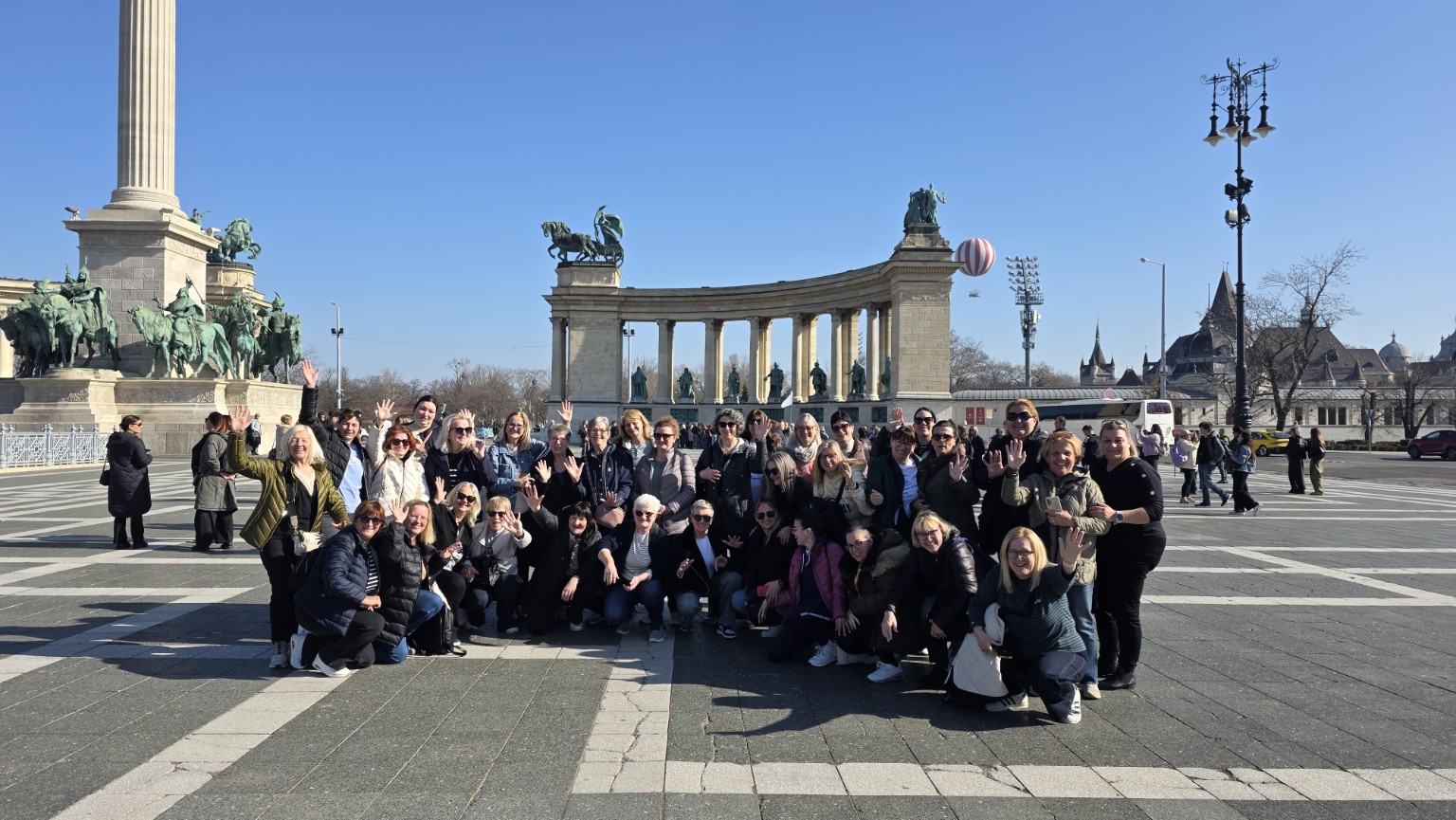
Heroes’ Square opens at the end of the avenue. The Millennium Monument brings together equestrian figures of the seven Magyar chieftains and a gallery of rulers and other historical figures. The tall central column is dedicated to the Archangel Gabriel. The square began taking its present form around the celebrations of 1896, but the ensemble continued to develop over the following decades.[22]
This is the history the state chose to present publicly and monumentally. Walk beside the figures and consider who is remembered, how they are portrayed and what role they play in the shared story. After the city streets, the square’s open space can feel almost like a stage; beyond it, City Park, or Városliget, offers a more relaxed continuation, with a lake and the picturesque Vajdahunyad complex.
Anonymus – The Faceless Chronicler
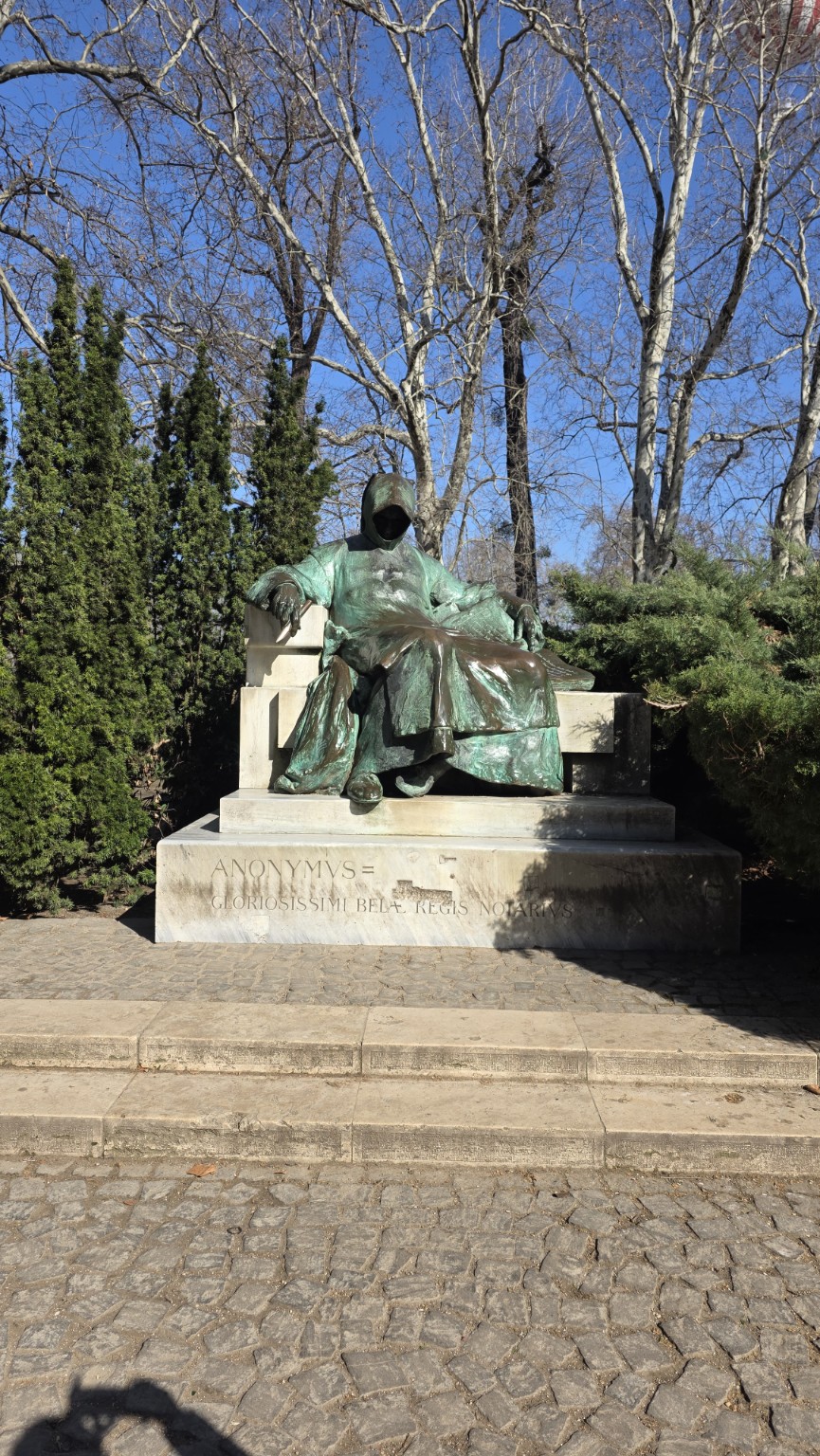
Near Vajdahunyad, a seated figure with a hood, book and pen attracts attention. This is Anonymus, by sculptor Miklós Ligeti, installed in 1903. He represents the anonymous author of the medieval Gesta Hungarorum, associated with the court of a King Béla, usually identified as Béla III. The chronicler’s identity has not been established with certainty, so the face hidden beneath the hood neatly expresses what we do not know about him.[31]
The photograph shows how different this figure is from the ceremonial horsemen in Heroes’ Square. He sits among trees, almost withdrawn into his work. As a writer with an interest in history, I find the image compelling: we do not even know someone’s name, yet his text has survived for centuries. After the great monuments to rulers, a man holding a pen has also found his place in the city.
The park also houses the Széchenyi Baths, opened in 1913. Their history introduces an important part of Budapest life: the use of thermal waters. The yellow façades and outdoor pools are among the city’s best-known images, but the baths require time for the experience itself. Giving them a few hours brings a different end to the day from simply continuing around the monuments.[23]
The Jewish Quarter – Beyond Façades and Courtyards
To return to denser urban life, we choose the historic Jewish Quarter. Its best-known religious centre is the Great Synagogue on Dohány Street, consecrated in 1859. The monumental building, with its distinctive towers and Moorish motifs, testifies to the importance of the community that built it. The adjoining museum and memorial spaces make a visit an encounter with both religious life and the history of persecution.[24]
Remember the wartime ghetto and the Holocaust in this neighbourhood. The streets we now follow towards restaurants and bars also carry that history. Memorials return it to public space, while visiting the synagogue provides essential context for what follows. Allow enough time before continuing into the surrounding streets.
The passages and internal courtyards are particularly interesting. A city that seems closed behind façades when seen from an avenue opens from within here: a single entrance may reveal a small world of cafés, staircases and galleries. This urban fabric also gave rise to one of contemporary Budapest’s best-known phenomena.
Szimpla Kert – A Second Life for Old Buildings
Szimpla Kert, on Kazinczy Street, is a key name in the culture of ruin bars, venues created inside old, neglected buildings. The project began in 2002 and moved to its present location in 2004. Its courtyard, smaller rooms, galleries and unusually assembled furniture became a setting for nightlife, encounters and cultural events.[25]
What is most interesting is the absence of any attempt to create a perfectly finished interior. Old objects find new uses, mismatched chairs share the same space, plants trail from galleries and walls remain full of traces. Our eyes keep settling on something we might overlook elsewhere. At Szimpla, that combination of objects creates the whole.
Connect it with the city’s other experiences. In Buda, we see restored royal history; at Gerbeaud, civic elegance; here, an old building receives a new public purpose through different means. Budapest has a long history of destruction and new beginnings; ruin bars are part of its contemporary response to what should be done with spaces that have lost their original function.
A quieter part of the day is more practical for examining the details. In the evening, the venue primarily comes alive as a popular nightlife destination, with crowds and noise naturally changing the experience.
New York Café – Splendour and Literature beneath One Ceiling
From Kazinczy Street, we can continue towards Erzsébet Boulevard and the New York Café. It opened in 1894 inside a palace built for the New York Life insurance company. Architect Alajos Hauszmann and his collaborators helped create a building whose ground-floor café is defined by columns, gilding, painted ceilings and abundant decoration. Even the view from the entrance explains why it has become one of the city’s most photographed coffee houses.[26]
Its name is almost always accompanied by the phrase “the most beautiful café in the world”. That is its reputation and how it presents itself, but a café’s beauty need not become an objective global ranking. What matters here is what greets us beneath that ceiling. Opulence fills the entire room, our eyes keep wandering upwards and an ordinary coffee order acquires an almost ceremonial setting.
The New York Café also deserves to be understood through its literary past. Writers, journalists and artists met here, including Ferenc Molnár and Dezső Kosztolányi. Coffee houses offered newspapers, a table, company and the chance to remain at the centre of city life for hours. Texts were written, friendships formed and ideas spread in such places. For me, this part of the story is as appealing as the painted ceiling.[27]
A legend associates Molnár with throwing the café’s key into the Danube so that it could never close. The story belongs to coffee-house folklore, but it says much about how the city saw such places: as rooms that should remain open as long as people needed company, conversation or a table at which to write.[28]
Visit Gerbeaud and the New York Café separately, allowing time for each. The first brings us to confectionery traditions and the life of a central square; the second draws us more deeply into the spectacle of a grand café interior and literary gatherings. Both are now famous tourist destinations, so queues and prices form part of the reality of visiting. Their history becomes more convincing when experienced at a table, with eyes that no longer have to hurry onwards.
↑ Back to ContentsBudapest on a Plate
After so much walking, the city begins to reveal itself through its smells too. Lángos, often written “langoš” in Croatian, is fried dough traditionally served with garlic, sour cream and grated cheese. It is best fresh and hot: crisper at the edges, softer in the middle, with simple toppings. It is filling enough to count as a substantial stop on the walk.[29]
Kürtőskalács is a sweeter street-food temptation. Strips of dough are wound around a cylindrical spit, baked while turning and given a caramelised surface, often with cinnamon or another coating. The pastry is associated with the Székely Hungarian tradition of Transylvania and has long been a familiar sight in Budapest. Try it warm, when the contrast between outer crust and soft interior is at its best.[29]
At the table, give spoon dishes a chance too. Hungarian gulyás is usually a soup with meat, paprika and potatoes, which may surprise anyone expecting goulash to mean only a thick meat stew. Pörkölt comes closer to that expectation. There is also paprikás csirke, chicken in a paprika and sour-cream sauce, often accompanied by nokedli, small dumplings, and halászlé, a fish soup strongly associated with paprika.[30]
Then come the cakes: layered Dobos torte with its caramel top, rétes, or strudel, and somlói galuska, a dessert of sponge pieces, chocolate sauce and whipped cream. There is no need to taste everything in one day. Food fits best into a journey when it finds a natural place: lángos after the market, cake with coffee, dinner after returning from the riverbank. It remains connected with the city and the day we have spent there.
A Night Cruise on the Danube – Budapest in Golden Light
That evening, we boarded a boat for a sightseeing cruise on the Danube. After exploring on foot all day, it was pleasant to let the city pass us by. The riverbanks lit up, palace outlines emerged from the darkness and light broke into long, restless reflections on the water. Budapest looked more ceremonial from the river than from the street, as though all the buildings we had examined close up had suddenly gathered within the same scene.
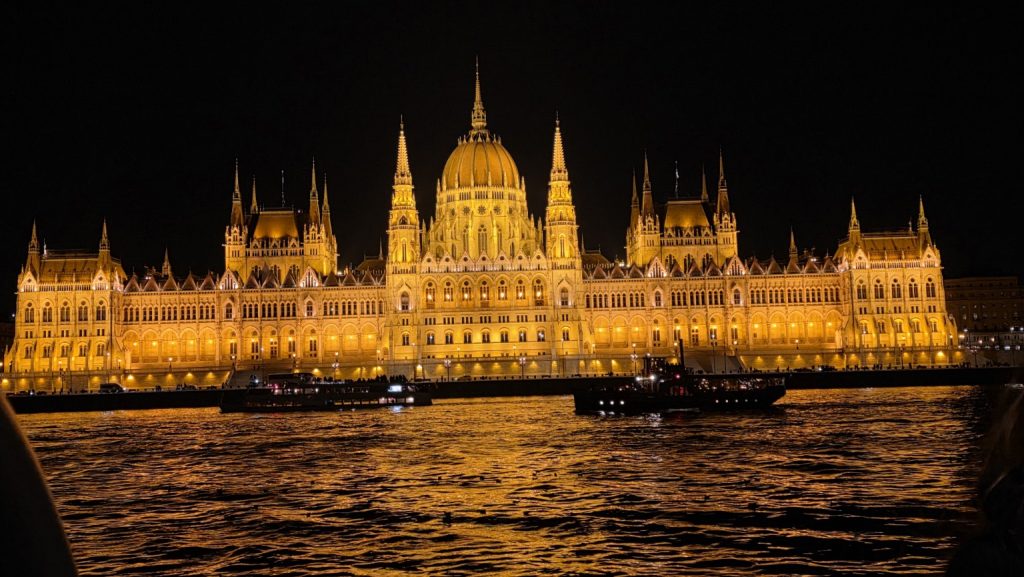
The Parliament Building impressed me most. Its illuminated dome, towers and long façade stood clearly against the dark sky, while the Danube carried golden reflections below. From the boat, its size feels different: the eye can travel the length of the whole building. The photograph preserved the scene, but can hardly convey the movement of the water or the feeling of passing before it. That night cruise was truly beautiful.
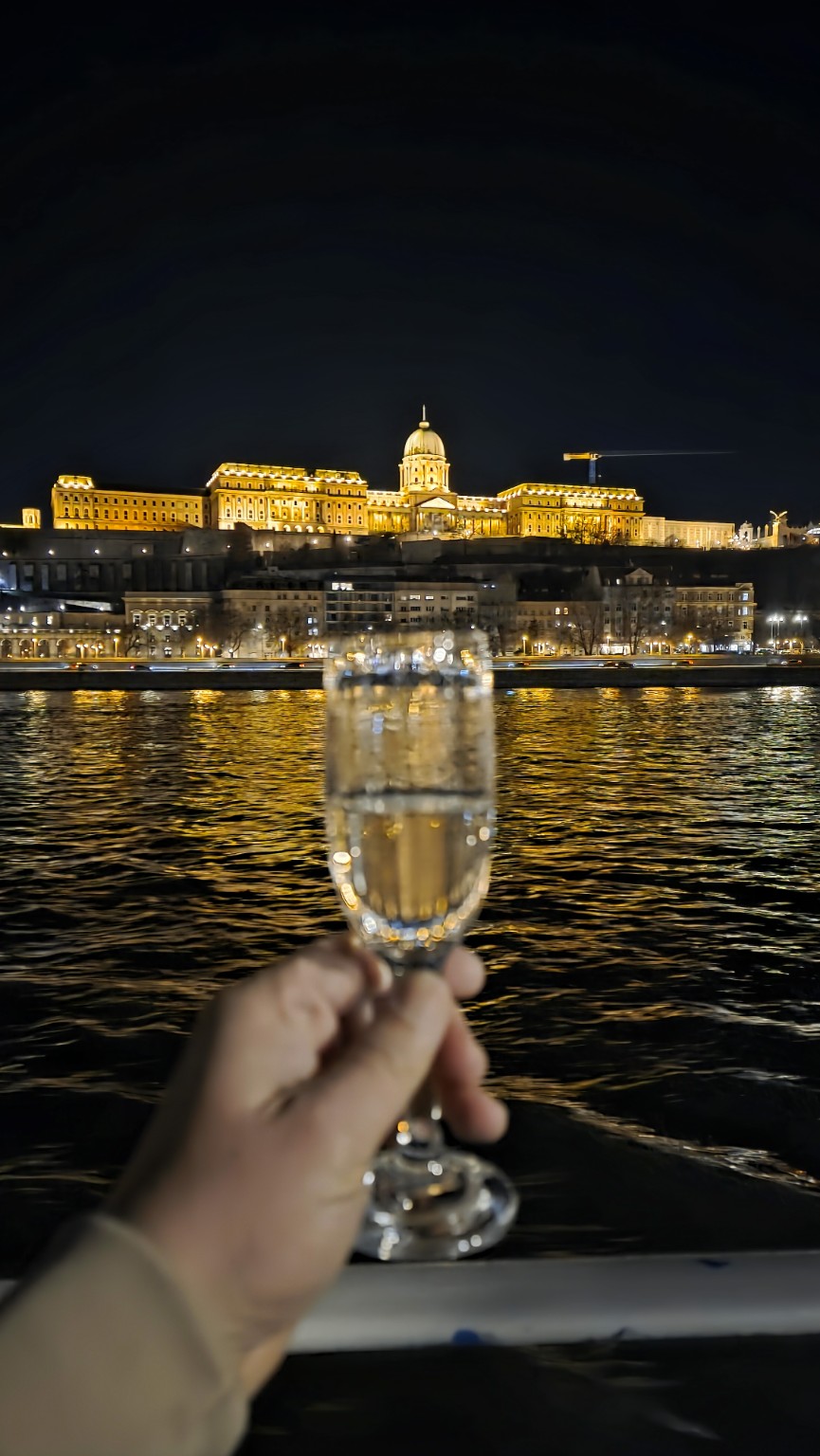
On the Buda side, the royal palace shone above the riverbank. In one photograph, a raised glass remained in the foreground, with the river and illuminated castle behind it. I cherish it precisely for that ordinary detail within the grand panorama. It reminds me of the evening on the boat, our journey and the pleasure of getting to know Budapest from the water after all our walks.
When I remember that March trip, alongside Parliament at night come the group in Heroes’ Square, the stone arch before Matthias Church and the flowers beside the Shoes on the Danube Bank. Very different scenes, each with its own mood. They keep Budapest close to me: within its great history, there is always room for a memory from our own journey.