Academia, astronomy, architecture, astrology and alchemy: a travel writer’s guide to Prague, from Old Town Square and the Astronomical Clock to Charles Bridge, the royal castle and the workshops of Rudolf II’s age.
In March 2026, I returned to Prague. I stayed at an Ibis hotel near the Old Town, which suited me for a simple reason: I prefer exploring this city on foot. It took little time to reach the first sights from the hotel; after that, I only had to follow the streets. The historic centre is connected enough to explore its best-known places by walking, yet so rich that even after several days I never feel I have finished sightseeing.
Gothic churches, Baroque palaces, bridges and squares draw me in, but I am especially interested in the people who left their mark behind them. In Prague, these are kings who built a capital, professors whose sermons shook Europe, astronomers who changed our picture of the universe and alchemists who sought the secrets of matter at their furnaces. Thinking of them brought five words together for me: academia, astronomy, architecture, astrology and alchemy. Five A’s as a way of looking more closely at a familiar city.
This is therefore a walk through Prague’s main sights, with historical detours wherever they are worthwhile. It need not be completed in a single day. One outing can cover the Old Town, Josefov and the Clementinum; another, Malá Strana, castle and Hradčany; a third, the New Town and Vyšehrad. The contents at the beginning of the article let you go straight to the place or subject that interests you.
A City Made of Several Towns
To understand Prague, begin with its geography. For centuries, today’s historic centre was not a single city. Separate urban communities stood beside the Vltava, each with its own administration, privileges, squares and interests. The Old Town (Staré Město) developed on the right bank as a centre of trade and civic life. Opposite it, beneath the royal castle, lies Malá Strana, founded as a royal town in 1257 by Přemysl Ottokar II. Hradčany extends above it, while the New Town (Nové Město) was established in 1348 by Charles IV.
Prague’s four historic towns were not administratively united until 1784, under Joseph II. Their differences can still be felt: the Old Town, with its squares and burghers’ houses, has a different character from the aristocratic Malá Strana, while life in Hradčany developed around the castle and cathedral. The Vltava and Charles Bridge connect these once separate worlds.
Charles IV – The Ruler Who Shaped a Capital
If I had to choose the ruler whose name best explains medieval Prague, it would be Charles IV of Luxembourg. Born in 1316, he became King of Bohemia in 1346 and was crowned Holy Roman Emperor in 1355. He spent part of his youth at the French court and understood the importance of education, faith and monumental buildings to a capital’s prestige.
His reign saw the founding of the university and New Town, the start of a new stone bridge across the Vltava and strong support for the construction of St Vitus Cathedral. These were connected projects: Charles systematically created a city worthy of an imperial seat. Scholars, artists, builders and merchants came to Prague, and we follow his legacy almost all the way from Old Town Square to the castle.
Old Town Square – The Heart of Civic Prague
We begin on Old Town Square (Staroměstské náměstí). Gothic, Baroque and Rococo alternate around its edges, while the space of a medieval marketplace is still recognisable between the façades. The square was developing as early as the twelfth century; it witnessed trade, celebrations, protests and executions. Coronation processions also crossed it on their way to the castle.
Part of older Prague actually lies beneath today’s street level. During the Middle Ages, the ground was gradually raised, partly to protect against floods, turning some Romanesque ground floors into cellars. Above them stand the Old Town Hall with its Astronomical Clock, the Church of Our Lady before Týn, the Baroque Church of St Nicholas, Kinský Palace and the great Jan Hus Monument. Pause at these before joining the crowds towards Charles Bridge.
Jan Hus – From the University to a Rupture in European Christianity
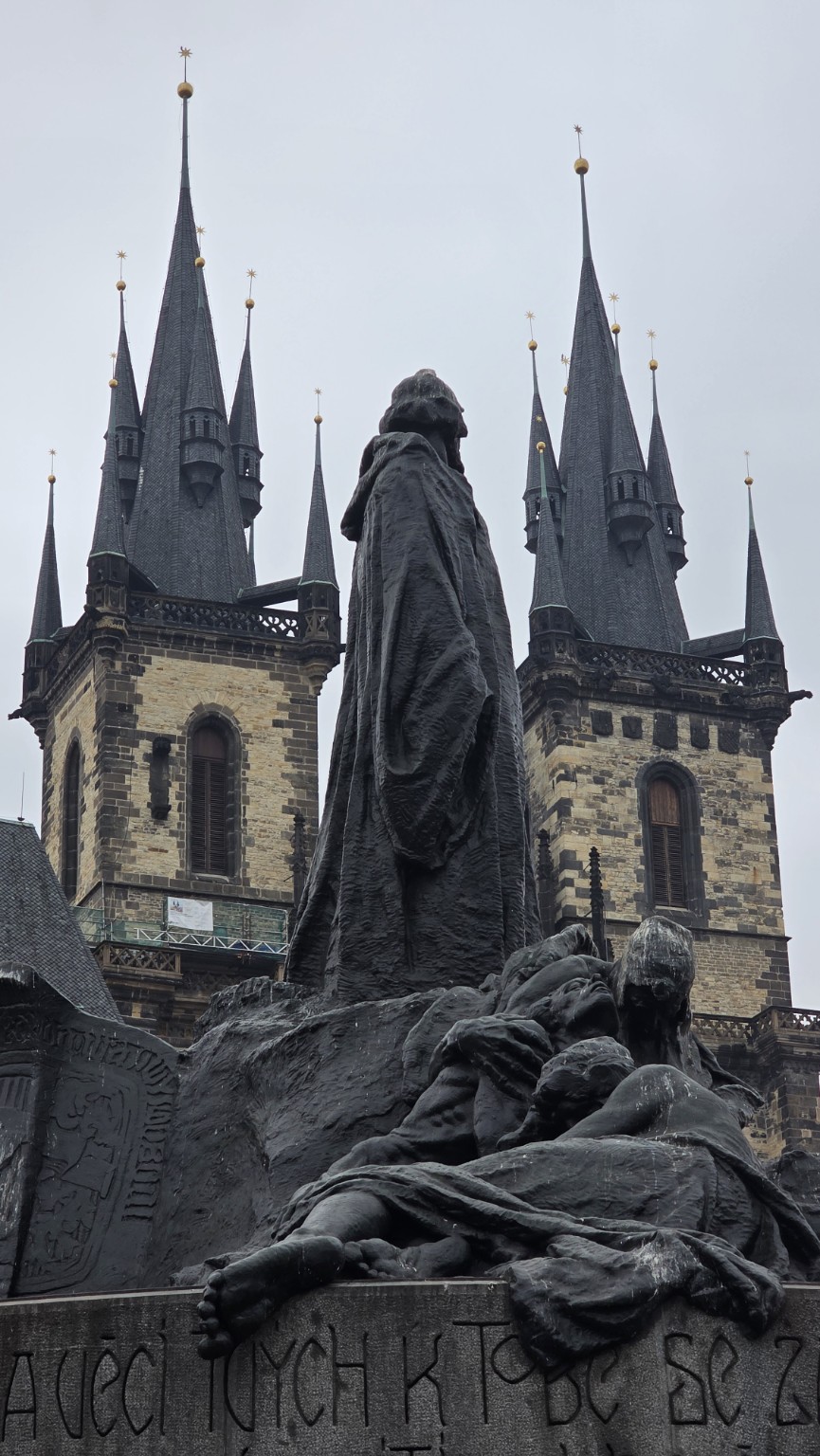
The monument to Jan Hus, by Ladislav Šaloun, was unveiled in 1915, on the five-hundredth anniversary of his death. Hus was a priest, professor and rector of Charles University; his Czech-language sermons in the Bethlehem Chapel reached far beyond academic circles. Influenced by the English theologian John Wycliffe, he criticised abuses within the Church and called for its moral renewal.
His conflict with ecclesiastical authorities ended at the Council of Constance: he was condemned for heresy and burned at the stake on 6 July 1415. His death inspired the movement that led to the Hussite Wars. Standing before his monument, the theme of academia acquires a very real human face. Debates among Prague’s professors could grow into conflicts that determined the country’s fate.
Kinský Palace – Kafka and the Balcony of 1948
On the eastern side of the square stands Kinský Palace, an ornate Rococo building from the mid-eighteenth century. In the late nineteenth century, it housed the German-language grammar school attended by Franz Kafka, while his father Hermann ran a shop on the ground floor. It is striking how many different city lives can fit into one palace.
Its balcony is also remembered for the speech delivered by communist leader Klement Gottwald on 21 February 1948, during the crisis that ended with the communist seizure of power. Four days later, President Edvard Beneš accepted Gottwald’s proposed changes to the government. The distinction matters: the balcony speech and the completion of the political takeover did not occur on the same day.
Prague’s Astronomical Clock – Far More Than the Apostles’ Procession
The Prague Astronomical Clock, or Orloj, stands on the southern façade of the Old Town Hall. Crowds gather on the hour to watch the apostles appear in the little windows above its dial. The brief show can overshadow what makes the clock truly exceptional: an intricate astronomical display connecting timekeeping with the observation of the heavens across the centuries.
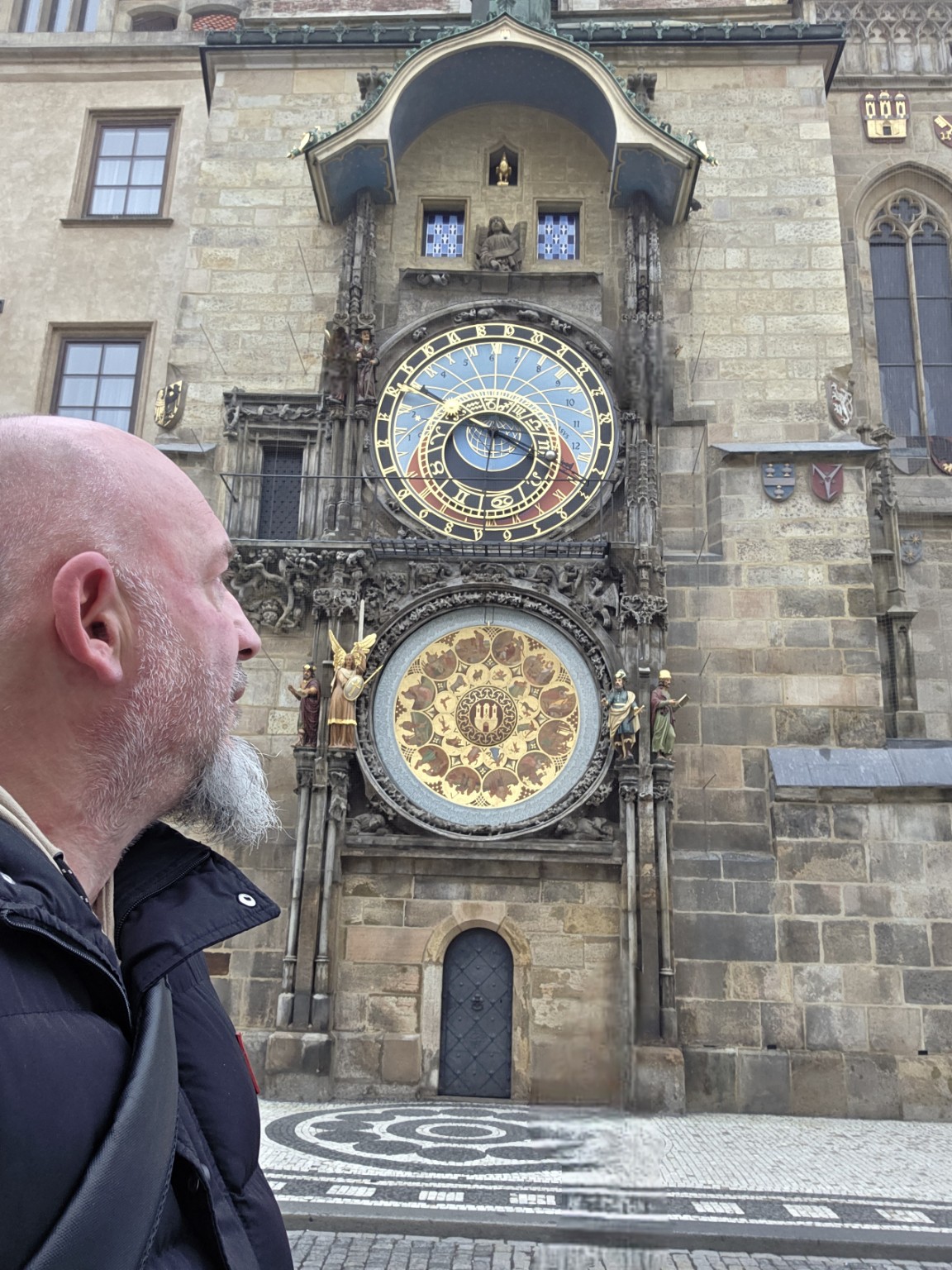
The oldest part dates from 1410. Clockmaker Mikuláš of Kadaň built it using an astronomical design associated with Prague scholar Jan Šindel. Its dial follows a medieval geocentric view of the heavens, showing the positions of the Sun and Moon and their relationship with the zodiac. Its different systems include Old Czech time, tied to sunset, and unequal Babylonian hours, whose length changes with the season.
A legend tells of master Hanuš, supposedly blinded by the councillors so that he could never build another such mechanism. The clock, however, predates his work; Hanuš is associated with later alterations. It is a compelling story, but a legend. I explain the dials, symbols and ways of reading the time in a separate article, Prague’s Astronomical Clock: Reading a Clock That Shows More Than Time.
The Týn Church – Gothic Architecture and Tycho Brahe’s Tomb
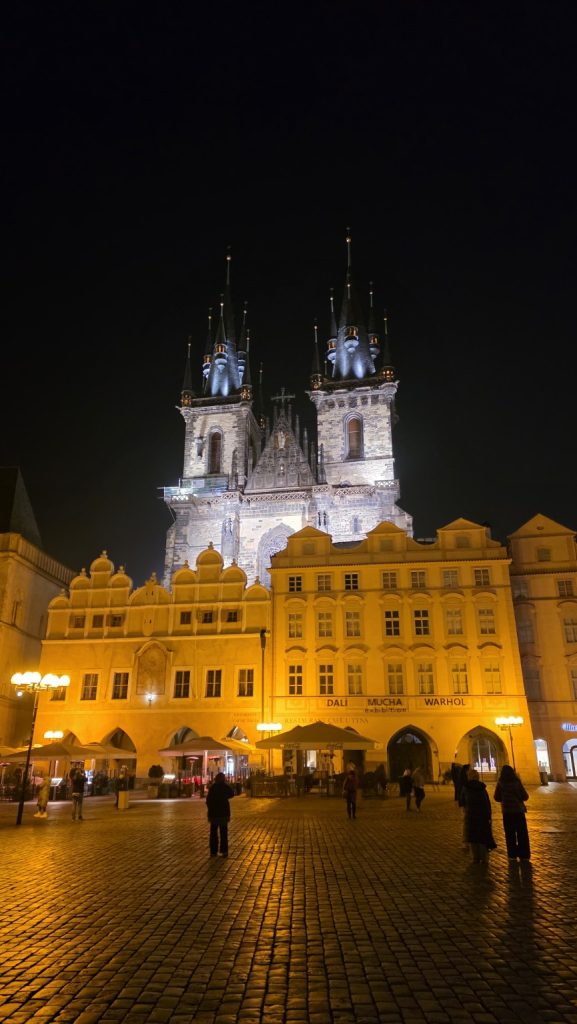
Opposite the town hall rise the two towers of the Church of Our Lady before Týn, each almost eighty metres high. Construction began in the fourteenth century, and its appearance changed over a long building history. During the Hussite period, it was an important centre for the Utraquists, who advocated communion in both bread and wine for the laity. The interior now preserves Gothic and Baroque art, altars and a historic organ.
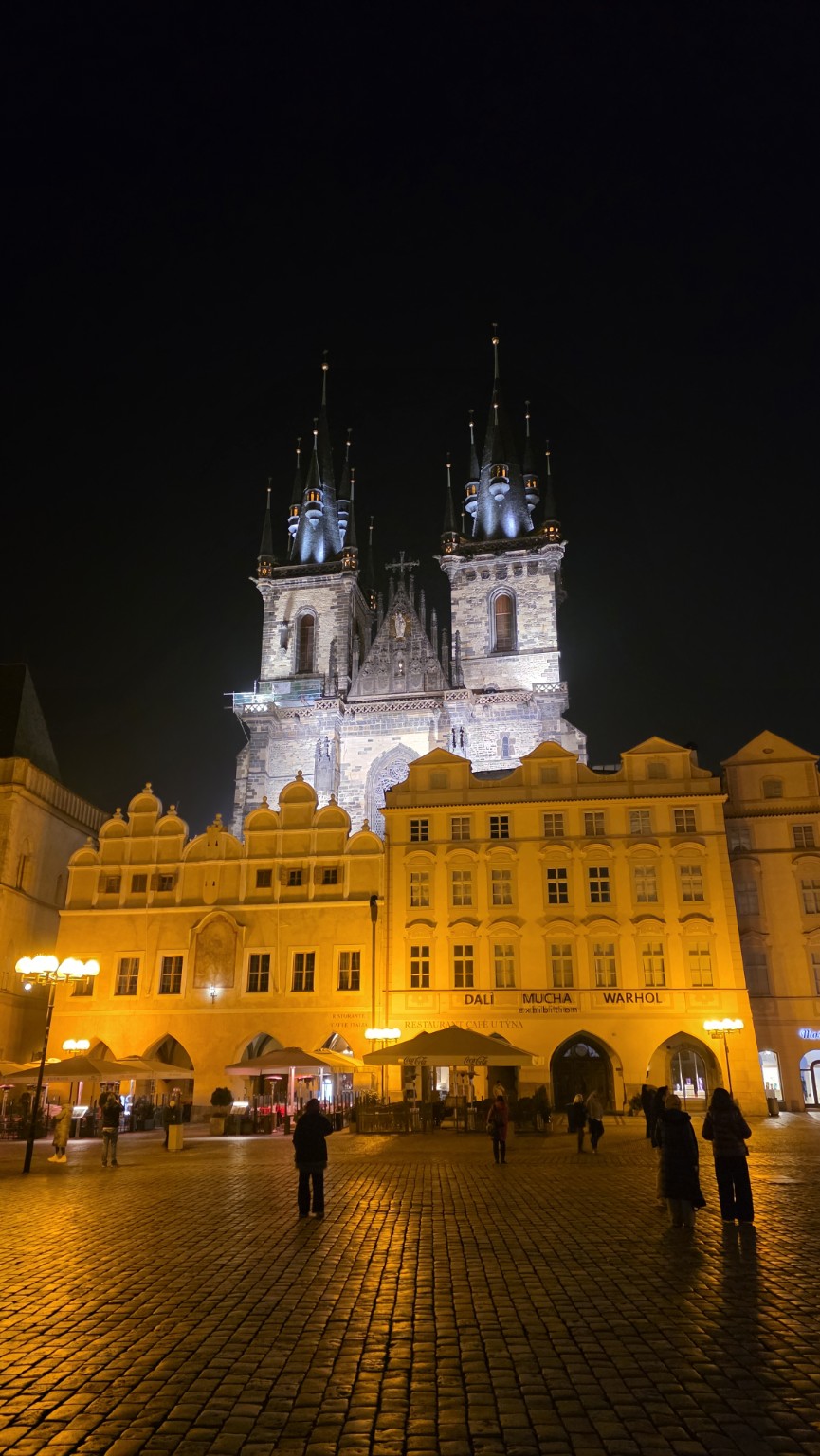
The tomb of Tycho Brahe is particularly important to this story. The Danish astronomer spent his final years at the court of Rudolf II and died in Prague in 1601. His precise observations became crucial to Kepler’s work. Only a few minutes’ walk separates the medieval Orloj from the grave of one of history’s great observers of the sky.
Academia – Charles University and the Carolinum
Near the square stands the Carolinum, the historic seat of Charles University. Charles IV founded the university on 7 April 1348, following earlier papal approval. The oldest university in Central Europe originally had four faculties: arts, medicine, law and theology. Modelled on major European institutions, especially Paris and Bologna, it made Prague a destination for students and professors.
A medieval university was not a campus as we imagine one today. Teaching and academic life occupied different buildings and colleges around the city. Charles founded a college for masters in 1366, while the Carolinum later became the institution’s principal historic seat. Theological and philosophical debates moved from classrooms into public life, as Hus’s fate so clearly shows. Royal patronage provided conditions for scholarship, but the ideas produced here did not always please those in power.
The Clementinum – A Library, Astronomy and Centuries of Learning
Continuing towards Charles Bridge brings us to the Clementinum, one of Prague’s largest historic building complexes. Between Karlova Street and the Vltava, it is now known chiefly for its magnificent Baroque Library and Astronomical Tower, but its history is much richer. A medieval Dominican church dedicated to St Clement once stood here and gave the complex its name. A new era began when the Jesuits arrived in Prague in 1556. They founded a college, which gradually developed into a major educational and scientific complex over the following centuries. In 1622, the Jesuits took over the administration of Charles University; in 1654, their academy was united with it as part of Charles-Ferdinand University.
Today’s Clementinum is a splendid example of Prague Baroque. Its celebrated Baroque Library, completed in 1722, looks almost unreal. Tall wooden bookcases filled with old books, ceiling frescoes, globes and historic astronomical instruments create a room in which knowledge truly seems to have been regarded as something exalted. The library preserves valuable historic collections, and its interior is among Europe’s best-known library spaces. The Astronomical Tower, approximately 68 metres high, is particularly interesting. It offers an excellent view of historic Prague, but tourism was not its original purpose. For centuries, the Clementinum was an important centre of astronomical, meteorological and geophysical observation. Systematic meteorological measurements began here in 1752, and its uninterrupted series of daily temperature observations dates from 1775. This gives the Clementinum a special place in the history of European meteorology.
One notable scholar associated with it was the Jesuit Josef Stepling, a mathematician, physicist and astronomer who helped develop the natural sciences in eighteenth-century Prague. The Clementinum continues the story of academic Prague in a different setting: alongside books are instruments, measurements and observational records. After the medieval university and its debates, we encounter people who patiently recorded changes in the weather and the positions of celestial bodies.
Karlova Street – From Royal Processions to Johannes Kepler
Leaving the Clementinum, we enter Karlova Street, one of the Old Town’s best-known streets. Today it is almost always filled with tourists, shops, restaurants and souvenir sellers, but it once formed an important part of the Royal Route, the ceremonial path taken by Bohemian rulers to their coronation in St Vitus Cathedral. The procession traditionally began around today’s Republic Square, crossed Old Town Square, followed Karlova and Charles Bridge, then climbed through Malá Strana towards the castle. This was more than a practical route to the cathedral. It publicly displayed royal authority, brought the ruler before the citizens and symbolically crossed the capital’s most important areas. From 1607, Johannes Kepler lived in the house called U Francouzské koruny, at Karlova 4. The German mathematician and astronomer made his most important discoveries about planetary motion during his Prague years.
Kepler’s story takes us into a very different Prague, that of the late sixteenth and early seventeenth centuries, when the city became one of Europe’s leading centres of astronomy, astrology and alchemy.
Rudolf II – The Emperor Who Made Prague a Capital of Scholars and Alchemists
Rudolf II of Habsburg, Holy Roman Emperor from 1576 to 1612, was crucial to the development of this unusual Prague. In 1583, he moved his principal court from Vienna to Prague, making the city a major European political centre again. Rudolf was an unusual ruler. Art, nature, astronomy, astrology, alchemy and collecting rarities interested him far more than military campaigns and everyday state affairs. His court gathered painters, sculptors, mathematicians, physicians, instrument-makers and investigators seeking to understand natural phenomena. His celebrated Kunstkammer, the imperial collection of art and natural curiosities, was among Europe’s richest. It held paintings, sculptures, precious objects, minerals, preserved exotic animals, mechanical devices and scientific instruments. Rudolf was especially drawn to objects demonstrating human skill or nature’s unusual possibilities.
Artists working at his court included Giuseppe Arcimboldo, known for portraits assembled from fruit, flowers and other objects, and Bartholomeus Spranger, an important painter of Northern Mannerism.
Tycho Brahe and Johannes Kepler – Two Men Who Changed Astronomy
The Danish astronomer Tycho Brahe arrived at Rudolf’s court in 1599. He was among the most precise observers of the sky before telescopes entered astronomical practice. On the island of Hven, where he had built his Uraniborg observatory, he spent years collecting exceptionally accurate positions of stars and planets. Brahe did not accept Copernicus’s original heliocentric system. He developed his own model in which the Sun orbited a stationary Earth while the other planets orbited the Sun. Although the model proved incorrect, his observations were precise enough to become invaluable to modern astronomy. Johannes Kepler arrived in Prague in 1600 and began working with him. Their relationship was not always easy. Brahe was older, distinguished and cautious about sharing his data; Kepler was an ambitious mathematician seeking the laws behind planetary motion. Brahe died in 1601, and Kepler succeeded him as imperial mathematician.
For centuries, it had been assumed that planets must move in circles, the circle being considered the perfect geometrical form. Kepler found that observations of Mars could not be explained accurately enough by that model. After prolonged mathematical analysis, he concluded that planets follow elliptical orbits, with the Sun at one focus. In Astronomia nova, published in 1609, he presented his first two laws of planetary motion. The first describes elliptical orbits with the Sun at one focus; the second states that a line joining a planet and the Sun sweeps out equal areas in equal times. A planet therefore moves faster nearer the Sun and more slowly farther away. He published the third law, relating the square of an orbital period to the cube of an orbit’s semi-major axis, in 1619, after leaving Prague. These discoveries were crucial steps towards modern astronomy and Newton’s later explanation of gravity.
Kepler spent more than a decade in Prague, from 1600 to 1612. Walking down Karlova is all the more interesting when we know that one of its houses sheltered a man whose mathematical analyses helped change our picture of the universe.
Astrology – When Emperors Sought Answers in the Stars
Today, we clearly distinguish astronomy from astrology. Astronomy is the science of celestial bodies and their physical laws; astrology attributes influence over human traits and events to celestial positions, for which there is no reliable scientific evidence. In the sixteenth and seventeenth centuries, that distinction was less clearly established. Astronomers often prepared horoscopes, astrological calendars and predictions for rulers. Kepler also practised astrology, partly because it earned income and partly because he believed certain relationships in nature might have wider significance. Nevertheless, he criticised many popular astrological interpretations. Rudolf II took a great interest in astrology. At European courts of the period, astrologers prepared rulers’ horoscopes, sought favourable dates for important decisions and interpreted celestial phenomena as possible signs of future events.
This was not unusual. In an age of frequent wars, epidemics and dynastic conflicts, the future was profoundly uncertain. Rulers wielding enormous political power often sought answers in the stars at the same time. In Rudolf’s Prague, astronomy and astrology lived side by side. The same people could perform precise mathematical calculations and compose astrological interpretations, showing how much more complex the history of science is than today’s neat divisions.
Alchemy – The Mysterious World of Rudolf’s Prague
Rudolf II was known for his interest in alchemists and their experiments. At his court, people sought ways to transform metals, prepare medicines, study minerals and discover what they called the philosopher’s stone. This legendary substance was credited with turning base metals into gold and, in some alchemical traditions, associated with the search for a universal medicine or an elixir of longevity. Alchemy involved more than the pursuit of gold, however. Its workshops developed practical skills in processing substances, distillation, heating and preparing chemical compounds. Some of that knowledge later contributed to chemistry and pharmacy, although alchemical theories differed fundamentally from modern science.
Edward Kelley and John Dee often appear in accounts of Rudolf’s Prague. Dee was an English mathematician, astronomer and astrologer; Kelley was his collaborator, who claimed to communicate with spirits. They stayed in the Bohemian lands and sought patrons among rulers and nobles, but their relationship with the emperor should not be imagined as steady, peaceful employment. Kelley was later imprisoned. Their biographies reveal how closely natural investigation, occult practices, ambition and the search for money could intertwine.
Speculum Alchemiae – The Underground Workshops of Old Prague
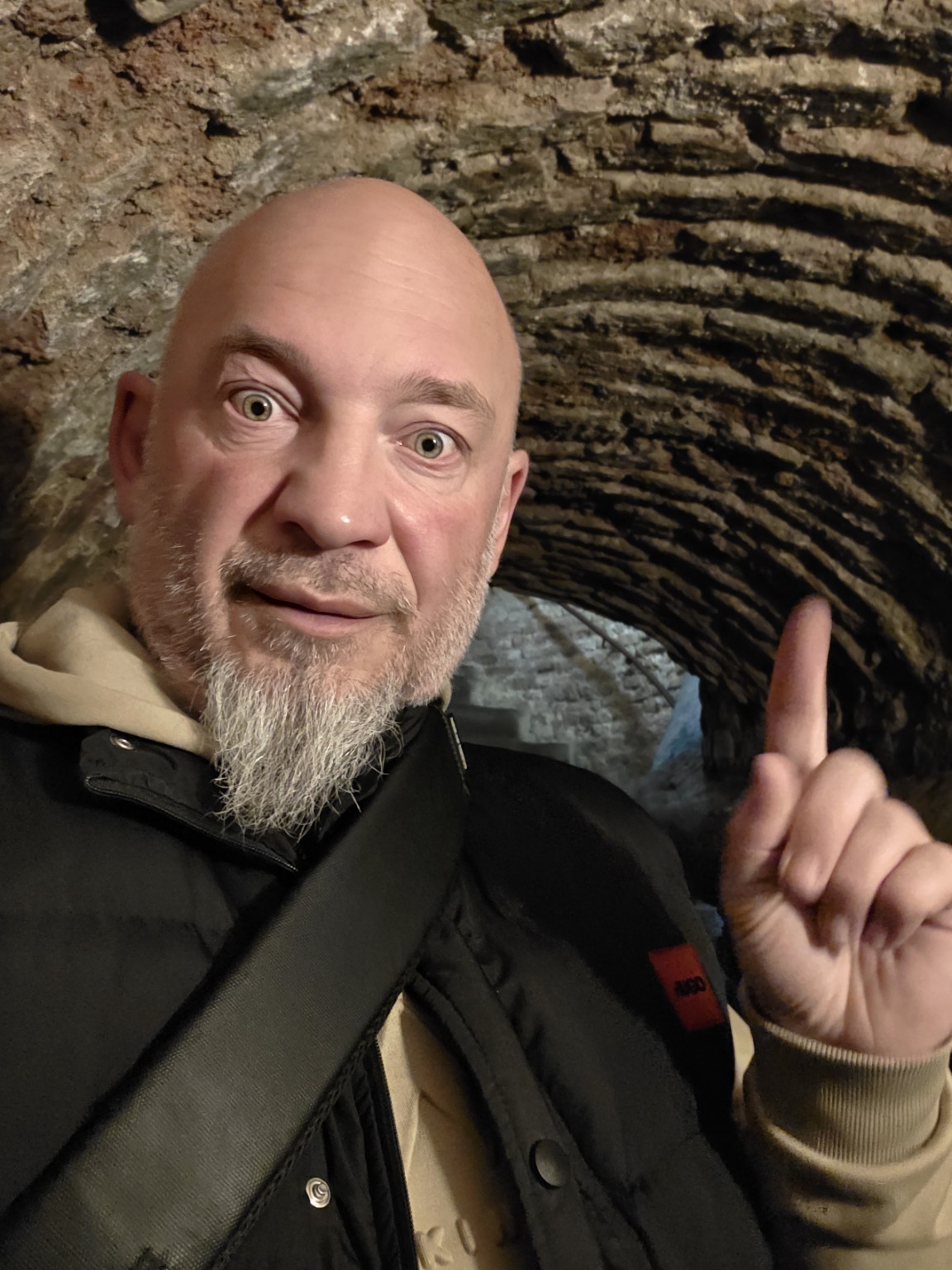
One interesting introduction to this part of Prague’s history is Speculum Alchemiae, a museum on Haštalská Street near the Jewish Quarter. It occupies a historic house beneath which underground rooms were discovered. These are now arranged to evoke Renaissance alchemical workshops, with furnaces, glass vessels, retorts and other objects suggesting the alchemists’ work. The atmosphere of the underground spaces and displays of their methods make the tour especially engaging. Nevertheless, accounts of secret imperial laboratories and famous visitors should be distinguished from what historical sources reliably establish. Prague has developed a rich tradition of legends, and alchemy was an almost perfect subject for them. Underground passages, secret ingredients, miraculous medicines and emperors obsessed with gold offer inexhaustible material for storytelling.
Josefov – Synagogues, the Old Cemetery and the Golem Legend
Near Old Town Square lies Josefov, Prague’s historic Jewish Quarter. Although much of the old district was demolished during redevelopment in the late nineteenth and early twentieth centuries, its surviving synagogues and cemetery testify to one of medieval and early-modern Europe’s most important Jewish communities. Among its best-known landmarks is the Old-New Synagogue (Staronová synagoga), built in the second half of the thirteenth century. It is considered Europe’s oldest surviving active synagogue and a major monument of Jewish Gothic architecture. The Old Jewish Cemetery, used from the fifteenth to the eighteenth centuries, is particularly moving. Limited space led to burials in multiple layers over the centuries; thousands of gravestones now stand close together, often tilted and irregularly arranged.
Among those buried here is Rabbi Judah Loew ben Bezalel, known as the Maharal of Prague, who died in 1609. His name is associated with one of Prague’s best-known legends, the Golem. According to later tradition, Rabbi Loew created a giant clay being to protect the Jewish community from persecution. Sacred words brought it to life, but its strength eventually became dangerous, forcing the rabbi to stop it. The legend says its remains are hidden in the attic of the Old-New Synagogue. No historical evidence from Rabbi Loew’s lifetime supports the story, and its best-known modern form developed much later. Nevertheless, the Golem became an important part of Prague’s cultural heritage, inspiring many literary and artistic works.
Josefov is particularly interesting because history and tradition constantly meet here. Alongside the Old-New Synagogue, visit the Spanish Synagogue, with its ornate Moorish-style interior; the Pinkas Synagogue, now a memorial to Bohemian and Moravian Jews murdered in the Holocaust; and the Maisel Synagogue, associated with the history of Prague’s Jewish community. Josefov requires time, especially if you wish to enter its synagogues and cemetery. Yet it is one of the city’s most important areas, and I would not recommend skipping it. Its history encompasses centuries of Jewish life, religious scholarship, trade and culture, as well as discrimination, persecution and the community’s near-destruction during the Second World War.
Charles Bridge – The Vltava’s Most Famous Crossing
Returning from the Old Town to the river brings us to Charles Bridge (Karlův most), probably Prague’s best-known landmark. Linking the Old Town with Malá Strana, it has been one of the city’s main practical and symbolic connections for centuries. Charles IV began its construction in 1357 after a major flood in 1342 badly damaged the earlier Judith Bridge. The project is traditionally associated with the workshop of Peter Parler, a leading architect of medieval Prague. Completed in the early fifteenth century, the bridge is approximately 516 metres long and almost ten metres wide. Sixteen arches support it, with monumental bridge towers at either end. The Old Town Bridge Tower, a magnificent example of European Gothic architecture, is particularly striking.
An intriguing numerical symbolism is associated with the start of construction. According to a familiar tradition, the foundation stone was laid on 9 July 1357 at 5:31, producing the sequence 1-3-5-7-9-7-5-3-1. This palindrome is interpreted as an expression of medieval interest in numerology and auspicious moments. However, contemporary sources do not reliably establish that precise starting time, so the story belongs to tradition rather than proven fact. The bridge was originally much simpler. Its famous sculptures were largely added during the seventeenth and eighteenth centuries, giving it a strong Baroque character. Today it carries thirty sculptural groups, with many originals replaced by copies for protection.
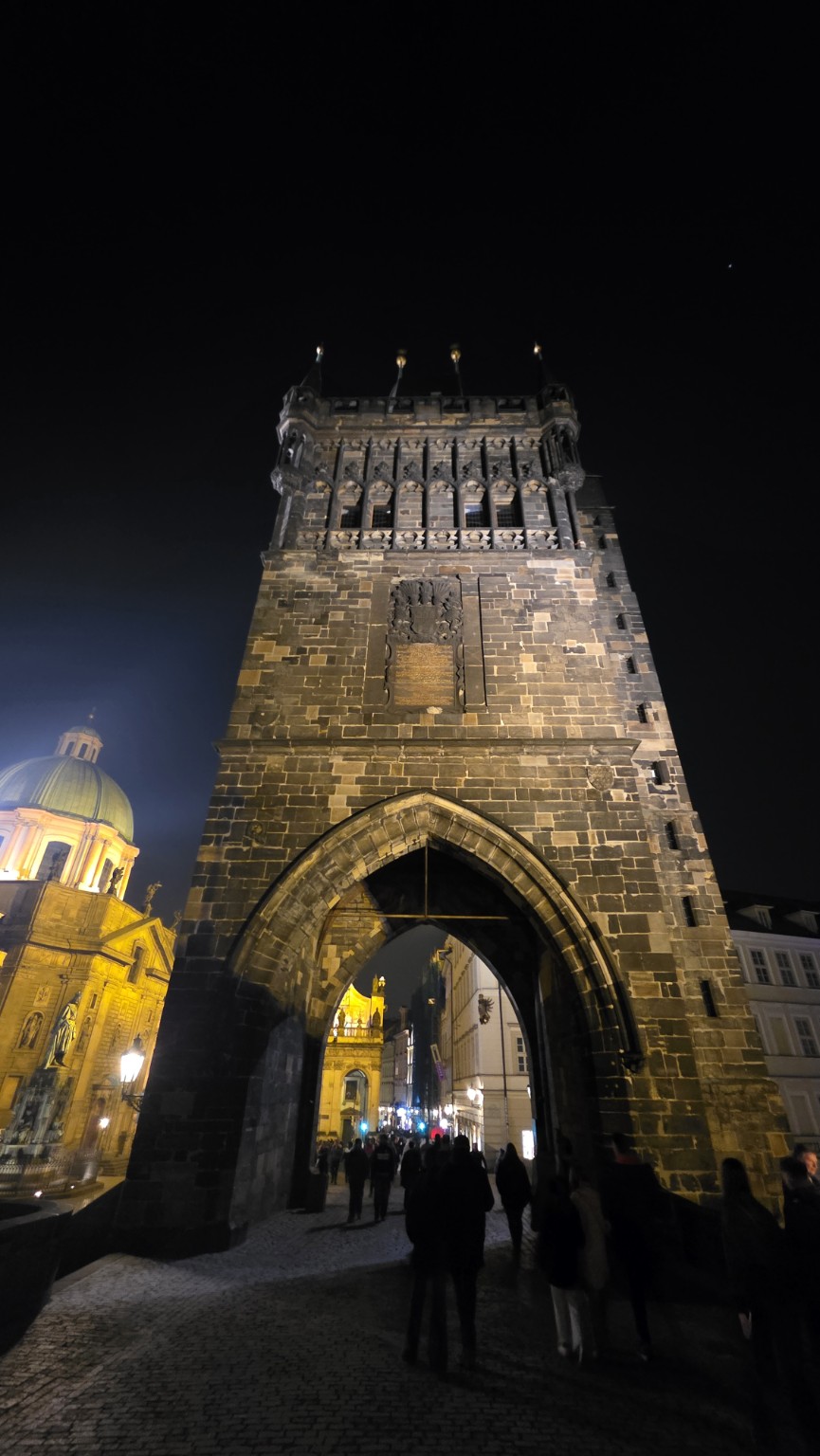
The best-known statue is undoubtedly that of St John of Nepomuk, the Bohemian priest and martyr tortured and thrown into the Vltava in 1393 on the orders of King Wenceslas IV. His death later became associated with a legend that he had refused to reveal the queen’s confession. Historical research points to a more complex political and ecclesiastical conflict, but the legend strongly shaped his cult. John of Nepomuk became one of Central Europe’s most venerated saints, particularly as patron of bridges, rivers and the seal of confession. His statues appear in many Croatian towns and villages, another link between our region and Bohemian history. Pause on Charles Bridge and look both upstream and downstream. One direction opens towards Prague Castle and St Vitus Cathedral; the other towards the Old Town’s towers. Early morning, before the large tour groups, or evening, as lights begin to appear above the Vltava, are particularly beautiful.
Malá Strana – Baroque Prague below the Royal Castle
Crossing Charles Bridge brings us into Malá Strana, one of Prague’s loveliest historic districts. Its narrow streets, palaces, churches and gardens create a different atmosphere from the lively Old Town. Founded in 1257, it gained much of its present appearance after the great fire of 1541 destroyed numerous medieval buildings. Renaissance and Baroque palaces rose in their place over the following centuries, often owned by the Habsburg monarchy’s most powerful noble families. At its centre lies Malostranské náměstí, dominated by the monumental Church of St Nicholas.
St Nicholas Church in Malá Strana – A Masterpiece of Prague Baroque
The Church of St Nicholas in Malá Strana is one of Central Europe’s major Baroque churches. Construction began in 1704, with leading architects of the Dientzenhofer family, chiefly Kryštof and his son Kilián Ignác, contributing to its design. It is known for its enormous dome, sumptuous interior, frescoes and abundant sculpture. Unlike Gothic architecture’s emphasis on height and vertical lines, Baroque creates a strong sense of movement here. Curved walls, light, the dome and rich ornament surround the visitor in a unified spatial experience. Its association with Wolfgang Amadeus Mozart, who played its organ during his visits to Prague, is especially interesting. A great requiem Mass was held here after his death in 1791, demonstrating the Prague public’s particular affection for the composer.
Prague was one of the cities where Mozart enjoyed exceptional success. His opera Don Giovanni premiered in 1787 at the Estates Theatre, which survives today as one of the city’s important cultural landmarks.
The Lennon Wall – Art, Music and Resistance to Communist Rule
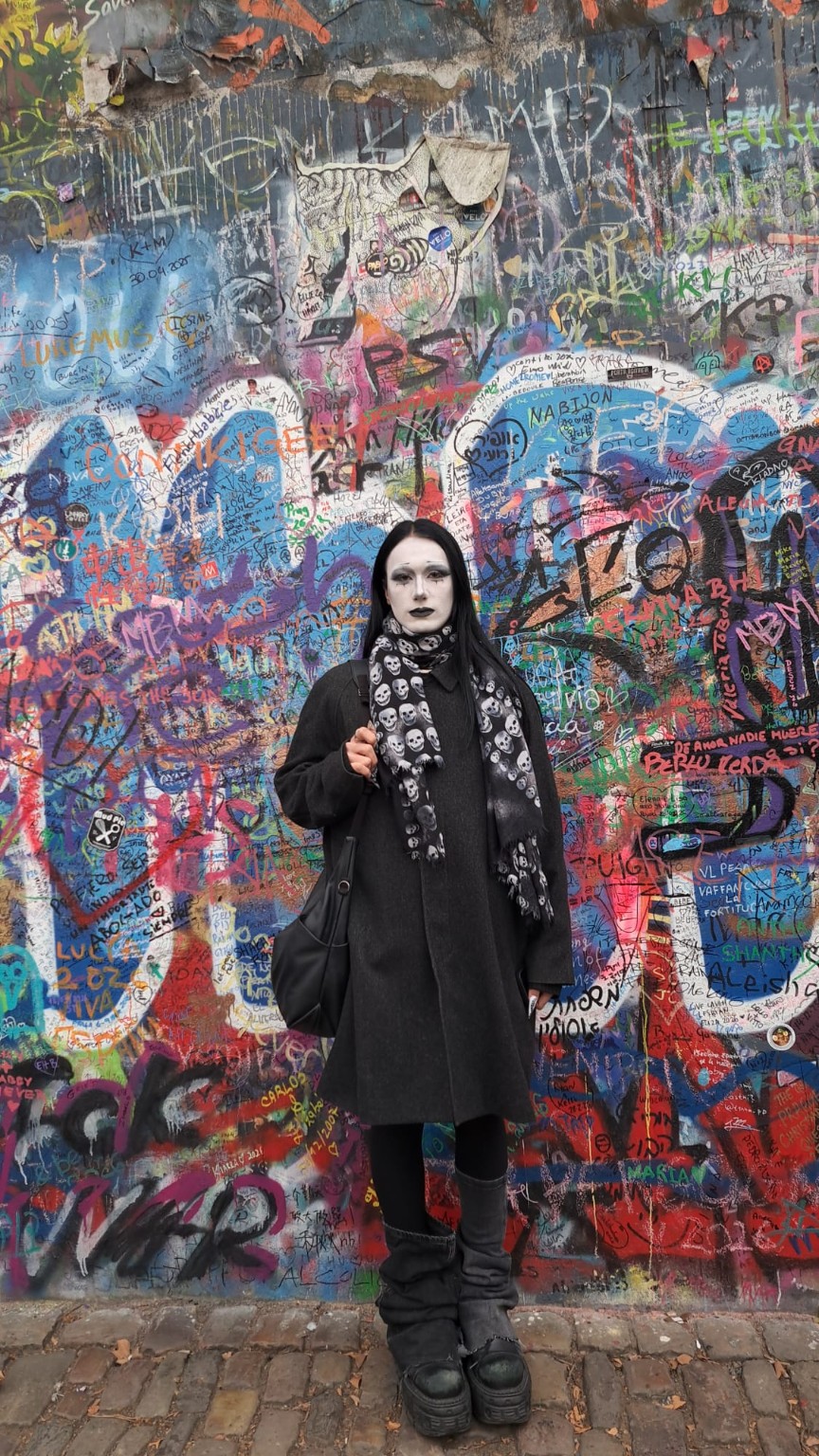
Near Charles Bridge, on Velkopřevorské Square, stands the Lennon Wall, a familiar site of Prague’s recent history. After John Lennon was murdered in December 1980, portraits, Beatles lyrics and messages of peace began appearing on it. During the 1980s, the wall gradually became a place where young Czechs expressed dissatisfaction with the communist regime and a desire for greater freedom. Authorities periodically removed or painted over the messages, but new ones kept appearing. It became a symbol of nonviolent resistance and free expression. Its appearance continues to change as new drawings and messages cover older ones, and its meaning long ago grew beyond the original tribute to Lennon. Unlike royal palaces and monumental memorials, its history was made chiefly by ordinary people. In a city where emperors and kings had shaped public space for centuries, one wall became a place for citizens to speak in their own voices.
Prague Castle – A Political Centre for over a Thousand Years
From Malá Strana, we climb towards Prague Castle (Pražský hrad), one of the world’s largest historic castle complexes. Its origins reach back to the late ninth century, when the Bohemian duke Bořivoj of the Přemyslid dynasty established a fortified seat above the Vltava. It expanded and changed continually over the following centuries. It housed Bohemian dukes and kings and Holy Roman Emperors; today it is the official seat of the President of the Czech Republic. Prague Castle is not a single building but an extensive complex of palaces, churches, courtyards, gardens and defensive structures. Its distinctive quality is the presence of almost every major period of European architecture within a relatively small area. Charles IV used it as an imperial seat, while Rudolf II gathered his art collection and scholars here. Later rulers continued remodelling it, and after Czechoslovakia was founded in 1918, Slovenian architect Jože Plečnik played an important part in its renovation.
St Vitus Cathedral – Six Centuries of Construction
The castle’s principal building is the Cathedral of St Vitus, St Wenceslas and St Adalbert, the largest and most important Czech cathedral. Construction of the present Gothic building began in 1344, when Prague’s bishopric was raised to an archbishopric. Its first architect was Matthias of Arras, a Frenchman brought to Prague by Charles IV. After his death, Peter Parler, one of the fourteenth century’s leading Gothic builders, continued the work. Parler introduced remarkable solutions, including intricate vaults, rich stone sculpture and the design of the choir. Building stopped during the Hussite unrest of the early fifteenth century, leaving the cathedral unfinished for centuries. A major neo-Gothic completion project began only in the nineteenth century and ended in 1929, almost six centuries after the foundations were laid.
Inside is the Chapel of St Wenceslas, one of Bohemia’s principal saints and the country’s patron. It preserves his tomb, with walls decorated in semi-precious stones, gilding and valuable frescoes. The cathedral also holds the tombs of many Bohemian rulers, including Charles IV, and the magnificent silver tomb of St John of Nepomuk. Its stained glass is particularly valuable, including the window designed by Alphonse Mucha, the celebrated Czech Art Nouveau artist. Medieval Gothic and much later art thus meet inside the cathedral too.
The Old Royal Palace and the Defenestration of Prague
The complex includes the Old Royal Palace, whose best-known room is the Vladislav Hall, built around the turn of the sixteenth century to a design by Benedikt Ried. The hall is famous for its exceptional late-Gothic vault with interlacing ribs. Intended for great ceremonies, gatherings and knightly tournaments, its dimensions reveal the ambitions of Bohemian kings. On 23 May 1618, a group of rebellious Bohemian Protestant nobles threw two Catholic royal governors and their secretary from a palace window. All three survived. Known as the Second Defenestration of Prague, the event is considered an immediate trigger of the Thirty Years’ War, the great European conflict of 1618–1648. It reveals the intense political and religious tensions of the period. A conflict beginning in Bohemia soon spread across much of the continent, with devastating consequences.
Golden Lane – Between History and Alchemical Legend
One of Prague Castle’s most visited attractions is Golden Lane (Zlatá ulička), a picturesque row of tiny houses beside the complex’s northern defensive wall. They were built in the late sixteenth century under Rudolf II and housed castle guards, craftspeople and others connected with the castle. The name is often associated with goldsmiths, and popular tourist tradition also links it with alchemists supposedly trying to make gold for Rudolf. No reliable evidence establishes these houses as the centre of imperial alchemical research, however. The lane remains fascinating. Its small houses now display historical recreations of former ways of life, while some spaces serve as exhibitions and shops. Number 22 is especially famous: Franz Kafka occasionally worked and wrote there in 1916 and 1917, using rooms rented by his sister Ottla.
Mihulka – A Tower Associated with Rudolf’s Alchemy
For the actual history of alchemical research, Mihulka Tower, also called the Powder Tower, on the northern side of Prague Castle, is more interesting. Built in the late fifteenth century as part of the defences, it served different purposes over time. In Rudolf’s age, it is associated with alchemical and other workshops, although their organisation is not always fully documented. Mihulka brings us back from Golden Lane’s tourist folklore to the more tangible world of court workshops. It is useful to distinguish what is known about a particular space from stories attached to it later.
Hradčany – Palaces, Monasteries and Views of Prague
Leaving the castle, continue through Hradčany, the historic quarter that developed around the royal seat. Aristocratic palaces, monasteries and churches fill the area, and some terraces offer magnificent city views. A particular highlight is Strahov Monastery, founded by the Premonstratensians in 1143. It is known for one of Europe’s loveliest historic libraries. Its two celebrated rooms, the Theological and Philosophical Halls, preserve valuable books, globes and other objects associated with the history of knowledge. The Theological Hall dates from the seventeenth century, the Philosophical Hall from the eighteenth. Both are famous for elaborate ceiling frescoes, high shelves and rich decoration.
Strahov Library complements the stories of Charles University and the Clementinum. Over centuries, Prague developed different centres of education, from university lecture rooms to monastic libraries. They preserved manuscripts, copied and studied books, hosted theological debate and gradually extended natural knowledge. Near the monastery stands Loreta, one of Prague’s important Baroque pilgrimage sites. At its centre is the Santa Casa, built in 1626–1631 after the model of the Holy House at Loreto in Italy, which Catholic tradition identifies as the Holy Family’s former home in Nazareth. The complex expanded during the seventeenth and eighteenth centuries and is now distinguished by its ornate Baroque façade, bell tower and valuable treasury. Its bells are also known for playing a Marian melody every hour.
Loreta’s wider historical context is also interesting. Its construction belongs to the Catholic renewal after the defeat of the Bohemian Protestant estates at the Battle of White Mountain in 1620. Baroque architecture then became one of the chief means of expressing renewed Catholic power and devotion in the Bohemian lands.
Architecture – From Gothic to Czech Cubism
Prague is particularly rewarding for architecture lovers because almost every major European style can be traced along its streets. Romanesque survives in certain churches and underground Old Town spaces; Gothic dominates the medieval towers and St Vitus Cathedral; Renaissance appears in royal and aristocratic buildings; and Baroque profoundly shaped Malá Strana and many churches. The Royal Summer Palace, also known as Queen Anne’s Belvedere, holds a special place in Prague Castle’s Royal Garden. Ferdinand I of Habsburg commissioned it in 1538 for his wife, Anna Jagiellon. It is a magnificent example of Renaissance architecture north of the Alps, with elegant arcades and balanced proportions very different from medieval Gothic.
In the early twentieth century, the city became an important centre of European modern architecture, with Czech Cubism a particularly interesting development. Although Cubism is usually associated with the paintings of Pablo Picasso and Georges Braque, Czech architects sought to apply its geometrical principles to buildings. A leading example is the House of the Black Madonna (Dům U Černé Matky Boží), designed by Josef Gočár in 1911–1912. Near Old Town Square on Celetná Street, it is a major monument of Cubist architecture. Angular surfaces, sharp corners and unusual geometry define its façade. It also houses the celebrated Grand Café Orient, with its Cubist interior. Buildings like this show that Prague has done more than preserve the Middle Ages: its architects and artists also helped create new European styles.
Wenceslas Square – Where Czech History Changed
I would save a separate walk for the New Town. From the Old Town, it is easy to reach Wenceslas Square (Václavské náměstí), one of Prague’s most important public spaces. Despite its name, this broad space, approximately 750 metres long, resembles a boulevard. It originated in the fourteenth century during Charles IV’s expansion of the New Town and initially served as a horse market. It acquired its current name in the nineteenth century, honouring St Wenceslas, the Bohemian duke and national patron. At its upper end stands the monumental equestrian statue of St Wenceslas by Josef Václav Myslbek, with the imposing neo-Renaissance National Museum, completed in 1891, behind it. In August 1968, following the Warsaw Pact invasion of Czechoslovakia, the square became a place of resistance to Soviet occupation. Images of tanks and citizens outside the museum remain among the best-known scenes of the Prague Spring and its violent suppression.
In January 1969, student Jan Palach set himself on fire in protest against the occupation and the social resignation that followed. His death deeply shook Czechoslovak society. A memorial on the square now honours him and Jan Zajíc, who later carried out a similar act of protest. Twenty years later, in November 1989, Wenceslas Square again became a stage for historic events. During the Velvet Revolution, hundreds of thousands gathered to demand an end to communist rule. Writer and dissident Václav Havel, a leading figure in the movement, became President of Czechoslovakia at the end of that year. Wenceslas Square matters as much as Charles Bridge or Prague Castle to an understanding of contemporary Prague. While medieval political decisions were made at the royal court, twentieth-century city squares became places where citizens publicly demanded change.
The National Theatre, the Vltava and Cultural Revival
Continuing towards the Vltava brings us to the National Theatre (Národní divadlo), one of the Czech Republic’s leading cultural institutions. Its ornate neo-Renaissance building, with golden roof decoration, is a recognisable city symbol. It was a major project of the nineteenth-century Czech National Revival. As Czech sought a stronger place in public and cultural life, a national theatre became a symbol of cultural independence. Public donations funded construction, and many Czech artists and architects contributed. The theatre opened ceremonially in 1881, but a fire badly damaged it only months later. A new fundraising campaign enabled its restoration, and it reopened in 1883 with a performance of Bedřich Smetana’s opera Libuše.
Smetana is one of the most important Czech composers, and his symphonic poem Vltava, part of the cycle Má vlast (My Homeland), is a musical portrait of Prague’s river. A riverside walk is particularly beautiful in the early evening. Views open towards Charles Bridge, Malá Strana and Prague Castle, while historic buildings, parks and bridges line the water. A sightseeing cruise on the Vltava also offers a different perspective. From the river, relationships between districts become apparent that are not always easy to see on foot.
The Dancing House – Contemporary Prague beside the Vltava
A little farther south, at the corner of Rašínovo Embankment and Jirásek Square, stands the Dancing House (Tančící dům), one of contemporary Prague’s most familiar buildings. Designed by Croatian-Czech architect Vlado Milunić and Canadian-American architect Frank Gehry, it was completed in 1996. Its unusual curved forms suggest a dancing couple, hence the nickname Fred and Ginger, after Fred Astaire and Ginger Rogers. The building initially divided opinion. Its contemporary architecture differed sharply from the surrounding historic façades, but over time it became a recognisable Prague landmark. I am especially interested in the fact that Milunić, one of its creators, was born in Zagreb. His name connects Croatian architectural history with a celebrated modern project in the Czech capital.
Vyšehrad – Prague’s Other Great Historic Hill
A visit to Vyšehrad, the historic fortress on a hill above the Vltava south of the centre, makes a fitting conclusion to Prague. Czech legends associate it with the earliest beginnings of Bohemian statehood and the prophetess Libuše, who supposedly foretold the great city of Prague. The fortress’s historical development is better documented from the tenth century onwards; it was particularly important as a royal seat in the eleventh century. Today, the complex includes medieval remains, Baroque fortifications, parks and the Basilica of St Peter and St Paul, whose present appearance largely dates from neo-Gothic restoration. Vyšehrad Cemetery is especially famous, the burial place of many leading figures in Czech culture, including composers Bedřich Smetana and Antonín Dvořák and writer Karel Čapek.
Vyšehrad is considerably quieter than Old Town Square and Charles Bridge. Its ramparts offer lovely views over the Vltava and southern parts of the city, and its appeal lies partly in revealing Prague beyond the busiest tourist routes.
The Prague I Return To
The five A’s helped me connect places that initially seem far apart. Charles University and the Hus Monument, the Orloj and Brahe’s tomb, Kepler’s house and Rudolf’s collections belong to the same city but raise very different questions. Around them are palaces, churches and bridges revealing changing tastes, who held power and what people hoped to leave behind. What I like most is being able to walk between these stories: leaving a library for the street, looking towards the castle from a bridge, then turning towards somewhere I had no time for on my previous visit. I began this outing with five words and finished with fresh reasons to return. Fortunately, Prague has not stopped giving me those.