Today we know that the Moon can obscure the Sun without stopping the production of solar energy.
The ancient Egyptians did not understand gravity and orbital mechanics in the modern sense. They interpreted celestial events through religious, mythological and symbolic frameworks.
We cannot claim that they interpreted every eclipse in the same way, or always regarded it as a victory for Apep. Surviving Egyptian sources do not support such a simple assertion.
Yet their worldview, in which the Sun’s daily victory over darkness sustained cosmic order, offers a powerful framework for understanding the symbolism of such an event.
Amun-Ra – The God Who Shaped Thebes
Amun, whose name is usually translated as “the Hidden One”, was especially revered in Thebes. Originally a local Theban god, he gradually became one of the most important deities in the Egyptian pantheon. His importance grew with Thebes’s rise as a political and religious centre.
During the Middle Kingdom, and especially the New Kingdom, Amun became increasingly associated with Ra, the ancient sun god. Amun-Ra united the idea of an unseen, creative divine force with the visible power of the Sun.
This association was no accident. To the Egyptians, the Sun was more than a celestial body providing light and warmth. It was the foundation of life, a symbol of creation, royal authority and cosmic order.
Every morning, the Sun was reborn on the eastern horizon. It crossed the sky by day and disappeared in the west at evening, entering the mysterious realm of night. Its return the following morning renewed life and marked order’s victory over chaos.
In Egyptian religious tradition, Ra travelled across the sky in his solar barque. At night he passed through the underworld, confronting hostile forces, notably Apep, a giant serpent embodying chaos and threatening cosmic order.
Ra’s daily victory made another sunrise possible.
Seen through that religious worldview, a total solar eclipse acquires extraordinary symbolic power.
Imagine the Sun, which should be shining high in the daytime sky, suddenly beginning to disappear. The light fades, the landscape slips into an unfamiliar twilight, and what has always represented security and order temporarily vanishes.
We must distinguish historical evidence from our modern interpretations. We lack sufficient sources to state confidently that Egyptians understood every eclipse as Apep attacking the Sun. Their mythology, in which light battles darkness each day, nevertheless provides a powerful symbolic framework for considering the phenomenon.
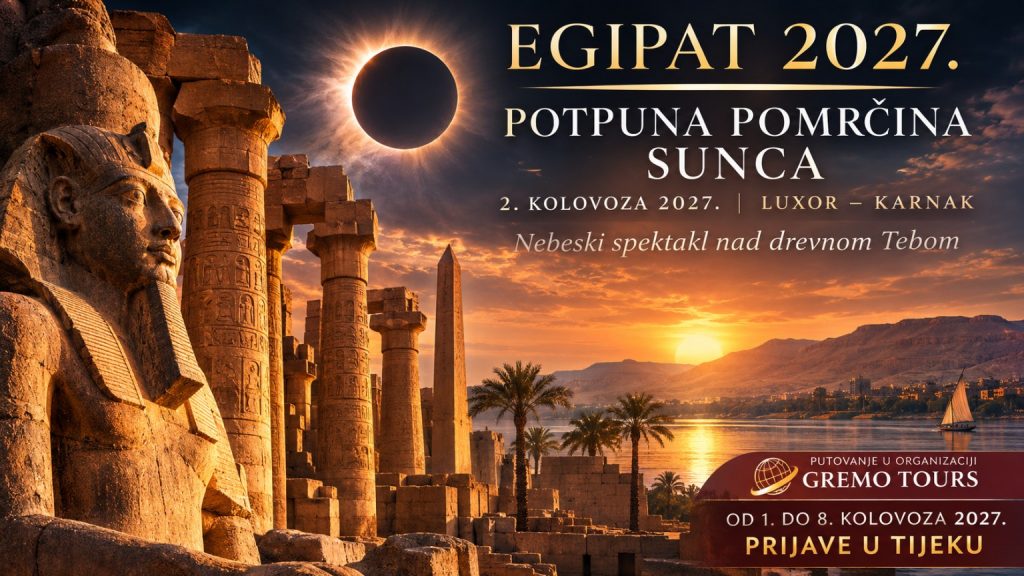
On 2 August 2027, we will have the opportunity to witness a total solar eclipse near a place where the cult of Amun-Ra found one of its most magnificent expressions.
Karnak – A World of Stone Dedicated to the Gods and the Sun
On the east bank of the Nile, in modern Luxor, stands Karnak, one of the largest and most important sacred complexes humanity has ever built.
Karnak was more than a temple in today’s sense. It was a vast religious centre, a place of royal legitimacy, ceremonies, processions, priestly power and economic activity.
Its construction and expansion continued for centuries. Numerous pharaohs left their mark, erecting pylons, obelisks, sanctuaries and monumental halls.
The central precinct was dedicated to Amun-Ra, while important sanctuaries also belonged to his divine consort Mut and their son Khonsu, a deity associated with the Moon.
Together they formed the Theban Triad.
This connection between Sun and Moon is particularly intriguing. The two celestial bodies that will appear to overlap in our sky on 2 August 2027 were each deeply woven into ancient Thebes’s religious life.
Their mythological association does not mean the Egyptians understood eclipses as we do today. But the symbolic conjunction of the event and the place where we will observe it is remarkable.
The Great Hypostyle Hall – A Forest of Stone Columns
One of Karnak’s most impressive features is its Great Hypostyle Hall, built largely during the reigns of Seti I and Ramesses II in the thirteenth century BC.
The hall covers approximately 5,000 square metres and contains 134 monumental columns arranged in sixteen rows.
The central columns rise to approximately twenty-one metres.
Their capitals resemble open papyrus flowers, while the lower columns evoke closed buds. The architecture suggests the primordial marshland from which, in Egyptian creation traditions, the ordered world emerged.
This was more than an impressively sized building. Its architecture spoke the language of creation.
Light had particular significance in such spaces. Entering through openings and between monumental structures, it created contrasts between light and dark, visible and hidden, earthly and divine.
Obelisks – Stone Monuments Associated with the Sun
Karnak also contains some of Egypt’s most famous obelisks.
An obelisk was far more than an architectural ornament. Its shape and symbolism were associated with solar worship, and its tip could be clad in a shining material reflecting sunlight.
Queen Hatshepsut’s obelisk, approximately 29.5 metres tall, is particularly well known and still rises within the complex.
Imagine a civilisation erecting such stone monoliths almost three and a half thousand years ago, orienting temples towards celestial phenomena and developing complex religious ideas about humanity, nature and the universe.
Then imagine sunlight disappearing in the middle of the day above that same landscape in 2027.
Karnak and the Astronomical Alignment of Temples
The ancient Egyptians observed the sky carefully.
Their astronomy was connected with calendars, agricultural cycles, religious festivals, timekeeping and the organisation of society.
The heliacal rising of Sirius — its first appearance in the morning sky after a period of invisibility — was especially important. It was associated with the Nile’s annual flooding cycle.
Egyptian temples also often displayed carefully considered orientations.
The main axis of Amun’s temple at Karnak approximately aligns with sunrise around the winter solstice. Research into its orientation points to an important relationship between architecture and the solar cycle, although interpreting the builders’ original intentions and changes over the centuries requires caution.
Sunlight was no incidental visitor to an Egyptian temple.
It was integral to its symbolic world.
One point must be clear: Karnak was not specifically designed for the eclipse of 2 August 2027. There is no scientific basis for claiming its builders predicted this particular eclipse or aligned their buildings with it.
The event’s distinction lies in an extraordinary meeting of astronomy, geography and history, rather than a hidden ancient prediction.
Luxor – Where Day Will Become Night
Modern Luxor occupies the site of ancient Thebes, one of the most important cities in Egyptian history.
During the New Kingdom, Thebes was a leading political and religious centre. Great temples and spaces associated with life and divine worship stood east of the Nile; a vast necropolis of royal and noble tombs developed on the west bank.
Many pharaohs, including Tutankhamun, were buried in the Valley of the Kings. Queen Hatshepsut’s monumental mortuary temple stands nearby, and the entire landscape bears witness to Egyptian civilisation’s extraordinary power.
Above this historic landscape, one of the twenty-first century’s longest total solar eclipses will take place on 2 August 2027.
The path of totality will cross parts of Europe, North Africa and the Middle East. The Moon’s shadow will pass over southern Spain, North Africa and the Arabian Peninsula, with particularly favourable conditions expected in southern Egypt.
Around Luxor, totality will last approximately six minutes and twenty seconds, depending on the observer’s exact location.
That is exceptionally long.
For comparison, many total solar eclipses last only two or three minutes at a particular location. The longest possible total solar eclipse on Earth lasts a little over seven and a half minutes.
That is why the 2027 eclipse matters so much to astronomers, photographers, researchers and sky enthusiasts.
What Will We Actually See?
At first, the event will be almost imperceptible.
The Moon will begin crossing the solar disc, producing a partial eclipse as the Sun gradually becomes an ever-thinner crescent.
Interestingly, the surroundings will not immediately become dramatically darker. Human eyes adapt remarkably well to changing light; even with much of the solar disc covered, the day may still seem relatively bright.
As totality approaches, however, the changes will become increasingly apparent.
The light will take on an unfamiliar quality. Shadows will sharpen, and the air temperature may fall noticeably.
Just before totality, shadow bands may appear: rapidly moving patterns of light and dark on pale surfaces, caused by the last rays of sunlight passing through Earth’s turbulent atmosphere.
Then comes one of nature’s most extraordinary moments.
The last narrow strip of the Sun’s photosphere will disappear behind the Moon.
For an instant, the diamond-ring effect may appear: a brilliant point of sunlight beside the dark lunar disc.
Then totality begins.
The Sun will appear as a completely black circle surrounded by a bright, delicate, irregular halo.
That halo is no optical illusion.
It is the solar corona, the outer atmosphere normally hidden by the glare of the Sun’s surface.
The corona extends millions of kilometres into space. Its temperature can reach millions of degrees, presenting an intriguing question in solar physics: why is the outer atmosphere so much hotter than the Sun’s visible surface?
During totality, reddish prominences may also be visible: enormous arcs and structures of plasma associated with the Sun’s magnetic field.
Bright planets and stars may appear, while the horizon in every direction retains an unusual glow resembling sunrise or sunset.
All of this will happen in the middle of the day.
After a few minutes, the Sun will emerge from behind the Moon.
The diamond ring will shine once more, the corona will disappear in the glare, and daylight will gradually return.
To an observer, it may feel like the Sun’s rebirth.
Seen through the ancient Egyptians’ religious ideas, such an image could have held profound symbolic meaning.
For us, it is an opportunity to see celestial mechanics in action with our own eyes.
Why Will Totality Last So Long in Egypt?
The length of totality is no coincidence.
It depends on several interrelated factors: the Moon’s distance from Earth, Earth’s distance from the Sun, the observer’s position within the lunar shadow and the speed at which that shadow crosses Earth’s surface.
The Moon’s orbit is not a perfect circle. When it is closer to Earth, its apparent diameter in the sky is slightly larger.
Earth’s orbit around the Sun is also elliptical. In early August, Earth is relatively close to aphelion, its most distant orbital point from the Sun. The Sun therefore appears slightly smaller than it does in early January.
During the 2027 eclipse, this combination favours prolonged totality: the Moon can cover the solar disc with enough room to spare for the total phase to last unusually long.
The observer’s position relative to the eclipse’s centreline also matters.
The closer we are to the centreline of the lunar shadow, the longer totality generally lasts. At the edges of the path, its duration falls towards zero.
Southern Egypt, near Luxor, lies in an exceptionally favourable part of the eclipse’s path.
Furthermore, early August in Upper Egypt is characteristically very dry and hot, with relatively little average cloud cover.
That does not guarantee clear skies, but statistically improves the chances of a successful observation.
Together, these factors make Luxor one of the world’s most attractive locations for observing the 2027 eclipse.
Six Minutes Connecting Three Thousand Years of History
There is something almost unbelievable about watching a total solar eclipse in a landscape where, more than three thousand years ago, pharaohs built monumental sanctuaries to deities associated with the Sun.
At Karnak, priests performed rituals through which they believed they helped sustain cosmic order.
Pharaohs erected obelisks and temples to affirm their relationship with the divine.
Builders observed the Sun, its annual cycles and its positions on the horizon.
Today, we know something they could not know in the same way.
We know that the Sun does not vanish during an eclipse.
We know that the Moon, approximately four hundred times smaller than the Sun, can appear almost the same size because it is approximately four hundred times closer to Earth.
We know a total eclipse occurs when the Sun, Moon and Earth align precisely enough for the Moon’s umbra, its complete shadow, to fall on Earth’s surface.
We know the event can be calculated with extraordinary precision.
We also know the shadow moves swiftly across continents, seas, deserts and cities, leaving only a few minutes of darkness behind.
Yet none of this knowledge diminishes a total solar eclipse’s magnificence.
Perhaps the opposite is true.
The better we understand celestial mechanics, the more astonishing it becomes to witness their effects.
An eclipse reminds us that we live on a planet constantly orbiting a star, accompanied by a natural satellite whose position occasionally creates one of nature’s most unusual sights.
All of this happens independently of human history.
The Sun rose over Thebes before Karnak’s first great temples were built. It rose over pharaohs, priests, builders and armies, illuminating the Nile, desert, royal tombs and monumental obelisks.
It still rises today.
On 2 August 2027, it will disappear behind the Moon for a few minutes above the very landscape where its light once embodied one of a civilisation’s central religious principles.
Where Science, History and Human Experience Meet
The total solar eclipse of 2027 matters for more than its duration.
It is also exceptional because of where it can be observed.
Luxor is one of the few cities where the monumental remains of one of humanity’s oldest civilisations, the landscape that shaped it and an extraordinary astronomical event meet within a relatively small area.
On the east bank stand Karnak and Luxor Temple, monuments to ancient Thebes’s religious life.
On the west bank lie the Valley of the Kings, Hatshepsut’s temple and many other expressions of Egyptian ideas about death, eternity and rebirth.
East and west held profound symbolic meaning. East was associated with sunrise and life’s renewal; west with sunset, death and the afterlife.
Between them flowed the Nile, Egypt’s great axis of life.
In this landscape, a total eclipse becomes more than an astronomical event.
It allows us briefly to connect two different pictures of the world.
One is ancient, understanding nature through myths, gods and sacred rituals.
The other is modern, able to calculate celestial movements with extraordinary precision.
We need not equate them to appreciate their value.
The Egyptians sought meaning in nature’s regularity and exceptional phenomena. Modern science explains the physical processes behind those phenomena.
Human beings, whatever their century, can still stand in wonder beneath the same sky.
When the Sun Is Reborn
One moment during a total eclipse is almost as impressive as its beginning.
It comes when the first brilliant ray of sunlight reappears from behind the dark lunar disc.
In a fraction of a second, the delicate corona is overwhelmed by the photosphere’s powerful light. The landscape begins returning to its familiar daytime appearance, shadows become recognisable again, and the sky gradually regains its usual colour.
For science, this is a straightforward consequence of the Moon continuing along its orbit.
For someone who has just spent several minutes in the Moon’s shadow, it can carry a much stronger meaning.
The Sun that disappeared appears again.
Light returns.
This image was one of the fundamental experiences underlying the ancient Egyptians’ religious worldview.
The daily sunrise renewed life and affirmed cosmic order.
Today we know the Sun never stopped shining during the eclipse. We know the darkness came from the Moon’s passing shadow, rather than a battle between gods.
But knowledge does not diminish the moment’s beauty.
It gives it another dimension.
For a few minutes in Luxor, we will witness an event belonging simultaneously to astronomy, history and human experience.
Perhaps, standing in the Moon’s shadow above ancient Thebes, we will briefly understand why the Sun meant so much more to a great civilisation than a source of daylight.
Egypt 2027 – A Journey to One of Our Age’s Greatest Celestial Spectacles
The total solar eclipse of 2 August 2027 will be one of this decade’s most significant astronomical events.
Its exceptionally long duration, southern Egypt’s favourable climate and the proximity of some of humanity’s greatest monuments make Luxor particularly attractive for viewing it.
That is why I have decided to organise and personally lead a journey to Egypt for this eclipse.
I want the journey to offer more than a place from which to observe the Sun.
I want us to discover the civilisation that developed one of the ancient world’s most complex religious and cultural systems beside the Nile: its temples, pharaohs, myths and relationship with the sky. To visit places where history unfolded, then witness an astronomical event that will add an extraordinary dimension to the experience.
The trip takes place from 1 to 8 August 2027, organised by the travel agency Gremo Tours.
The programme includes a stay in Egypt and an organised excursion to observe the total solar eclipse in the Luxor area, alongside an introduction to Egypt’s extraordinary historical heritage.
The price is €1,490, and bookings are open.
For programme details and reservations, contact Gremo Tours through its official website, www.gremotours.hr.
Until then, remember the date.
2 August 2027.
That day, above ancient Thebes, the Moon will hide the Sun for a few minutes.
More than three thousand years ago, people built temples in that same place to celebrate its divine power.
We will stand there with different knowledge, but perhaps a very similar sense of wonder.
Some phenomena remain wondrous even when we fully understand them.
Slaven Vujić
A Wonderful World – Stories of the World, History and Travel