Among the people who shaped European civilisation, few names compare with Constantine the Great. He was the Roman emperor who changed the direction of the greatest power of his age, opened the door to Christianity and founded a new imperial capital on the Bosporus. Yet behind his story stands a woman whose life is equally fascinating, and whose name is mentioned far less often today.
That woman was St Helena.
History remembers her as Constantine’s mother and the saint who, according to tradition, found Christ’s Cross in Jerusalem. That description covers only a fraction of her life. Helena was more than an observer of her age’s great events. She participated in history, a woman whose influence and deeds left their mark from Britain to the Holy Land, from imperial palaces to some of Christianity’s most important shrines.
From Humble Girl to an Emperor’s Mother
Unlike many figures in Roman history, Helena was not born into the aristocracy. Most sources place her origins in Asia Minor, while some ancient authors describe her as a woman of humble birth. In the Roman Empire, where social standing often determined a person’s fate, few could have imagined that she would become one of the most influential women of her time.
Her life changed when she met Constantius Chlorus, a gifted commander who would become one of the empire’s rulers. Their relationship produced Constantine, a boy destined for an extraordinary role in history.
Politics soon separated Helena and Constantius. To advance through the imperial hierarchy, he made a more advantageous marriage, leaving Helena aside. Her bond with her son nevertheless remained strong throughout her life. When Constantine became emperor, he showed his mother a respect unusual among Roman rulers.
A Vision That Changed the World
Civil wars swept through the empire in the early fourth century. Several contenders fought for control of a vast territory stretching from Britain to the Middle East. Constantine proved an exceptionally capable commander, but the event that would make him immortal came in 312, before the Battle of the Milvian Bridge near Rome.
According to Christian tradition, Constantine saw the sign of a cross in the sky with the words “In this sign you will conquer” (In hoc signo vinces). Whether historical fact, symbolic narrative or a combination of both, its consequences were real.
After his victory, Constantine became master of the western empire. In 313, together with Emperor Licinius, he issued the Edict of Milan, granting Christianity freedom after almost three centuries of persecution.
For Christians throughout the empire, this was a historic turning point. A faith that had gathered in catacombs and private homes could now build churches freely, worship publicly and participate in the life of the state.
The Council of Nicaea and a New Age
Constantine did more than protect Christians. In 325 he convened the First Council of Nicaea, one of the most important events in Church history.
Bishops from across the empire gathered to discuss issues threatening to divide Christians. Their work produced the Nicene Creed, a foundational statement of Christian faith still recited, in a somewhat modified form, in churches around the world.
Constantine thus became more than a political ruler: he played a central role in shaping Christian Europe.
The Founding of Constantinople
Perhaps his greatest undertaking was founding a new imperial capital.
On the site of the old Greek city of Byzantium, he built a city bearing his name: Constantinople. Inaugurated in 330, it quickly became the political, economic and cultural centre of the eastern Roman Empire.
For the next thousand years, Constantinople would be one of the world’s richest and most influential cities, capital of the Byzantine Empire and a bridge between Europe and Asia.
Today we know it as Istanbul.
Helena Augusta
While Constantine built a new future for the empire, his mother’s role grew increasingly important.
He granted her the title Augusta, the highest dignity a woman could hold in the Roman Empire. Her name appeared on coins, official documents and inscriptions throughout the state.
But Helena did not seek glory on battlefields or through political intrigue. Her legacy would emerge from a very different journey.
In her eighties, she set out on pilgrimage to the Holy Land.
It would be a demanding journey even today. In the fourth century, it was a remarkable undertaking. Travelling thousands of kilometres, Helena visited Jerusalem, Bethlehem and other places associated with Jesus Christ.
The Search for Christ’s Cross
That pilgrimage gave rise to the best-known story of her life.
According to Christian tradition, Helena ordered excavations at the site of Christ’s Crucifixion in Jerusalem. Three crosses were discovered. To determine which belonged to Christ, they were brought to a sick woman, who was reportedly miraculously healed by touching one of them.
Whatever historians debate about the details, Helena’s association with the Cross helped make its veneration an important part of Christian tradition.
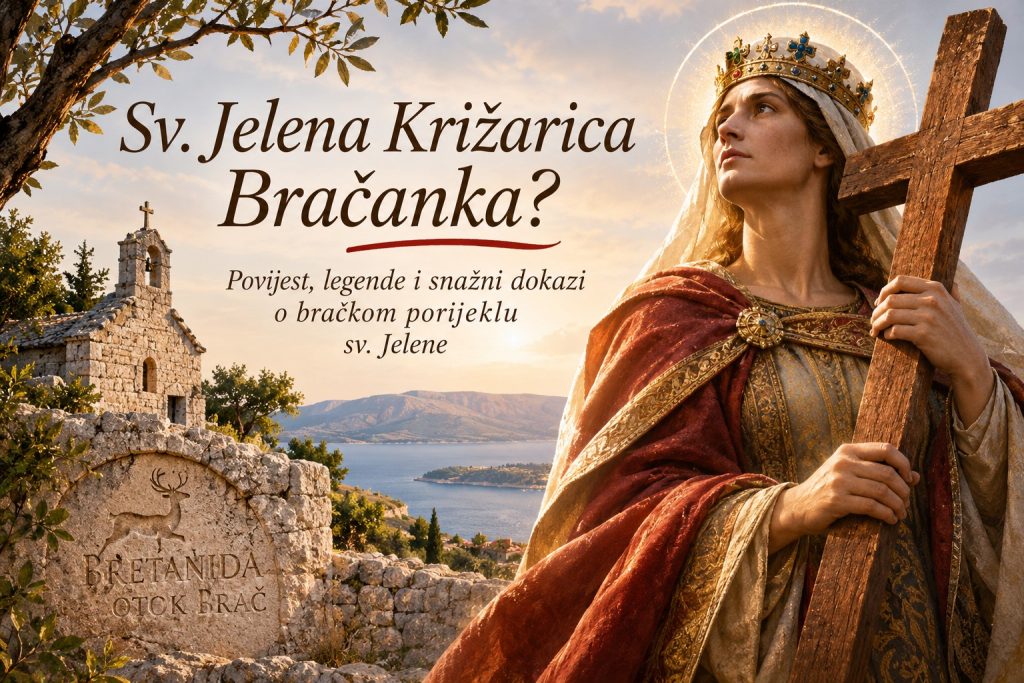
For this she is remembered in Croatian as Sveta Jelena Križarica — St Helena, finder of the True Cross.
Churches That Changed the Christian World
Helena’s pilgrimage left more than stories behind.
Some of Christianity’s most important churches are associated with her name and Constantine’s support.
In Jerusalem, the Church of the Holy Sepulchre was built on the site Christians identify with Christ’s Crucifixion, burial and Resurrection. Almost seventeen centuries later, it remains one of Christianity’s holiest places.
In Bethlehem, the Church of the Nativity was built above the cave traditionally identified as Jesus’s birthplace. It is considered one of the oldest churches still in use.
The Eleona church rose on the Mount of Olives, associated with the place where Christ taught his disciples, while numerous other projects marked holy sites across Palestine.
Helena thus became, in a sense, Christianity’s first great pilgrim, a woman whose undertakings helped shape the map of holy places we still know.
Traces in Dalmatia
For those of us on the eastern Adriatic coast, Helena has an additional significance.
She lived when Salona was one of the most important Roman cities in this region. Christianity spread strongly through Dalmatia during Constantine’s reign, and traces of that period remain in Salona’s basilicas, inscriptions and early Christian cemeteries.
It is hardly surprising that traditions connecting Helena with our region developed over the centuries. How much is history and how much legend remains a question that attracts researchers.
Mother and Son
Looking at Helena and Constantine today, it is easy to imagine historical monuments: names in textbooks, faces on icons, figures from a distant age.
Behind those names, though, were real people.
A mother who raised a son in the uncertain world of the late Roman Empire.
A son who became emperor and changed history.
Together they left a mark that has endured for seventeen centuries. Constantine transformed the empire; Helena helped shape Christianity’s spiritual landscape.
Perhaps that explains their story’s continuing appeal. It concerns more than an emperor and a saint.
It is the story of a mother and son whose legacy can still be traced from the ruins of Salona to the basilicas of Jerusalem, from the Adriatic coast to the walls of Constantinople.