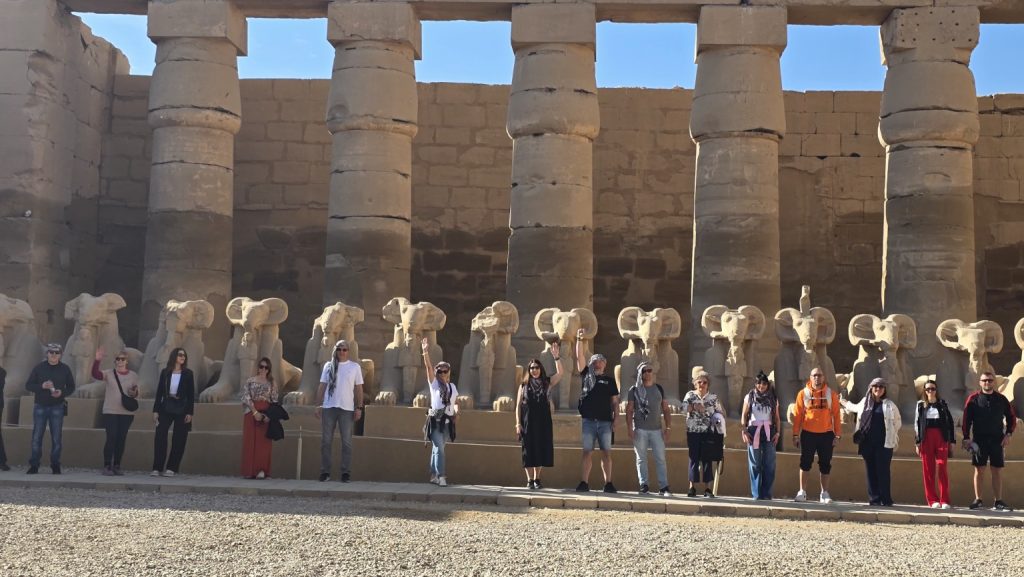
Egypt is an unusual country for a traveller. One day you stand before a building that held the world height record for more than three millennia. The next, you walk among columns like stone trees. Then you climb onto a quad bike, head into the desert and spend part of the day playing with children. Just when you think you have begun to grasp the country’s character, you board a boat for the Red Sea’s coral reefs.
That was the rhythm of our January journey.
We stayed in Hurghada, taking day trips to Cairo and Luxor, into the desert and out to Giftun Island. Each revealed another Egypt: pharaonic, riverine, desert and maritime. Somehow we had to bring them together into one picture, leaving room for the people we met and our own sense of wonder.
Hurghada: Between the Red Sea and the Desert
Hurghada was our starting point and the place we returned to. That matters, because travelling through Egypt can easily become an attempt to swallow several thousand years in a few days.
From our coastal hotel, we visited places whose names were already familiar: Giza, Karnak, the Valley of the Kings. Familiar names can mislead us, though. We say “ancient Egypt” as if discussing one period, almost one generation.
Khufu, Hatshepsut and Ramesses II lived in very different times.
Approximately thirteen hundred years separated the Great Pyramid’s construction from Ramesses II’s reign. They often appear on the same page of our itinerary, yet history separates them by enough time for entire states to rise and fall.
From Hurghada, we travelled in two directions at once: along roads through modern Egypt and backwards through the centuries.
Cairo and Giza: What Four and a Half Thousand Years Look Like
Before the pyramids, you must first overcome a problem: you have already seen them.
In photographs, documentaries, schoolbooks, packaging and advertisements. Their shape is so familiar that arriving at Giza feels like encountering something almost remembered, although you have never been there.
Then you see the size of the stone blocks and have to learn everything again.
The Great Pyramid was built for Khufu, also known as Cheops, a Fourth Dynasty pharaoh who ruled approximately 2589–2566 BC. Originally 146.5 metres high, it remained the world’s tallest structure for about 3,800 years. Read that twice. For almost four millennia, people built cities, temples and capitals, and Khufu’s pyramid still towered above them.
Beside it stand the pyramids of Khafre and Menkaure, Khufu’s son and grandson. Giza is also a family history in stone, on a scale the eye struggles to encompass. Temples, causeways, smaller pyramids and tombs of royal relatives and senior officials surrounded the main pyramids. Each great pyramid belonged to a complex landscape dedicated to its ruler’s afterlife.
I am also drawn to what is not immediately visible. Stone had to be quarried, transported, worked and positioned. Workers needed food, labour needed organising and measurements needed calculating. The finished form stands before us; the immense human effort behind it must be imagined.
The Sphinx: A Face That Outlived Its World
Near the pyramids stands the Great Sphinx, a lion’s body with a human head, approximately seventy-three metres long and twenty metres high. Archaeological evidence associates it with Khafre’s reign in the twenty-sixth century BC.
The lion’s body and royal face speak a language of power understandable without hieroglyphs. Animal strength and human authority unite in a creature large enough to make its surroundings part of the message.
Then you notice how exposed that powerful image is to time. Stone is damaged, the face weathered, parts lost. Those changes make it more immediate: this object had to pass through millennia before reaching our eyes.
The Grand Egyptian Museum: Giving Pharaohs Their Faces Again
After Giza we visited the Grand Egyptian Museum. The same civilisation unfolds there at another scale: a statue, inscription, human face or carefully worked detail.
The great entrance hall contains a monumental statue of Ramesses II, 11.35 metres tall. It originally stood at Memphis, beside Ptah’s main temple. Behind his legs are carved two of his children, Prince Khaemwaset and Princess Bintanath. The colossal ruler includes a detail easily overlooked: his family, represented on a much smaller scale.
Ramesses II ruled approximately 1279–1213 BC, almost seven decades. Once you begin recognising his name on Egyptian monuments, it becomes clear that he understood the value of his signature.
The museum connects great names with tangible objects and the skill of making them. Alongside monumentality comes precision. Someone carefully shaped a tiny detail that you, thousands of years later, examine at close quarters.
For a moment, history becomes more than a chronology of rulers. It becomes a history of the human hand.
The Nile: A River That Fed Kings and Builders
We also sailed on the Nile, without which everything we visited is difficult to understand.
Ancient Egypt lived by the rhythm of its floods. Water spread, then receded, leaving fertile silt. People sowed, harvested and fed cities on that land. Too little flooding could mean hunger; too much threatened fields and settlements. Between those extremes lay hope for a good year.
Beliefs developed alongside that practical rhythm. The river returned, the earth produced again, life renewed itself. It is easy to understand the power of such a sight for people trying to explain the world and their own mortality.
A boat offers a view of Egypt from the water. Behind pyramids and temples emerge harvests, transport, fishing and daily work. A pharaoh could imagine eternity; his state still needed feeding every day.
A Day in Luxor: Among Builders, Gods and Tombs
Our day trip to Luxor, ancient Thebes, was an especially concentrated encounter with history. We visited the Valley of the Kings, the Valley of the Queens, Hatshepsut’s temple, Karnak and the Colossi of Memnon.
Within one day came royal burials, political ambitions, religious rituals and construction feats that still seem almost unbelievable.
The Valleys of the Kings and Queens: History beneath the Surface
After Giza, it is fascinating to reach a landscape where royal tombs hide within rock.
Many New Kingdom rulers were buried in the Valley of the Kings. The best known today is Tutankhamun’s tomb, KV62. His worldwide fame owes much to events thousands of years after his death.
Howard Carter and his team found the first step leading to the tomb on 4 November 1922. On 26 November, Carter first looked into its antechamber. Those November dates opened one of archaeology’s most famous chapters.
Tutankhamun’s tomb is modest beside those of more powerful pharaohs. Its riches therefore raise the question of what much larger royal burials once contained. Chance preserved enough to make a young, politically less significant ruler more famous than many illustrious predecessors.
The Valley of the Queens contains the tomb of Nefertari, Ramesses II’s principal wife, discovered in 1904 by Ernesto Schiaparelli’s Italian archaeological mission. Its paintings are a great testament to Egyptian art.
These places also deserve to be seen as the result of practical work. Someone excavated the space, prepared surfaces, arranged scenes, wrote signs and applied colour. Royal hopes for life after death employed highly skilled living people.
Hatshepsut: The Woman Who Became Pharaoh
Hatshepsut is one reason Egyptian history cannot be reduced to male royal names.
She exercised pharaonic power approximately 1473–1458 BC, alongside Thutmose III, her stepson and nephew. Her representations also used masculine royal attributes, fitting her person into an ancient, powerful language of kingship.
Her mortuary temple at Deir el-Bahari is recognisable by three terraced levels and colonnades against a great cliff. Its order and clarity are apparent even before you know anything about its patron.
Approach the reliefs, and their historical content unfolds.
The walls depict an expedition to the Land of Punt: its people, homes, environment and goods brought back to Egypt. Elsewhere, Hatshepsut explains her right to the throne and divine birth. The temple preserves both an account of distant travel and the ruler’s interpretation of herself.
This is what draws me to historical places. On one wall you can find art, belief, economics and a carefully composed political message.
Karnak: A Forest of 134 Stone Columns
At Karnak, history first asserts itself through size.
The Great Hypostyle Hall contains 134 columns. The twelve central columns rise to about twenty-one metres, their capitals imitating open papyrus flowers. Stone becomes an enormous plant. Walking through a space combining architecture with images of nature, the human body becomes a very small measuring instrument.
Much of the hall’s construction and decoration belongs to Seti I and his son Ramesses II. The entire complex, however, developed over many centuries. Rulers added buildings, restored, decorated and inscribed their names.
Sometimes they altered other people’s names too.
Research shows that Ramesses II replaced some of his father’s cartouches with his own name. Later rulers continued similar practices. In the stone, a familiar human ambition becomes visible: wanting the credit recorded under your name.
Then there are the obelisks.
Hatshepsut’s surviving standing obelisk rises almost thirty metres. Made of pink granite from Aswan, it weighs more than three hundred tonnes. Its inscriptions associate its erection with her sixteenth regnal year.
That figure requires imagination. Hundreds of tonnes had to be quarried, transported and raised. Connect the number with the object before you, and the obelisk becomes a story of ropes, workers, planning, danger and knowledge.
That is why Karnak interests me as a place whose grandeur consists of countless practical tasks.
The Colossi of Memnon: A Pharaoh Renamed by the Greeks
The Colossi of Memnon actually depict Amenhotep III, a fourteenth-century BC pharaoh. They stood beside the entrance to his great mortuary temple.
Their familiar name comes from later Greek visitors, who associated the northern statue with Memnon, a hero of their own mythology.
The reason was unusual: under certain conditions, the damaged statue made sounds at dawn. Visitors interpreted them as Memnon greeting his mother, the dawn goddess. The statue became an ancient attraction people travelled to hear and describe. After repairs under Emperor Septimius Severus, the sound ceased.
One pair of statues thus brings together an Egyptian pharaoh, a Greek myth, a Roman emperor and modern travellers. Egypt keeps acquiring new layers of stories.
The Desert and a Bedouin Family: Another Kind of Knowledge
After the pharaonic monuments, we went into the desert, rode quad bikes and camels, and spent part of a day visiting a Bedouin family.
The country around Hurghada belongs to the Eastern Desert, between the Nile and Red Sea. It differs from the endless sea of sand we often carry in our minds from films and advertisements. Egypt’s deserts contain rock, mountains and dry riverbeds, demanding knowledge of routes and available sources of life.
Various communities live here, including the Ma’aza Bedouin, whose traditional culture geographer Joseph Hobbs studied while spending almost two years with one clan. That alone suggests how long it takes to understand a way of life seriously.
Traditional nomadic life requires knowledge of the land, herd movements and survival in arid conditions. Settlement, transport, education and tourism are changing these communities’ lives. Around Hurghada and other tourist centres, some families now organise desert excursions and related services.
We should remember that when visiting. The people we meet inhabit their own present, with work, adaptations and family needs.
I played with the children there.
After all the great buildings, this is one of the simpler scenes I want to retain. “Visit to a Bedouin village” is easily written into an itinerary. A real encounter begins when that line acquires faces and we truly share some time.
We experienced the desert through driving, movement and excitement. With the family came an opportunity to pause, pay attention and briefly become guests.
Giftun and the Coral Reefs: Egypt Growing beneath the Surface
A day on Giftun, an island off Hurghada, brought an entirely different landscape. We travelled by boat around coral reefs. After desert excursions and historical sites, the sea changed both the colours and the rhythm of our journey.
Giftun belongs to the island and reef landscape that makes this part of the Red Sea so attractive.
Beside the reefs, it is worth remembering an easily forgotten fact: corals are animals. Colonies of tiny coral polyps build reefs. Many shallow-water corals live with microscopic algae, which provide some food through photosynthesis while the coral provides shelter. What looks like an underwater garden emerges from delicate relationships between organisms.
That knowledge lends a different significance to sailing around reefs. Beneath the surface lies a world that grows, feeds and responds to change. Its beauty requires care: anchors, touching, litter and thoughtless behaviour can damage an environment that recovers very slowly.
After royal builders and stone monuments, we encountered another kind of construction, carried out by tiny sea creatures.
Egypt expanded its image once again on that excursion.
What Remains after Returning Home
Looking back on our January journey, I can follow it through very different scenes: Khufu’s pyramid, royal tombs, Hatshepsut’s terraces, Karnak’s columns, the Nile, desert, playing with children and the boat to Giftun.
Each has its history and its own way of catching our attention.
As a tour leader, I especially value the moment a familiar name opens into a concrete story: Hatshepsut becomes a ruler who sent expeditions and raised obelisks; Ramesses’s cartouche reveals his ambition; an ancient statue receives a Greek name because it once made sounds at dawn.
History becomes easier to remember when connected with places we have walked through.
Alongside it remain the people with whom we shared those places.
That is why Egypt makes sense to me as this kind of journey: broad enough to encompass temples, river, desert and sea, yet personal enough to preserve, among all the great names, a day spent with people.