Seven Days in Morocco — Part Four: with Aziz among nomads, traces of ancient seas and the musicians of Khamlia
After arriving in Merzouga and seeing the dunes for the first time, Aziz took me to explore the surrounding area. We would visit a nomadic family, a fossil site, an old mine and Khamlia, a village known for its Gnawa musicians. The sand was close by, but we spent much of the day on stony ground, among homes, people and the remains of former workplaces. By evening I realised how much I would have missed had I thought of Merzouga simply as somewhere to climb into a jeep or onto a camel.
Tea with a Family Who Call the Desert Home
Aziz took me to the nomadic dwellings of an Amazigh, or Berber, family who welcomed us with tea. Their home was very modest: wooden supports, coverings, fabric and hides, arranged and tied together to provide shelter. Material described to me as camel hide was combined with different pieces of cloth. In the photographs you can see seams, knots and patches, each piece serving a practical purpose.
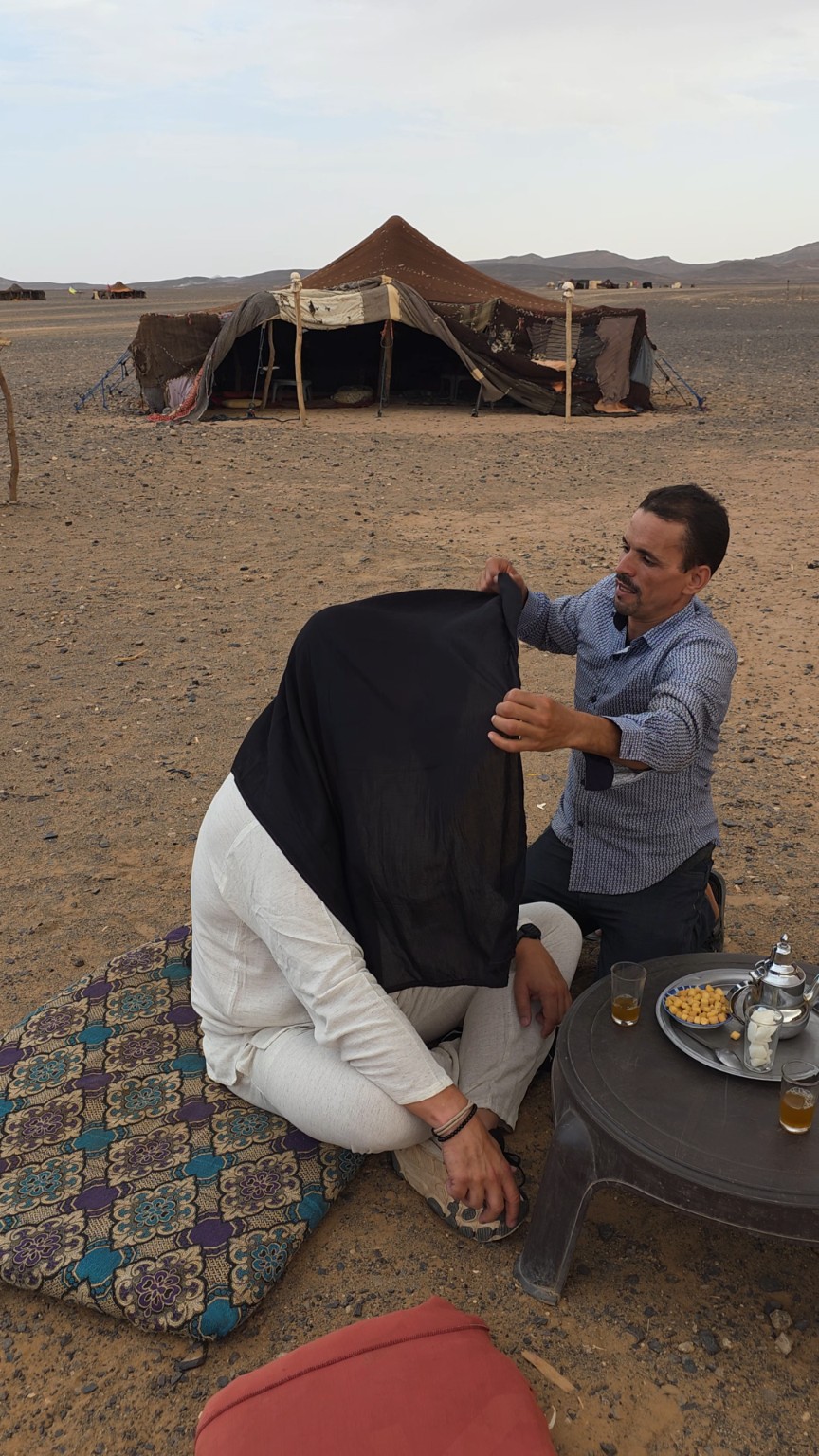
They made me tea, then tied a scarf around my head. I am sitting on a mat beside a low table, with glasses, a teapot and sugar in front of me, while my host arranges the fabric. Behind us is the family’s dwelling, beyond it the open landscape. The photograph catches the scarf before it is fully tied, but clearly shows the care taken over it.
That gesture has stayed with me. I had come to see how people lived, and their first response was to seat me and offer refreshments. Tea gave the encounter time to unfold, beyond stepping out of a vehicle, taking a few photographs and moving on. I was keenly aware of the difference between my visit and their life here: I would leave for my accommodation; they would still be here when evening came.
A Kitchen under Its Own Roof
Beside the main dwelling was a small, separate kitchen. The photograph shows a low, domed oven, a pot on a metal hearth, some utensils and supplies stored under cover. Branches support the roof, while fabric encloses as much of the space as necessary. Everything sits close to the ground, within a small area.
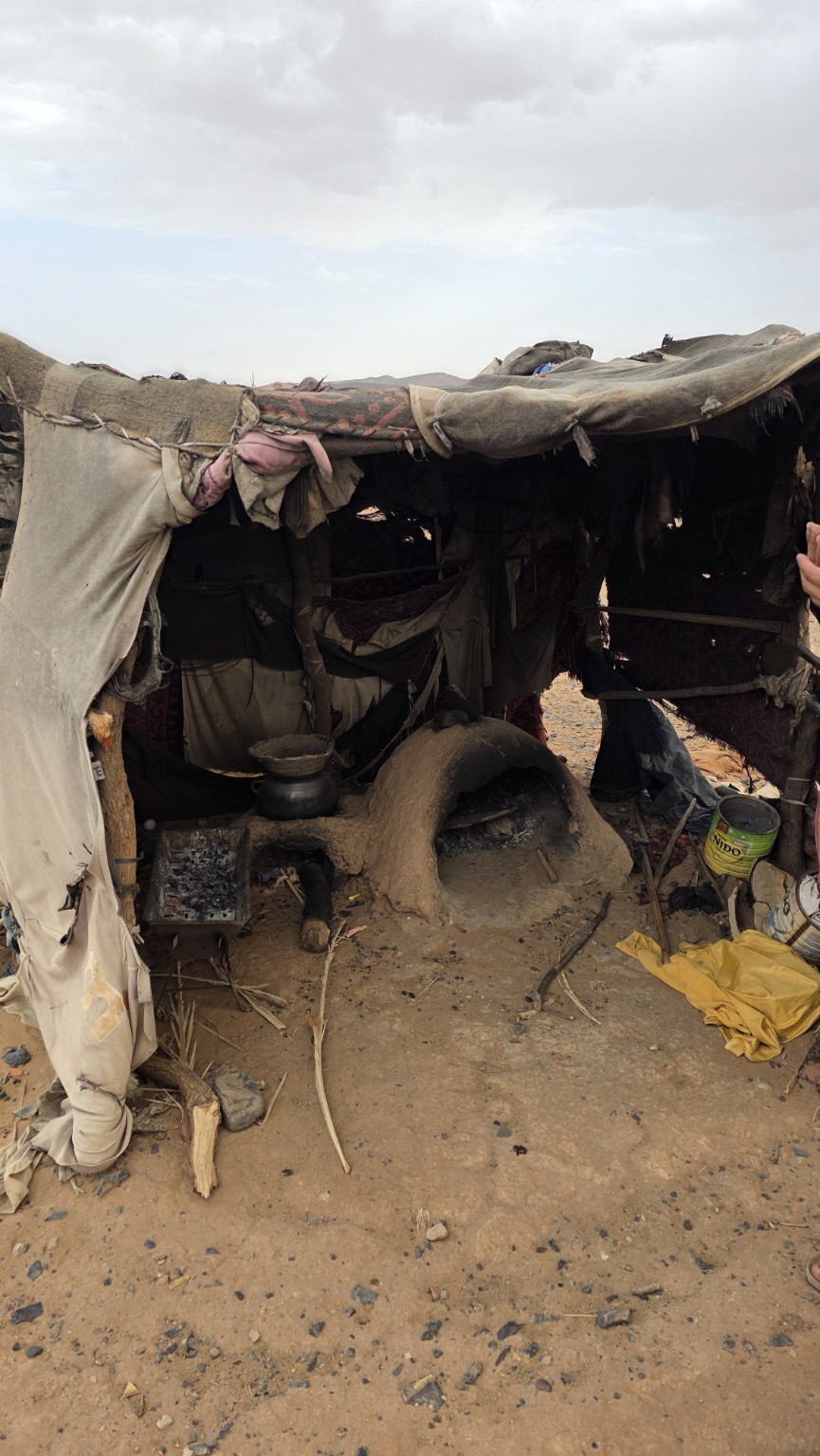
The family kept goats and chickens. Looking around, I tried to understand how they managed the tasks we carry out at home almost without thinking: preparing a meal, storing food, washing dishes and sheltering from the weather. Here, each required a solution using far fewer resources.
They lived very modestly. I was their guest only briefly, and one visit cannot tell me the whole story of their lives. I can describe what I saw: a simple shelter, a small kitchen, animals and a family who welcomed me. Those concrete scenes left a stronger impression than any sweeping account of nomadic life.
When My Phone Changed Hands
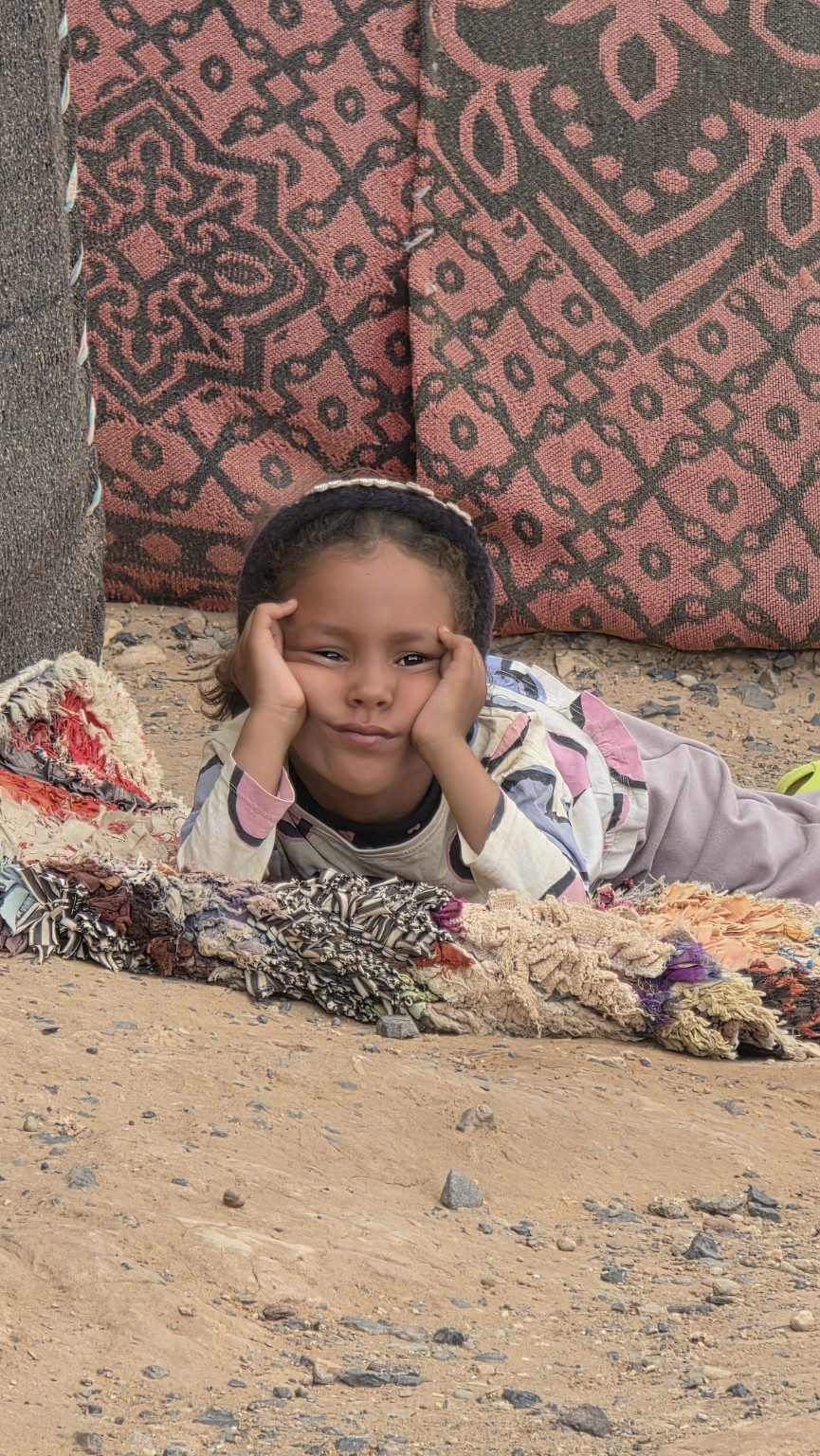
I spent time with the children too. At one point, one of the girls took my phone and photographed her sister. She was lying on a mat, propped on her arms, looking towards the lens. That portrait, seen through her sister’s eyes, remains a treasured memory of our time together.
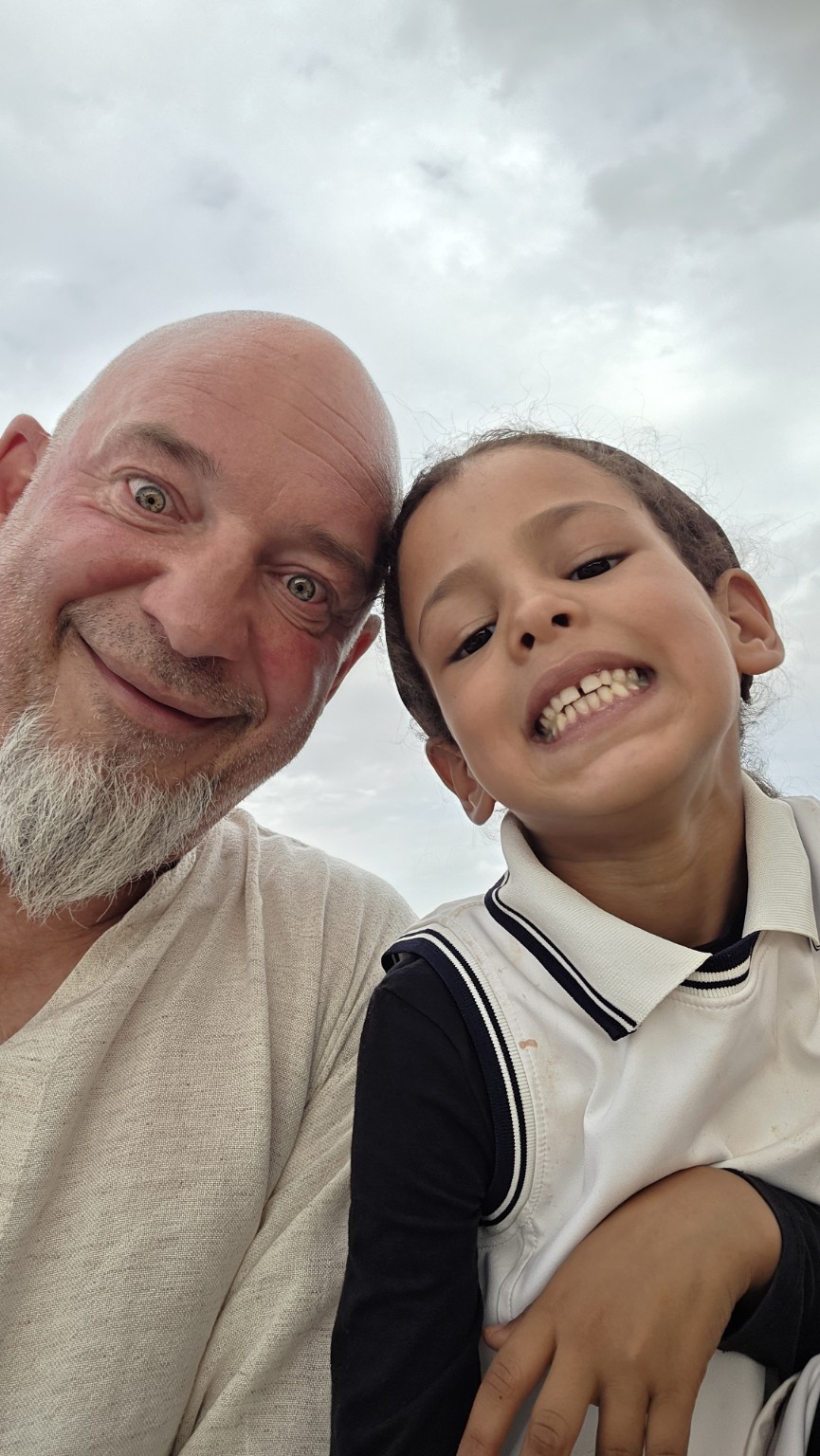
The smiling photograph of us together was also the girl’s idea. She wanted a picture with us all in it, so we gathered close to the lens and captured the moment. I am especially glad that the children wanted to help create the memories I took home.
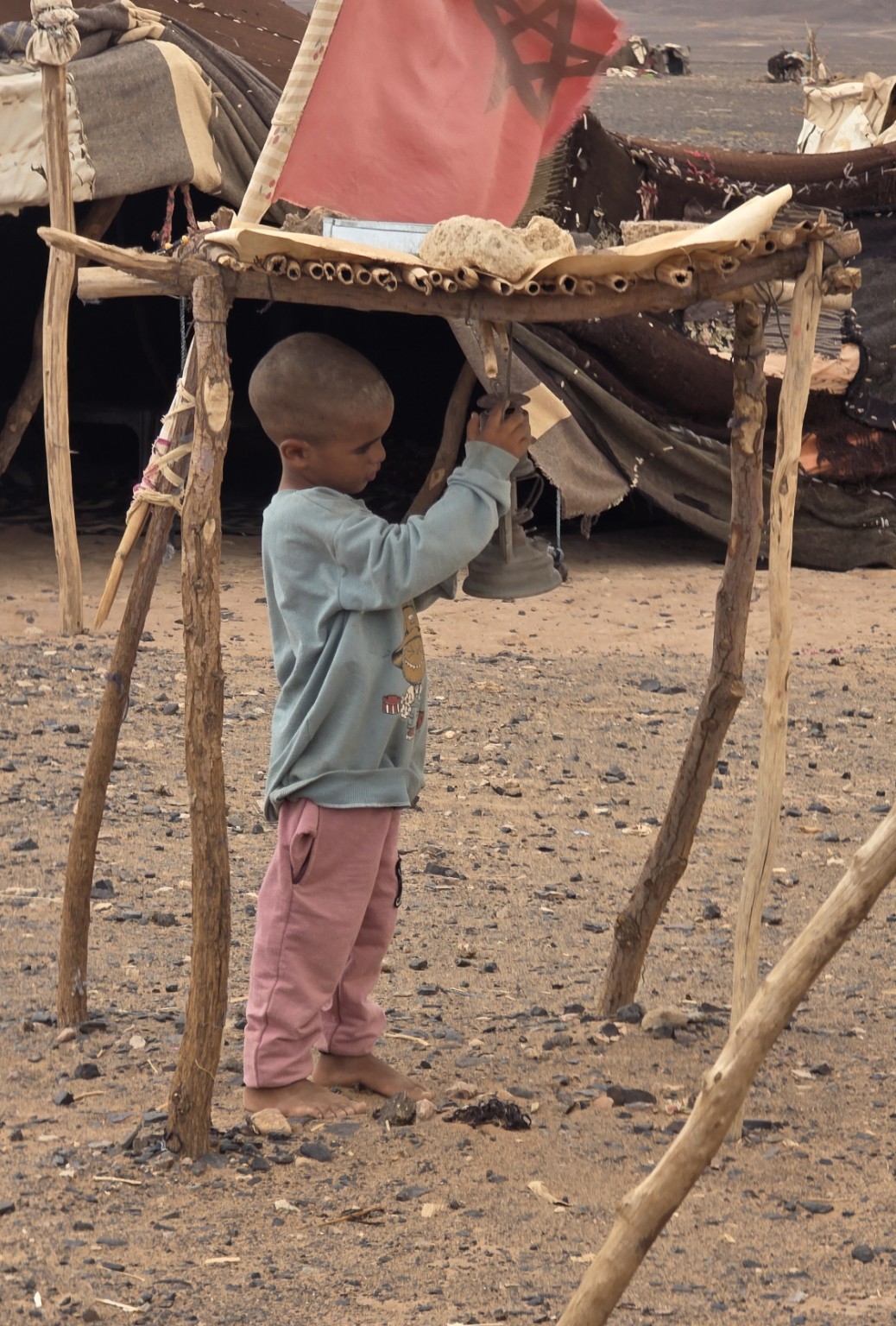
When I think back to that visit, I remember those little moments between tea and the onward journey. We spent time together, my phone changed hands, and the photographs now bring back the faces of people with whom I shared part of a day.
Stone That Remembers the Sea
Between visiting the family and going to Khamlia, we stopped at a fossil site. After the homes and animals, our attention suddenly shifted to the ground. In a landscape like this, your eyes first travel towards the horizon; the story of the fossils makes you bend down and look at the rock.
South-eastern Morocco is known for its rich fossil sites, including remains of ancient marine life. Trilobites, extinct marine arthropods with distinctive segmented bodies, are among the best-known examples. Some local sites contain fossils from the Devonian, approximately 419 to 359 million years ago.
Those numbers are hard to grasp. You stand on dry ground near the Saharan dunes and try to imagine a seabed. Today’s desert overlies a much older geological story, formed long before this place acquired its familiar landscape. That is why the stop mattered to me: once I had heard about the life preserved within it, I no longer looked at the stone in quite the same way.
An Old Mine and an Unusual Wall Painting
We also visited an old mine. The photograph I brought back shows more than an abandoned building and rock. An enormous insect is painted on a wall, with my companion in blue standing beneath it. Alongside the serious story of labour and stone, I came away with an almost surreal image.
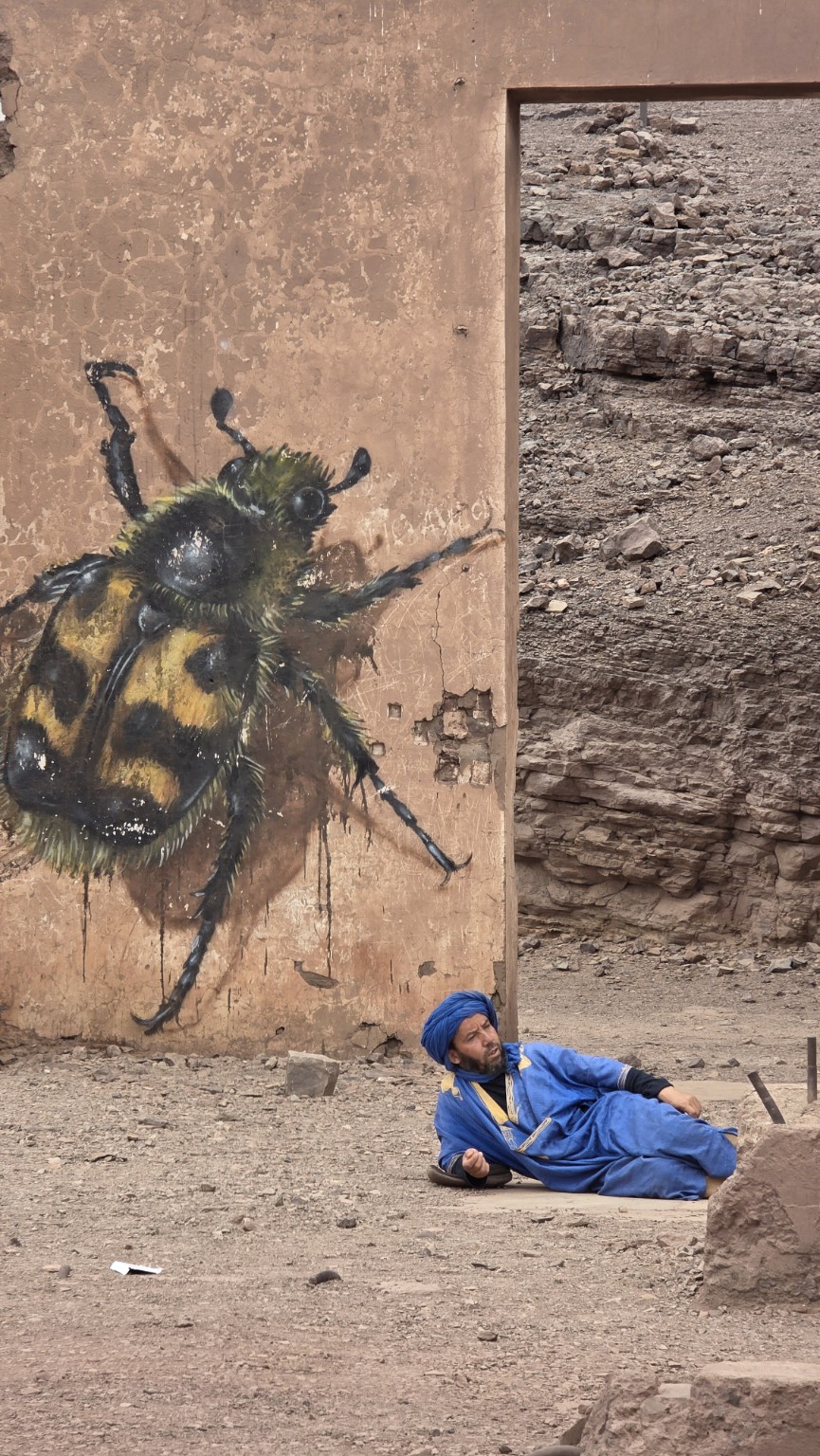
Near Merzouga is the mining area of M’Fis, also written Mefis or Mifis. Mineralogical sources record galena, an important lead ore, baryte and manganese minerals there, among other finds. This helps explain the wider region’s mining history, although I have yet to confirm the precise name of the mine we visited.
The partly surviving walls raise different questions from the fossils. Who came here to work? What was a working day like, and what remained when the site was no longer needed? The mine is a reminder that the land around the dunes provided raw materials and hard work long before we arrived with cameras.
Khamlia: A Welcome of Tea and Music
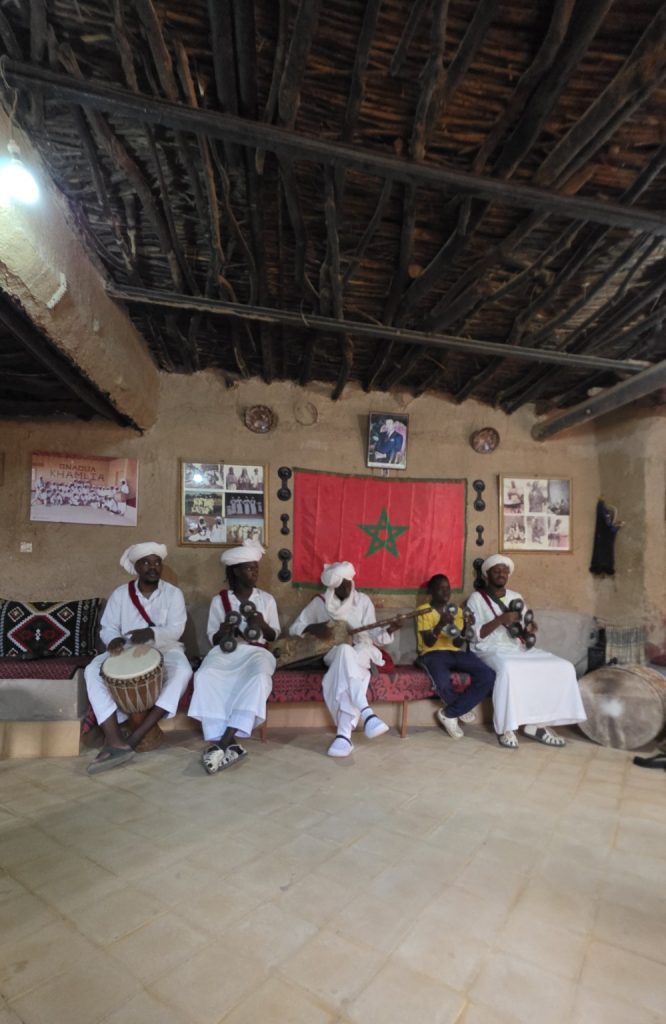
Khamlia introduced us to another side of southern Morocco. We entered a room with earthen walls and a roof of wooden beams and branches. Photographs, a Moroccan flag and the village’s name hung on the walls. Musicians sat along one side, mostly dressed in white with turbans. A stringed instrument and metal percussion were in the middle, with a drum to one side.
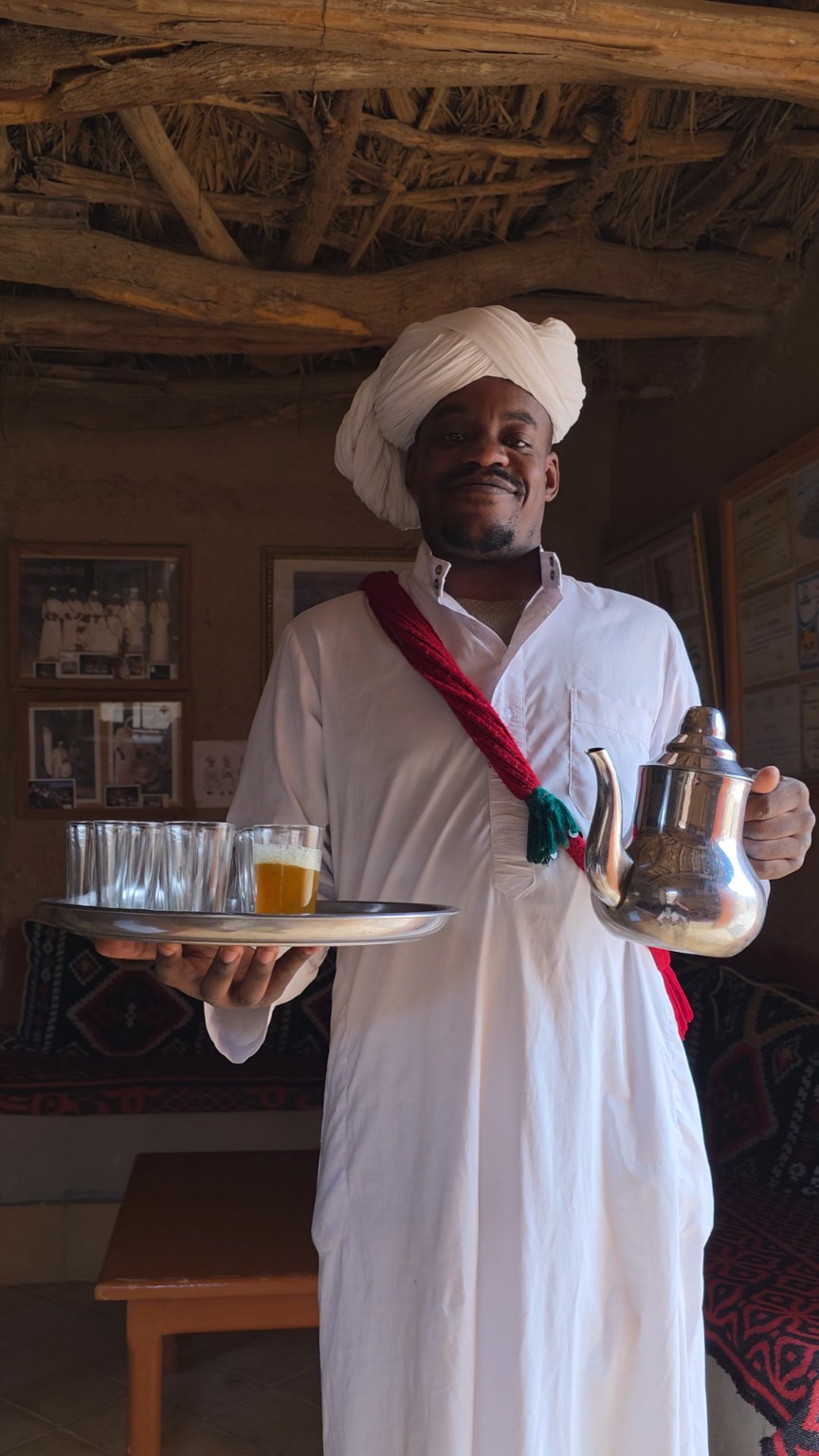
Khamlia, a few kilometres south of Merzouga, is known for its community of Gnawa musicians, also often spelt Gnaoua. The tradition’s origins lie in sub-Saharan Africa and centuries of movement across the Sahara. Historical accounts also use the name Bilad al-Sudan for a broad region south of the Sahara, rather than solely the modern country of Sudan. Forced displacement and the slave trade form part of that history.
That history lends weight to the music we heard. Gnawa encompasses musical, social and spiritual practices that bring together sub-Saharan traditions and Moroccan culture. In 2019, UNESCO inscribed Gnawa on its Representative List of the Intangible Cultural Heritage of Humanity, recognising its connections with the history of slavery and the slave trade.
The Rhythm That Holds the Group Together
At the heart of the sound is the guembri, also known as the hajhuj, a three-stringed instrument with a deep tone. It is accompanied by qraqeb, metal percussion instruments resembling large castanets, and drums. A master musician, the maâlem, leads, while the others respond with their voices and rhythm.
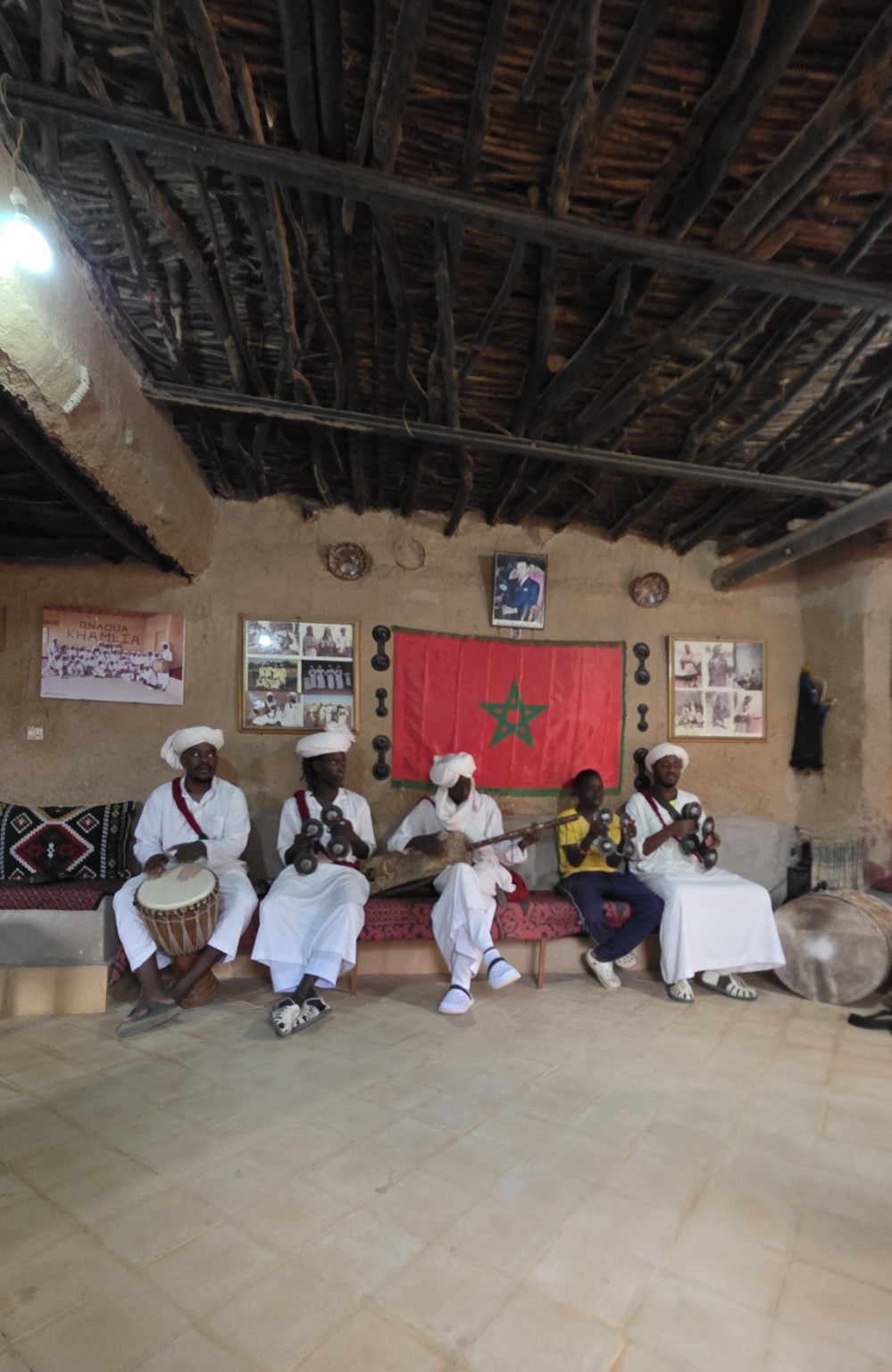
In my photograph, a younger player sits among the older musicians. He holds the same metal percussion instruments and joins the performance. That detail matters to me: in one image, you can see knowledge being passed on through participation, watching and repetition.
An important element of Gnawa tradition is the lila, a night-time ceremony combining music, invocations and other ritual practices. The performance we attended should not be confused with a complete ceremony of that kind. Even a brief encounter, though, lets you hear the distinctive interplay of deep strings, metallic rhythm and voices, supported by a much longer tradition.
Listening after our visits to the nomadic family, the fossils and the mine, I thought again about the different lives we encounter within such short distances. Aziz had guided us through a landscape that might have looked empty from a vehicle, yet every stop revealed something new: a family home, traces of an ancient sea, mining work and music that preserves shared memories.
Before Heading into the Dunes
As the day drew to a close, we approached the edge of Erg Chebbi. In the photograph, the sand in the foreground gives way to a darker, stony plain crossed by vehicle tracks. The dunes were already in view; the camel caravan and our night in the desert would wait until the following day.
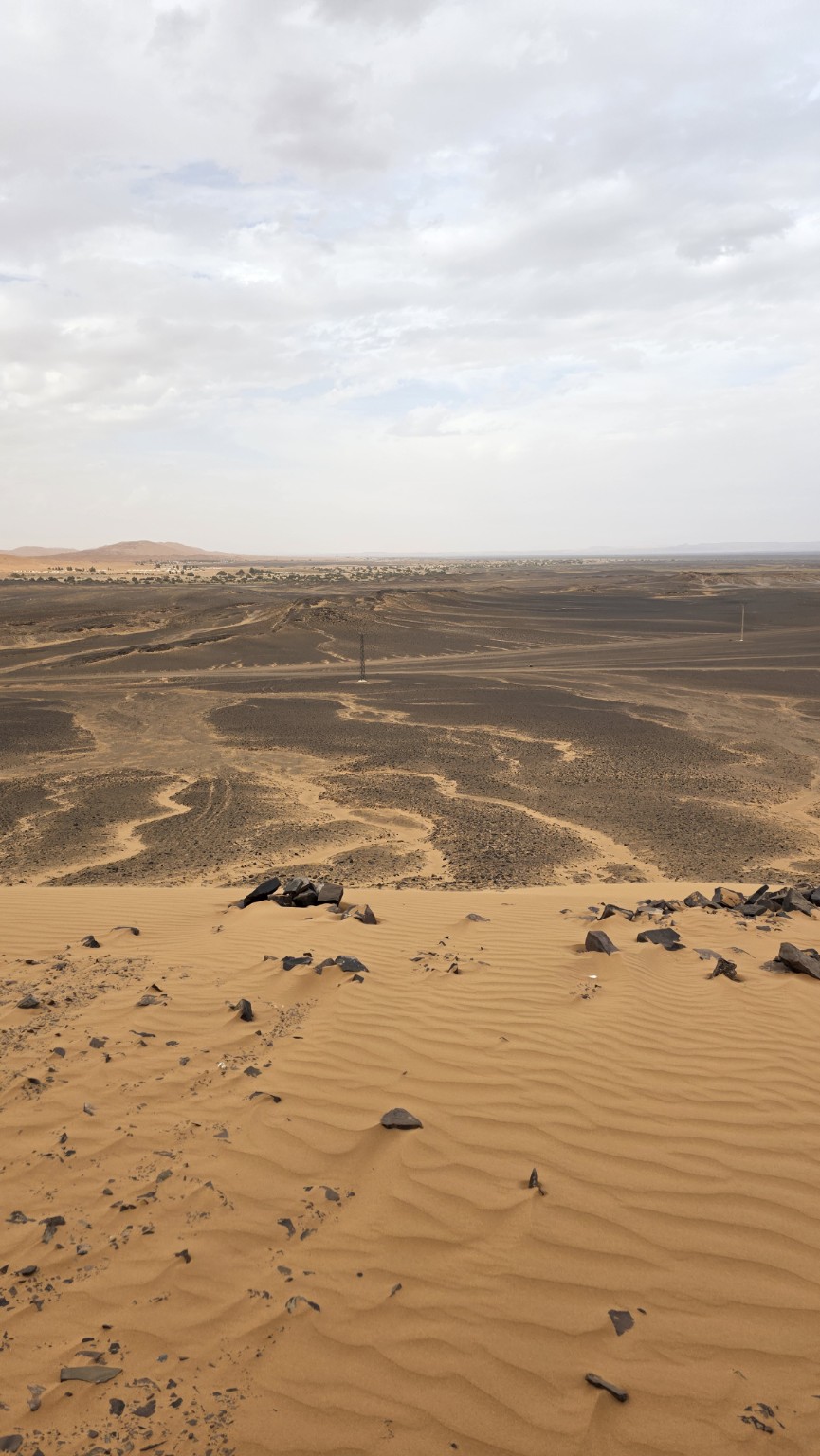
I was preparing for that next stage with a different feeling from the day before. The dunes were now linked to people I had met: the family who made me tea, the children in front of the camera, the musicians in Khamlia and Aziz, who had brought me to them. When I set off tomorrow, those encounters would travel with me.
Across the Dunes of Merzouga with Aziz
To finish the day, Aziz took us for a drive across the dunes of Merzouga. Part of that drive is captured in this video, a memory of the day’s end beside Erg Chebbi.
Previous instalment: From Canyons to Dunes: Following Hospitality towards the Sahara.
Next instalment: Barefoot into Silence — Sunset, Night and Morning in Erg Chebbi.