Some journeys bring us home with photographs. Others leave us with new knowledge and memories. Then there are journeys that change us inwardly, almost imperceptibly. Our last pilgrimage to Assisi and Rome belonged to that third kind.
Rome is a city I always return to with a particular feeling. However often I walk its streets, pause before its churches or contemplate the remains of a civilisation that shaped European history, it surprises me again. Perhaps because Rome is more than a city. It is a vast book of human history, written in stone, marble, faith, art, ambition, victories and defeats. Almost everywhere, human transience meets the longing for eternity.
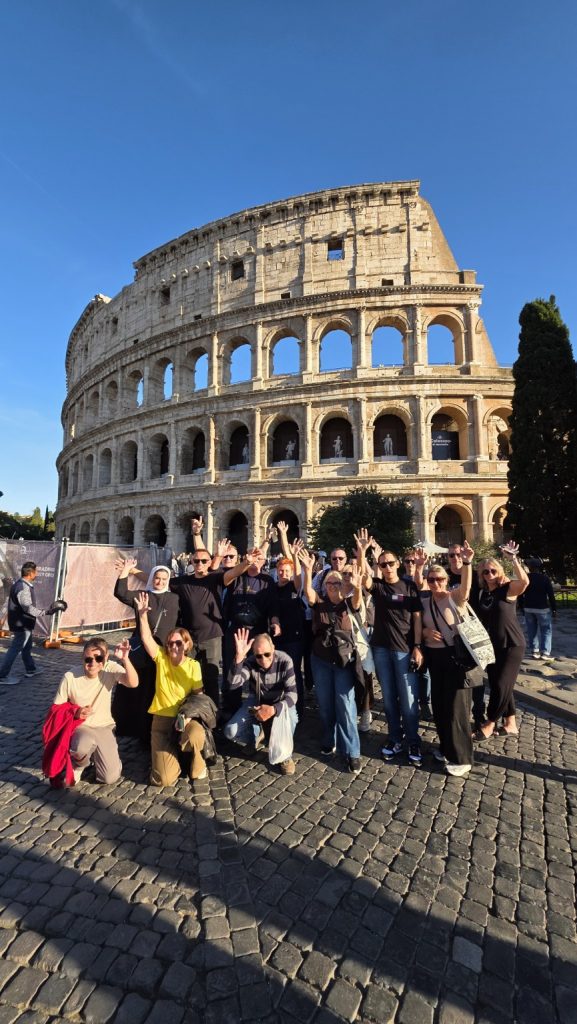
This time I travelled with a group of pilgrims from Croatia, including my great friend and brother in Christ, Marko. Although we were heading towards some of Christianity’s most important places, monuments, basilicas and shrines were not the only things that made the journey special. It was the people.
From the first hours, a rare, almost indescribable closeness grew among us, something that cannot be organised or planned. Laughter, conversations, shared prayers, singing and the simple joy of meeting one another accompanied us throughout. At times I felt we had known one another for years, although some had only just met.
That human warmth became the most beautiful thread connecting everything we experienced.
Assisi – Where Poverty Became Riches
Our first major destination was Assisi, the medieval Umbrian town on the slopes of Monte Subasio. Even the sight of its stone houses, narrow streets and church towers evokes another age.
Assisi is, of course, inseparable from St Francis, one of the most unusual and influential figures in Christian history.
Francis of Assisi was born in the late twelfth century, an age of rapidly growing Italian cities, crusades and deep social divisions. The son of a wealthy merchant, he was a young man with prospects of comfort, prestige and riches. His life, however, took another path.
He renounced his inheritance, wealth and social position to live in evangelical poverty. At a time when land, money and armies measured power, Francis offered something almost revolutionary: simplicity, brotherhood, peace and love for every creature.
Eight centuries later, his words and example have lost none of their power.
In Assisi, we were welcomed by a young Franciscan, Brother Nikola, who guided us through the principal places of Franciscan spirituality. His presence gave our visit particular value. Seeing churches as historic monuments is one thing; hearing about them from someone living the spirituality that inspired them is quite another.
In the magnificent Basilica of St Francis, we encountered a major monument of medieval art. Its upper and lower churches, together with the crypt holding Francis’s remains, testify to an unusual union of artistic splendour and the spirituality of poverty.
Frescoes associated with great masters of medieval Italy, especially Giotto, tell of Francis’s life, encounters, renunciation and faith. In these paintings, we can sense a great shift in European art: human beings, their emotions and everyday lives gradually acquire new importance.
We also visited the Basilica of St Clare, Francis’s contemporary and spiritual companion. Clare left the security of an aristocratic life and chose radical poverty, founding the community of Poor Clares. Her story reminds us how often great historical changes begin with quiet personal decisions.
Then we encountered a very different saint: Carlo Acutis.
Born in 1991, this young enthusiast for computers and modern technology died of leukaemia at just fifteen. His faith, simplicity and efforts to use the internet to spread knowledge of the Eucharist made him particularly relatable to younger generations. He was canonised in 2025.
In Assisi, the Middle Ages and the digital age thus meet in an unusual way. Francis, Clare and Carlo belong to different centuries, but their lives share a question: what do we truly need for our lives to have meaning?
Perhaps that is Assisi’s greatest value. Rather than seeking to impress us with size and power, it invites us to consider simplicity.
Rome – Where History Never Ended
After Assisi’s quiet and medieval beauty, we arrived in Rome.
Rome is something else entirely.
Here, twenty-eight centuries of history live beyond the museums: in streets, squares, beneath modern foundations, in churches built on ancient temples and in the daily lives of millions.
Rome was the centre of the Republic, capital of the Empire, city of the first Christian martyrs, seat of the papacy, stage of Renaissance and Baroque, and one of Western civilisation’s most important cultural centres.
I am always fascinated by the constant overlap of its historical layers.
In one place, we stand before the remains of pagan Rome; a few steps away, we enter a church where people have prayed, celebrated Mass and preserved the memory of the earliest Christians for centuries.
Our Roman pilgrimage was just such a journey: through the history of Christianity and humanity alike.
From the Holy Stairs to the Lateran – Following Early Christianity
The great Roman shrines made a particularly powerful impression.
At the Basilica of the Holy Cross in Jerusalem, Santa Croce in Gerusalemme, we encountered the tradition of St Helena, Emperor Constantine’s mother, who made a pilgrimage to the Holy Land in the fourth century.
According to Christian tradition, she discovered relics of Christ’s Cross, fragments of which are preserved in this Roman basilica.
Whatever the complex historical questions surrounding particular relics, St Helena remains a fascinating woman of late antiquity. Her life belongs to the age when Christianity, after centuries of persecution, gradually emerged from the catacombs and became a major force in the Roman Empire.
Nearby stand the Holy Stairs, the Scala Santa, traditionally said to have been brought from Jerusalem and trodden by Jesus before Pontius Pilate.
Pilgrims traditionally ascend them on their knees in prayer and recollection. It is one of those places where history and devotion create a distinctive atmosphere, bringing us face to face with our own thoughts, gratitude and questions.
We also visited the magnificent Basilica of St John Lateran, officially dedicated to the Most Holy Saviour and Saints John the Baptist and John the Evangelist.
Many do not realise that the Lateran Basilica, rather than St Peter’s, is the cathedral of the Bishop of Rome, the Pope.
Its place in Church history is exceptional. Built in Constantine’s age, it was a centre of Western Christianity for centuries. Its façade carries the famous inscription calling it the mother and head of all churches in the city and the world.
Standing in the Lateran means standing where the history of Christian Europe was shaped.
St Mary Major and St Peter in Chains – Between Tradition and History
Our destinations also included Santa Maria Maggiore, the Basilica of St Mary Major, one of Rome’s four major papal basilicas.
Among its magnificent ancient columns and fifth-century mosaics, we can sense a continuity of Christian art extending over fifteen hundred years.
The early Christian mosaics are especially striking. They belong to a period when the Western Roman Empire was undergoing profound political and social changes. As its borders fragmented, Christian art created a new symbolic language that would shape the Middle Ages.
The basilica also holds the tomb of Pope Francis, whose pontificate profoundly influenced the contemporary Catholic Church.
We visited San Pietro in Vincoli, St Peter in Chains, where tradition holds that the chains binding the apostle Peter are preserved.
The church also holds one of Renaissance sculpture’s greatest masterpieces: Michelangelo’s Moses.
Originally conceived for Pope Julius II’s monumental tomb, the magnificent marble figure is so powerfully expressive that he seems about to rise at any moment.
In cold stone, Michelangelo captured tension, determination and inner strength in a way that still inspires admiration.
Such encounters happen constantly in Rome. We come for faith and find ourselves before some of the human spirit’s greatest achievements.
Ancient Rome – Glory, Power and Transience
We devoted part of our journey to ancient Rome.
We passed the Colosseum, the ancient world’s largest amphitheatre, built in the first century AD under the Flavian emperors.
Its monumentality still testifies to Roman technical ability, but also to the contradictions of a civilisation that left the world law, architecture, roads and urban culture while staging bloody spectacles in its arenas.
Beside it rises the Arch of Constantine, erected to honour the emperor’s victory over Maxentius in AD 312.
That victory marked an important turning point in Constantine’s rise, and his reign brought a profound change in Christianity’s position within the Roman Empire.
From the Capitoline Hill, we looked across the Roman Forum.
Before us stretched the remains of temples, basilicas, triumphal arches and public buildings that once formed the political and social centre of a vast empire.
Cicero and other Roman statesmen spoke there; victory processions passed through; decisions changed the fate of peoples, and struggles for power unfolded.
Today, ruins stand there.
In that lies one of Rome’s most powerful messages.
Empires that seemed eternal disappeared. Emperors who believed they governed the world’s fate became names in history books. Monumental buildings turned into fragments.
Yet human beings still ask the same questions about power, meaning, justice and transience.
On Piazza del Campidoglio, redesigned by Michelangelo in the sixteenth century, we encountered another great historical layer. A Renaissance genius gave the ancient Roman site a new urban unity, connecting classical heritage with his own age’s aesthetics.
We also visited Santa Maria in Aracoeli on the Capitoline. Its interior, with columns of different origins and a rich history, shows again how Christian Rome grew within the ancient city’s inheritance.
We saw Trajan’s Column too, erected in the early second century, its spiral reliefs recounting the emperor’s wars against the Dacians.
History carved in stone, almost like an ancient film rising towards the sky.
Then, like countless travellers before us, we stepped into vivid Baroque Rome, reaching the Trevi Fountain and Spanish Steps.
With its lavish scene of water and marble, the Trevi Fountain is one of Roman Baroque’s most recognisable works. The Spanish Steps, connecting Piazza di Spagna with Trinità dei Monti, have been a place of meeting, walking and city life for centuries.
Rome truly is inexhaustible. One moment we contemplate the Roman Empire’s fall; the next, we sit in a square, watch passers-by and enjoy the Italian capital’s unmistakable atmosphere.
Sunday in the Vatican – A Moment of Fellowship
Yet if I had to choose a day that particularly marked our pilgrimage, it would be Sunday.
Brother Nikola was with us again, and an encounter with the Catholic Church’s spiritual centre lay ahead.
St Peter’s Square is one of those places difficult to describe to someone who has never stood there.
Bernini’s seventeenth-century colonnades embrace the space outside the basilica like enormous arms. Their symbolism is deeply Christian: a Church welcoming people of every nation from every corner of the world.
We joined the faithful gathered for the Sunday Angelus with the Pope.
In that moment, many differences that usually divide us fall away. People speak different languages, come from different cultures and carry different life stories, but share the same prayer.
For me, that scene is always powerful.
Not only because of the Pope or the monumental architecture around us, but because we feel part of something much greater than our everyday worries and boundaries.
We also visited St Peter’s Basilica, one of the most magnificent buildings humanity has raised.
Beneath its enormous dome, designed by Michelangelo and completed by his successors, art, history and faith meet in a distinctive way. From Michelangelo’s Pietà, one of art’s most moving images of human suffering, to Bernini’s monumental bronze baldachin above the main altar, everything speaks of centuries of creation, prayer and attempts to express the invisible through the visible.
Beneath the main altar, according to ancient Christian tradition and archaeological research, lies the apostle Peter’s tomb.
Peter’s life ended in martyrdom in Rome, traditionally during Nero’s first-century persecution of Christians. A man who had once been a Galilean fisherman became a central figure in Christian history.
It is difficult to reflect on this without noticing history’s unusual paradox. Roman emperors whose power once seemed unlimited now belong to archaeology and textbooks. Above a simple Galilean fisherman’s grave rises one of the world’s largest churches, a place visited by millions over centuries.
Perhaps this is one of Christianity’s loveliest messages: armies, riches and political power are not the only forces shaping history. Sometimes its course is changed most profoundly by people possessing only faith, conviction and a willingness to live by them.
The Song That Connected Our Journey
Yet however deeply Assisi, Rome, its basilicas, ancient monuments and great art delighted us, something else gave the pilgrimage its most beautiful and personal character.
It was song.
Among us was my dear friend, the well-known Croatian tenor Marko Pecetić, whose voice has the rare ability to turn an ordinary moment into something long remembered.
Marko accompanied our journey with singing, but this was no prepared programme or series of performances for an audience. Song happened spontaneously, wherever we found ourselves.
We sang in the Roman metro among people hurrying about their daily business. We sang on Rome’s streets, among centuries-old façades and squares crossed by generations before us. We sang in churches, where the music acquired particular depth and meaning.
We sang in St Peter’s Square too.
There was something unusually beautiful in those moments. Our small Croatian group, in one of the world’s great and most visited cities, brought part of its own tradition, joy and spirituality into a space belonging to all humanity.
Marko’s voice often began the song, and the rest of us joined. Sometimes solemnly, sometimes exuberantly, sometimes simply because we were happy together.
Perhaps that was the greatest magic of all.
We were more than individuals sharing a coach and itinerary. We became a community sharing an experience, an atmosphere, conversations, prayer and song.
There was plenty of laughter, spontaneous joking, long conversations and those small, seemingly unimportant moments that become the dearest memories.
Such an atmosphere cannot be bought or guaranteed by a good itinerary. It grows between people, from their openness, kindness and willingness to meet and accept one another.
We were, I must admit, exceptionally fortunate.
The warmth and sincere joy among the people gathered on this pilgrimage lasted from beginning to end. More than once, I found myself reflecting on how precious such encounters are.
A Journey That Reminds Us What Matters
I often think about the meaning of travel.
I travel widely, visiting different countries, cities, historic places and cultures. Over the years, I have met countless people and seen much that delighted, surprised or prompted me to think.
But I am increasingly convinced that travel’s true value lies beyond the places we visit.
Of course, seeing the Colosseum matters, as do understanding Roman history, pausing before Michelangelo’s work, entering the Basilica of St Francis or praying in St Peter’s Square.
All these experiences enrich our knowledge, widen our horizons and help us understand the world we belong to.
But travel has another dimension, perhaps an even more important one.
It is the encounter with another person.
An encounter in which everyday roles, occupations, social positions and differences fade. We meet simply as people, with our stories, concerns, hopes, joy and faith.
Pilgrimage gives that dimension additional depth.
We go on pilgrimage both to see and to find something: perhaps an answer to a question long carried within us, a peace we lack, or gratitude we forget to express in the everyday rush.
Sometimes we find something we were not seeking.
Friendship. Understanding. A sense of belonging.
Or the simple joy of being alive, able to travel, sing, laugh and share beautiful moments with others.
Between Francis’s Poverty and Rome’s Grandeur
On the journey home, I reflected on the unusual contrast between Assisi and Rome.
In Assisi, we explored the life of a man who renounced almost everything the world considered valuable.
In Rome, we contemplated the remains of antiquity’s greatest political power and magnificent buildings raised over centuries by emperors, popes, artists and builders.
On one side, Francis, who chose poverty.
On the other, Rome, a city of power, wealth and monumentality.
Yet both speak of the same human longing: for our lives to mean something and for something we leave behind to outlast time.
Roman emperors built triumphal arches to immortalise their victories. Francis built none, yet eight centuries later his name is spoken across the world.
Michelangelo sought in marble a beauty that would outlive him. Carlo Acutis used a computer and the internet to bring his faith closer to others.
Different times. Different people. Different paths.
But the same human need for life not to pass in vain.
Perhaps that is why travelling and learning history matter so much. History teaches humility. It reminds us that we are not the first to confront life’s great questions; before us came people who loved, believed, feared, built, made mistakes and hoped.
Others will come after us.
What remains is to try to fill our own time with something good.
What Remains When We Return
When the journey ends, photographs remain.
They show the Basilica of St Francis, Assisi’s stone streets, the Lateran, Colosseum, Roman Forum, Trevi Fountain, St Peter’s Square and the many other places we visited.
They remind us of the cities’ beauty, the monuments’ scale and our time together.
But what matters most will not be in the photographs.
It will remain within us.
Marko Pecetić’s voice echoing through Rome’s streets will remain. So will our conversations, laughter on the coach, songs in the metro, prayer in St Peter’s Square, meetings with Brother Nikola and moments when we felt part of something beautiful.
My friendship with my brother Marko will remain too, along with gratitude to all the dear people with whom I shared this journey.
Above all, the feeling that for a few days we briefly left behind the everyday rush and rediscovered the value of simple things.
A good conversation.
A shared song.
A sincere prayer.
Human closeness.
The joy of being together.
That is why I will remember this pilgrimage as more than another visit to Rome, however much I always look forward to returning.
I will remember its people.
The atmosphere we created together.
The song that accompanied us from Assisi to the Vatican.
And the simple but great truth St Francis left through his life: our greatest wealth lies in what we can give others rather than what we possess.
On this journey, we gave one another a great deal.
Thank you to everyone who belonged to our little pilgrimage community. Thank you, Brother Nikola, for your welcome and spiritual guidance; thank you to my friend Marko Pecetić for the singing that gave our journey its special tone; and thank you to each of you for kindness, smiles and fellowship.
I believe we will return to Rome.
But this particular Rome, with these people, this song and these moments, will remain forever ours.
The most beautiful journeys are not always those on which we see the most of the world. Sometimes they are the journeys on which the people around us reveal how beautiful the world really is.
Slaven Vujić