From the Colosseum and the Imperial Fora to the Trevi Fountain, Roman meals and prayer in St Peter’s Square: a walk through a city where great historical events continually intersect with personal stories.
I carry several very different memories from my last pilgrimage to Rome: the view of the Forum from the Capitoline Hill, Michelangelo’s Moses, the water of the Trevi Fountain and our time waiting in St Peter’s Square. It is hard to rank them by importance. One belongs to ancient history, another to art, a third to the simple pleasure of walking, and the last to something far more personal. In Rome, these things are constantly intertwined. We leave a church and step into traffic, pass the remains of the imperial city on our way to coffee, and suddenly recognise our own song in a square filled with different languages.
I like getting to know a city on foot and connecting its places with the people who lived there. Rome offers almost too much material for such a walk. This article therefore follows several connected areas: the ancient centre, the squares of the historic city, the Vatican, the great basilicas and the neighbourhoods along the Tiber. I have linked the places we visited on our pilgrimage with other important Roman landmarks, so that the story can also help someone planning a first visit. Everything that follows requires several days and the occasional journey by transport; trying to squeeze all of Rome into one walk would leave us with tired feet and superficial memories.
The Tiber, the Hills and a City That Outgrew Its Beginnings
The easiest place to begin Rome’s history is beside the Tiber. The river carried traffic, linked the interior with the sea and created boundaries that had to be bridged. Settlements grew on the hills beside it and eventually developed into a city. The story of Romulus and Remus, the she-wolf and the founding in 753 BC belongs to Rome’s own traditions about its beginnings. The historical city took shape more gradually. That distinction between tradition and archaeology makes a useful introduction to Rome: what the Romans believed about themselves is often as important to understanding their monuments as what we can prove today.
The age of kings, the Republic, the Empire, papal Rome and the capital of modern Italy have all left different cities in the same place. Sometimes they lie literally one above another; sometimes they share the same walls. When a row of ancient columns appears beside a busy street, we are looking at more than an isolated piece of the past. This is a place whose purpose, ground level, neighbours and owners have changed, yet which has remained part of the city. Getting to know the historic centre therefore means following those changes as well as remembering its landmarks.[1]
Emperors, Popes and Artists Who Shaped Rome
Before setting out, it helps to remember a few names. Augustus belongs to the beginnings of the Empire; Vespasian and Titus are associated with the Colosseum; Trajan and Hadrian left some of the most recognisable ancient buildings. Constantine was important to the establishment of the great Christian basilicas. His reign also introduces the story of his mother, St Helena, who mattered particularly to me on this journey. There is no need to memorise a list of rulers: it is enough to connect their names with the places we will see.
Later, we will increasingly encounter popes as patrons and artists as the people who gave their ideas form. Michelangelo, Raphael, Gian Lorenzo Bernini and Francesco Borromini appear at different points along the same walk. Rome’s splendour becomes easier to understand when we see the ambitions of those who commissioned it alongside its beauty. Palaces, fountains, obelisks and enormous façades shaped the public image of power. A coat of arms on a building is therefore worth examining almost as carefully as the sculpture beneath it: it tells us who wanted to be remembered.
The Colosseum – Beyond Rome’s Most Familiar Image
Standing before the Colosseum, it is easy to feel that we already know the building, having seen it so often in photographs. Only close up do its scale, the depth of its arcades and the differences between the surviving sections become clear. The Flavian Amphitheatre was built in the first century AD under the emperors of the Flavian dynasty. It hosted gladiatorial combat and animal hunts, spectacles displaying the wealth, organisation and power of imperial Rome. Its complex system of passageways and seating areas reveals how much engineering knowledge supported such entertainment.[2]
It is worth slowing down and imagining the building in use: crowds finding their seats, noise from the stands and the work of the people who kept the whole system running. The scene immediately becomes less remote, but also less innocent. Behind our admiration for the architecture lies the violence on which much of its programme depended. Later centuries brought other uses, from homes and workshops to the removal of building materials. The ruin we photograph today is also the result of those lives after the Empire. Allow time to study the structure as well as the site of the former arena.
The Arch of Constantine – Victory on the Threshold of a New Age
Beside the Colosseum stands the Arch of Constantine, erected in AD 315 to commemorate the emperor’s victory over Maxentius at the Milvian Bridge in 312. Not all its reliefs date from Constantine’s reign: elements from older monuments associated with Trajan, Hadrian and Marcus Aurelius were reused. Within one structure, art from different periods meets a new ruler’s political need to connect his authority with respected predecessors.[3]
This is an important transition in our Roman story. We will meet Constantine again at the Lateran and, through his mother Helena, at Santa Croce in Gerusalemme. One common simplification needs to be avoided: Constantine did not make Christianity the state religion. His reign brought freedom of Christian worship and strong imperial support for the Church; the declaration of Nicene Christianity as the Empire’s official faith came later in the fourth century. At the arch, we are still in the world of Roman imperial victory, but the basilicas we will visit show how much was soon to change.
The Forum and Palatine – Where the City Governed the World
The Roman Forum stretches between the Palatine and Capitoline hills. At first sight, the remains of columns, walls and paving require considerable imagination. Picture a square filled with buildings, speeches, court proceedings, religious ceremonies and people making their way to their own business. The Forum brought political and everyday life into direct contact. In antiquity, its basilicas served public functions, including the administration of justice; the word should not immediately make us think of a Christian church here.
Along the Via Sacra, among ruined temples and triumphal arches, it becomes easier to understand how thoroughly public space was filled with messages. Who had won a victory, who was being thanked, which ruler had restored a building: everything had a visible inscription or sign. Above it rises the Palatine, associated with the city’s earliest traditions and later imperial residences. The Forum and Palatine deserve to be experienced as a substantial visit in their own right. Views from the surrounding heights help us find our bearings, but walking down among the remains gives a different sense of their scale.[1]
The Capitoline – A View That Connects the Ruins
On our journey, I also viewed the Forum from the Capitoline Hill. That view stayed with me because it suddenly gives the scattered remains a spatial logic. We can see the valley, the arrangement of buildings and the hills enclosing them. Later, when remembering a particular temple or arch, we have somewhere to place it. Views like this matter to me almost as much as entering the landmark itself.
The Capitoline also brings us to Piazza del Campidoglio, the square whose redesign was conceived by Michelangelo. The Capitoline Museums stand beside it, making it possible to combine a walk, a panorama and an encounter with ancient art. In the other direction lies the route towards Piazza Venezia and the white monument to Victor Emmanuel II. Within minutes, we move from the ancient centre to a place that speaks of the creation of the modern Italian state. Rome keeps changing its historical subject, often before we have finished the previous one.[4]
Trajan’s Column – War Told in Stone
Beside the Imperial Fora stands Trajan’s Column, erected in AD 113 to commemorate the emperor’s wars in Dacia. Its spiral relief climbs the shaft like a long visual narrative. It depicts soldiers marching, construction, crossings and encounters: the organised world of an army on campaign. Trajan appears repeatedly as a constantly present ruler. The monument is a valuable historical source, but its message must be read with the understanding that the victor determines what we see.[5]
We cannot make out every scene from the ground, and there is little point pretending otherwise. It is enough to follow the relief winding around the column and grasp the idea: the emperor’s victory becomes a lasting public image. St Peter now stands at the top, placed there in the sixteenth century in place of the lost ancient statue. A single upward glance thus takes in both the imperial past and the later papal city. It is one of those Roman details easily missed if we merely tick off the monument’s name.
San Pietro in Vincoli – Encountering Michelangelo’s Moses
From the ancient quarter, it is worth making a detour to San Pietro in Vincoli, St Peter in Chains. On our journey, we paused here before Michelangelo’s Moses. The sculpture forms part of the funerary monument to Pope Julius II, originally conceived on a much grander scale than was realised. Moses is seated, but his body seems tense, as though he is about to rise. His gaze, hands and the folds of his clothing hold our attention even without anything around him to explain the scene.
Horns are visible on his head, a familiar iconographic detail associated with the Latin translation of the biblical description of Moses’ face after his encounter with God. The church also preserves chains venerated as a relic of St Peter; their story belongs within Church tradition. In a single visit, we encounter devotion to an apostle, a pope’s wish for a lasting monument and an artist whose work draws visitors centuries later. Rome has many churches, but Moses gives this one a special place in an itinerary.[6]
The Pantheon – An Opening to the Sky
A walk through the historic centre can begin on Piazza della Rotonda, outside the Pantheon. The inscription on the façade names Marcus Agrippa, who commissioned an earlier temple, while the present building is largely associated with Hadrian’s reign. In AD 609, it was consecrated as the Christian church of Santa Maria ad Martyres. Entering it therefore means encountering both one of antiquity’s great surviving interiors and a church used for worship for centuries.
The opening in the dome, the oculus, attracts most attention. The height of the interior and the diameter of the rotunda are approximately equal, around 43 metres, and the opening to the sky transforms the light inside. Rain also enters through it and drains through openings in the floor. That simple fact dispels a persistent tourist tale that it never rains inside the Pantheon. The real building is more interesting than the story: the sky is literally part of the experience. Raphael’s tomb is also here, another reason to lower our gaze from the dome and explore the interior.[7]
Piazza Navona – Baroque Splendour on the Foundations of a Stadium
It is a short walk from the Pantheon to Piazza Navona. The square’s elongated shape follows the layout of the Stadium of Domitian, which hosted athletic competitions. Once we know what stood here, the edges of the square make more sense: the houses and church occupy the space around the former arena. The surface has changed, but the older building still determines the shape of one of Rome’s best-known gathering places.
At its centre stands Bernini’s Fountain of the Four Rivers, with personifications of the Danube, Nile, Ganges and Río de la Plata, while the church of Sant’Agnese in Agone bears the strong imprint of Borromini’s work. This is a fine example of the Baroque shaping an entire square: water, stone, façades and open space all address the gaze of someone arriving on foot. Walk around the fountain on every side. The figures’ positions and relationships change with each step, and what seemed a single image in a photograph becomes a sequence of different scenes.[8]
Caravaggio – A Short Detour to Great Painting
Between the Pantheon and Navona stands San Luigi dei Francesi, the Church of St Louis of the French, known for Caravaggio’s paintings of the life of St Matthew. Places like this show why it is worth leaving some free time in Rome. Behind a façade we might otherwise walk past is art that elsewhere would justify planning an entire visit. Here, it remains connected with the chapel and church for which it was created.[9]
Before these paintings, begin simply by looking: where the light comes from, whose face it illuminates and where a hand directs our attention. Caravaggio’s scenes never feel like a tidily distant world. The people in them have weight, doubt and sudden movements. After the bright squares, an encounter like this inside a church changes the rhythm of a walk. It is good to let it do so; Rome becomes exhausting when we demand the same quick experience from every place.
The Trevi Fountain – Water That Commands a Whole Square
The approach to the Trevi Fountain is part of its effect. The streets do not quite prepare us for what opens between the façades: an enormous watery scene, rocks, figures and a palace that becomes their backdrop. The fountain was built in the eighteenth century to a design by Nicola Salvi and completed in 1762. The central figure represents Oceanus, a personification of the great waters; he is often casually called Neptune, but the two should not be confused here.[10]
On our visit, Trevi was another of those stops where it was difficult to take everything in while finding our own space among other visitors. Yet it only takes a moment away from the search for a perfect photograph to see how the water and stone work together. Sculptures grow out of the rocks, while the façade above them acts like a stage. Tossing a coin and the promise of returning to Rome belong to tourist tradition. I suspect the city finds a reason for us to return without a coin: something always remains around the next corner.
The Spanish Steps and the Rome of Poets
From Trevi, we continue towards Piazza di Spagna and the Spanish Steps, which climb to the church of Trinità dei Monti. At their foot is the Barcaccia fountain, shaped like a low, half-sunken boat. The steps show how a link between two levels of a city can become a great architectural work. Step back into the square to appreciate the whole, then turn around a few times as you climb.
This part of Rome is also associated with the travellers, artists and writers who stayed here. The square holds memories of John Keats, while the nearby streets recall an age when visiting Italy was an important part of a European artistic education. Fashion-house windows now attract as much attention as the façades, but that older literary Rome can still be found. As a writer, it is natural to wonder how many different people arrived in the same city convinced that they were seeing it for the first time entirely through their own eyes.[11]
Towards the Tiber – Bridges and Castel Sant’Angelo
When heading towards the Vatican, it is worth saving the approach across the Tiber. The space opens out beside the river, and the Castel Sant’Angelo, the Castle of the Holy Angel, shows how many uses a single building can acquire. Built as Hadrian’s mausoleum, it later became a fortified stronghold associated with papal Rome. Its massive circular structure looks very different from the church façades towards which we are walking.[1]
I would allow time for the riverside itself. After the narrow streets, a view along the water offers a pause, while the distant dome of St Peter’s gradually draws our attention. Rome is not arranged to reveal every great building immediately and in full. We often experience it most beautifully on the approach, as the separate elements of the view begin to connect. Crossing a bridge can therefore matter as much as arriving outside a landmark.
St Peter’s Basilica – Centuries of Building above an Apostle’s Tomb
St Peter’s Basilica was built on the site where the apostle’s tomb is venerated. The present building replaced an earlier basilica from Constantine’s reign; construction began in 1506, and it was consecrated in 1626. Many architects contributed, including Bramante, Michelangelo and Carlo Maderno. Remember the duration of the undertaking as you look: what we now experience as a harmonious whole emerged from different ideas over several generations.[12]
Outside lies Bernini’s square with its colonnades; inside, Michelangelo’s Pietà, the vast space beneath the dome and Bernini’s baldachin draw the eye. Scale can be deceptive: sculptures and architectural details seem smaller than they are because everything around them is enormous. Choose a few places to pause and let your eyes adjust. Remember one important distinction here: Rome’s cathedral is at the Lateran. St Peter’s has an exceptional place in the Catholic world, but the episcopal seat of the Bishop of Rome belongs to another basilica.
The Vatican Museums and the Sistine Chapel
The Vatican Museums deserve a separate part of the day. Visiting them is different from entering St Peter’s Basilica: these are separate visits with their own entrances and arrangements. The vast collections can leave us tired before reaching the rooms we most wanted to see. It is more useful to choose a few sections in advance than try to give everything equal attention. Among the best-known are the Raphael Rooms, decorated by Raphael and his workshop in the early sixteenth century.[13]
In the Sistine Chapel, Michelangelo’s ceiling frescoes, painted in 1508–1512, and the later Last Judgement, painted in 1536–1541, belong to different periods of his life. Look at the differences in the arrangement of figures, their tension and the sense of space. The famous detail of the Creation of Adam is only a small part of the whole. Visitors who spend the entire time searching for those two almost-touching hands can miss much of what surrounds them. Art like this asks for a little time and a willingness to let the eye wander before it settles.[14]
The Angelus – When Rome Became Personal
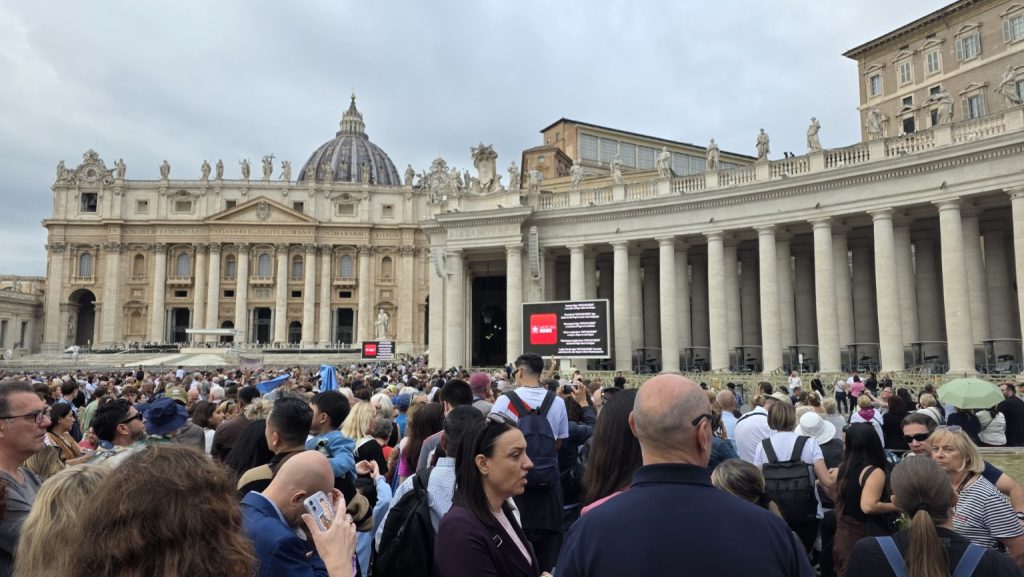
My most important memory of the Vatican is not tied to a building. I was in St Peter’s Square with around fifteen pilgrims from Croatia, among many other communities waiting for the Holy Father. Before he appeared, my brother in Christ, Marko, began a song. It rang across the square as we waited to pray together. There was something in that joy that is difficult to put into words: so many different people, yet the feeling that we had gathered in the same place with a shared and understandable wish.
As I prayed the Angelus in Latin with the Pope for the first time in my life, I was thinking of my grandfather, Bepo. He spent forty years as bell-ringer and sacristan at our church in Supetar. I knew his world through its bells, the church and service repeated day after day. That memory came naturally to me in the great Vatican square. Of all the Roman ages I can tell stories about, this moment is the closest to my heart: in a distant city, I suddenly felt something deeply my own, connected with my family and the place I come from.
Santa Maria Maggiore – Mosaics That Remember a Different Rome
To visit the great basilicas, we return to the other side of the city. Santa Maria Maggiore, the Basilica of St Mary Major, is especially important for its fifth-century mosaics. They belong to the reign of Pope Sixtus III and the period after the Council of Ephesus. Alongside later chapels, the ceiling and subsequent alterations, an early Christian visual layer survives, allowing us to see very different periods of Roman devotion and art within the same interior.[15]
We visited this basilica on our pilgrimage too. After so many monumental spaces, it becomes especially important to recover a way of looking carefully. The mosaics ask us to slow down, raise our eyes and accept that their story will not reveal itself all at once. Their gleaming surfaces, repeated figures and arrangement of scenes belong to a different visual language from Michelangelo’s bodies or Baroque movement. Those differences prevent the basilicas from merging into a single memory. Each retains something by which we can recognise it again.
The Lateran – Rome’s Cathedral and Constantine’s Legacy
The Basilica of St John Lateran is the cathedral of the Bishop of Rome, the Pope. Its origins lie in Constantine’s reign and the great change in Christianity’s position within the Empire. Its present appearance is not that of an untouched fourth-century building: the basilica has been restored over the centuries, and Borromini’s remodelling for the Jubilee of 1650 left a strong imprint on the interior. Here too, historical continuity reveals itself through change rather than the absence of change.[16]
At the entrance, we also paused beside the statue of Constantine, connecting this visit with his arch near the Colosseum. There, military victory is celebrated; here, the history of imperial support for the Christian community opens before us. Walk the length of the interior and observe the relationship between its great statues, architecture and sanctuary. The Lateran is fundamental to understanding ecclesiastical Rome. A story that began and ended only at St Peter’s would remain incomplete.
The Holy Stairs – Twenty-Eight Steps of Prayer
Near the Lateran stands the Scala Santa, the sanctuary of the Holy Stairs. According to Christian tradition, its 28 marble steps belonged to Pilate’s praetorium in Jerusalem, and St Helena had them brought to Rome. The tradition associates them with Christ’s ascent to appear before Pilate. It is important to be clear that we are speaking of a tradition venerated for centuries; historically establishing the origin of each stone is a different question.
We also visited this site, connected with the Sancta Sanctorum, once the popes’ private chapel. Here, our relationship with sightseeing changes. The central staircase is traditionally ascended on one’s knees, while surrounding passages offer another way through. We need not share every pilgrim’s experience to understand that we are in a place of prayer. It is an important stop in my story of Helena, partly because it shows how strongly her name has remained present in Rome’s religious memory.[17]
Santa Croce in Gerusalemme – In the Footsteps of St Helena
We came to Santa Croce in Gerusalemme with a specific purpose: to follow the story of St Helena, finder of the True Cross. The basilica is associated with the Sessorium, the imperial residential complex where Helena lived. That alone gives the visit a different weight: her name here is tied to a particular place in the late-antique city. The present façade dates from much later, but beneath the history of alterations remains the connection with the imperial family and the establishment of an important Roman pilgrimage site.[18]
Relics associated with Christ’s Passion are venerated in the basilica: fragments of the wood of the Cross, thorns, a nail and part of the inscription known as the Titulus Crucis. Tradition links their arrival in Rome with Helena and Jerusalem. Claims about their origins must be distinguished from the fact of their long veneration. For me, this connection between a person, a place and a tradition is precisely the reason to linger. Together, the Lateran, the Holy Stairs and Santa Croce bring Constantine’s age closer in a way that the arch alone or a historical overview cannot. They open a much larger story of Helena, her actual life and the image of her that developed after her death.
St Paul Outside the Walls – Rome’s Other Apostolic Landmark
For a fuller view of Rome’s great basilicas, allow time for St Paul Outside the Walls, San Paolo fuori le mura. Its history is connected with the site where Paul’s tomb is venerated. A great fire in 1823 badly damaged the old basilica, so much of what we see today results from nineteenth-century rebuilding, alongside surviving older elements. Once again, a more complex history lies behind an apparently uniform appearance.[19]
Plan this visit separately, as the basilica stands beyond the historic centre we have been exploring. Allow enough time for the interior and monastic spaces, rather than treating it as a final stop to squeeze in. In the story of Christian Rome, Peter and Paul belong together. Their places of veneration give the city another historical map, one that partly overlaps with the imperial monuments and partly leads far beyond them.
The Jewish Quarter and Trastevere – Closer to Everyday Rome
Returning to the Tiber opens up a different walk. The area of the former Jewish ghetto, beside the Portico of Octavia, recalls the long history of Rome’s Jewish community. Established in 1555 under Pope Paul IV, the ghetto was a place of enforced segregation. Today’s streets, restaurants and encounters should not obscure the meaning of its name. Here we also encounter the rich Roman-Jewish culinary tradition, including its famous carciofi alla giudia, fried artichokes.[20]
Crossing the river brings us to Trastevere, a neighbourhood best explored slowly, among smaller squares, churches and streets. We need not search for an imagined tourist-free city to enjoy its life. It is enough to watch how people step outside, sit at tables and make their way past one another. After a day filled with emperors’ and artists’ names, it is refreshing to reach a part of Rome where we need not immediately attach a date to everything. Even here, though, enter a church such as Santa Maria in Trastevere, rather than reducing the whole neighbourhood to dinner.
Rome at the Table – Few Ingredients, Plenty of Character
Roman cooking makes a fitting end to a long day of sightseeing. Cacio e pepe brings together cheese and pepper; gricia adds guanciale, cured pork jowl; carbonara is known for eggs, sheep’s-milk cheese and guanciale; and amatriciana includes tomato. A short list of ingredients conceals considerable skill. When a dish is so concise, both a good balance of flavours and anything that upsets it are easy to notice.[21]
One of my favourite moments on a journey is finally sitting down and stopping the count of places still to visit. Conversation naturally brings back what we have seen that day. Someone remembers a sculpture, someone a square, someone a small encounter. A meal is therefore part of getting to know a city even when it is not a dedicated culinary exploration. Rome certainly has enough sights to make us postpone lunch until we are exhausted, but that rarely improves the journey. Leave time for a table, a coffee and an ordinary pause.
Connecting Rome in a Series of Walks
I would link the ancient centre in a walk from the Colosseum and the Arch of Constantine towards the Forum, Palatine and Capitoline, allowing time for Trajan’s Column. San Pietro in Vincoli fits well into a visit to this part of the city, but allow for the climb and the time you actually want to spend at each stop. Another walk can connect the Pantheon, San Luigi dei Francesi, Piazza Navona, Trevi and the Spanish Steps. That is a day for walking between squares, with room to turn down streets we had not originally planned to explore.
The Vatican deserves a visit of its own; if the museums are included, give it enough time and energy. Santa Maria Maggiore, the Lateran, the Holy Stairs and Santa Croce form a separate route through Christian history and Helena’s story, on foot and by transport where needed. St Paul Outside the Walls requires an additional journey. For all of this, I would rather allow several calmer days than create a timetable in which every delay feels like a problem. The landmarks’ official websites are the best places to check visiting times, tickets and entry arrangements before setting out.
When I think of Rome today, the places do not return in a tidy sequence. I remember the view over the Forum, Moses before whom we paused, and our arrival at Santa Croce with a clear reason for wanting to be there. Then comes Marko’s song in St Peter’s Square, before the Pope appeared, and my grandfather Bepo in my thoughts during prayer. So many great names and centuries, yet the city stays close through a handful of moments. Through them, we come to recognise it as part of our own lives.