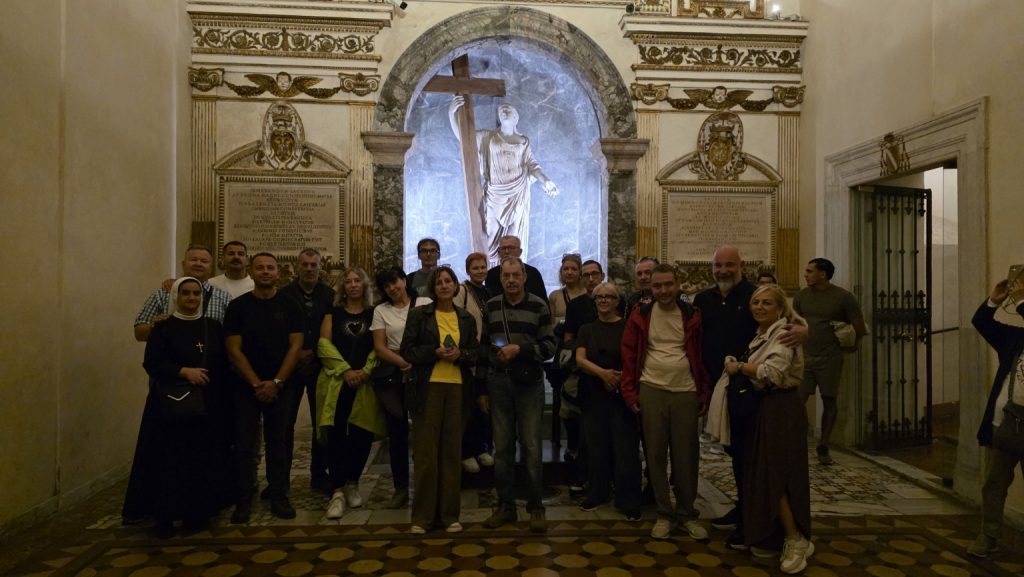
On our last pilgrimage to Rome, with a group from Croatia, three places held special meaning. Santa Croce in Gerusalemme, the Holy Stairs and St John Lateran were more than stops along our pilgrimage route. For me, they meant an encounter with a history that has long occupied my thoughts and a woman whose life I am researching. I believe her story is much more interesting and complex than standard saints’ biographies suggest. She was St Helena, mother of the Roman emperor Constantine the Great, credited in Christian tradition with finding Christ’s Cross in Jerusalem, and remembered at some of Christianity’s holiest places.
The visit also had a personal dimension. For some time, I have been researching St Helena’s life, particularly traditions connecting her with the island of Brač. I wanted our pilgrimage to include places that say more about her than a few sentences in a church guide. I wanted to see where her story meets that of the Roman Empire, where one woman’s faith became intertwined with her son’s political power, and where Christianity began acquiring great public buildings after centuries of persecution and uncertainty.
Santa Croce in Gerusalemme – Jerusalem in the Heart of Rome
In the eastern part of old Rome, near the Lateran, stands Santa Croce in Gerusalemme, the Basilica of the Holy Cross in Jerusalem. Its name immediately raises a question: why does a Roman church call itself “in Jerusalem”? The answer takes us back to the fourth century, to Constantine and his mother Helena, when this area was associated with the imperial residential complex known as the Sessorium.
Before becoming a Christian shrine, the Sessorium formed part of a luxurious imperial estate comprising residences, halls, gardens and other facilities. Its history predates Constantine, particularly reaching back to the Severan dynasty. The complex included the Amphitheatrum Castrense, whose remains are now incorporated into the Aurelian Walls. An important imperial residence developed here in the early fourth century, and Helena, Constantine’s mother, is associated with it.
According to historical and ecclesiastical tradition, part of the former imperial palace was converted into a Christian place of worship. A great hall of the Sessorium became the nucleus of the future basilica. The transformation is deeply significant. A space belonging to Roman imperial power became a place for venerating the Cross, a symbol that in earlier centuries had represented one of Rome’s most degrading punishments.
The Romans used crucifixion as public punishment and intimidation, chiefly against slaves, rebels and people without the privileges of Roman citizenship. According to the Gospels, Jesus of Nazareth was executed on such a cross. A few centuries later, at the very heart of that former imperial civilisation, the Cross became an object of veneration. It is difficult to imagine a more powerful historical reversal.
St Helena occupies the centre of this story. According to Christian tradition developing during the fourth century, she travelled to the Holy Land late in life, taking part in identifying and honouring places connected with Jesus’ life, Passion and Resurrection. Her journey is usually dated to around AD 326, when Constantine was already sole ruler of the Roman Empire.
We must distinguish historically attested events from later tradition. Helena’s presence in the Holy Land is known from early Christian sources, especially Eusebius of Caesarea, Constantine’s contemporary and biographer. He describes her devotion, charitable works and church building, but does not explicitly mention finding Christ’s Cross. The account of Helena as finder of the True Cross appears clearly in later fourth-century ecclesiastical sources and subsequently becomes more elaborate.
According to that tradition, three crosses were discovered at the site of Christ’s crucifixion, and the true one was identified through a miraculous healing following contact with it. Historical scholarship cannot confirm the details, but it must also recognise that the veneration of relics of Christ’s Cross in Jerusalem is documented by the mid-fourth century. Bishop Cyril of Jerusalem speaks in his catechetical lectures of wood from the Cross already spreading among the faithful.
Tradition holds that Helena brought some of those relics to Rome, to the former imperial palace. A shrine thus emerged that allowed Romans to feel symbolically close to Jerusalem without travelling to the other end of the Mediterranean.
A particularly interesting tradition says that soil from Calvary in Jerusalem was brought to the basilica too, hence its name, Santa Croce in Gerusalemme. It was more than a church dedicated to Jerusalem: through relics and earth, part of Jerusalem’s sacred space was understood to have been brought to Rome.
Today’s basilica results from numerous alterations. Its eighteenth-century Baroque façade differs greatly from the early Christian building. Yet beneath later architectural layers survives a historic core reaching back to Constantine’s age. The basilica preserves relics traditionally associated with Christ’s Passion, including fragments of the Holy Cross, two thorns from the crown of thorns, a nail and part of the inscription panel known as the Titulus Crucis.
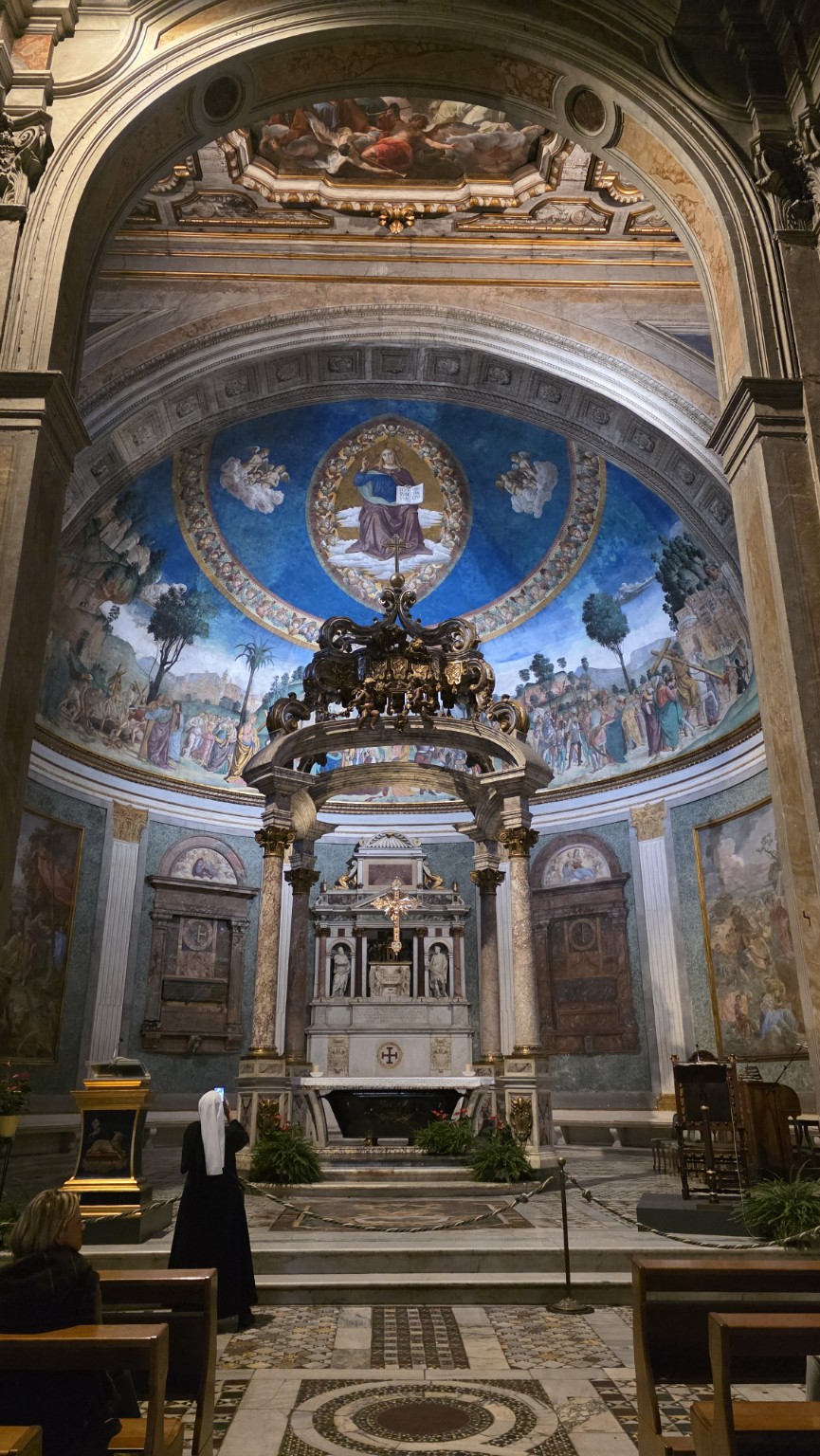
That panel is among the most intriguing relics. According to the Gospel account, an inscription above Jesus’ head stated the reason for his condemnation: Jesus of Nazareth, King of the Jews. John’s Gospel says it was written in Hebrew, Latin and Greek. The relic at Santa Croce contains fragments in three languages, but its authenticity remains disputed. Scientific examination has not confirmed a first-century date.
For a pilgrim, however, authenticity is not the only question these objects raise. They also testify to the history of faith and the centuries during which people sought to preserve a material connection with events that shaped their spiritual lives.
Standing in the basilica, I thought about this unusual connection between place and time. Traces of imperial Rome lay beneath and around us, while before us were objects generations of Christians had venerated in remembrance of Christ’s Passion. At the centre stood Helena, a woman who lived at the meeting of two worlds.
The Holy Stairs – A Tradition Connecting Jerusalem and the Lateran
After Santa Croce, we continued to the Holy Stairs, known by the Latin name Scala Sancta. Housed in a separate building near St John Lateran, they are among Rome’s best-known pilgrimage sites.
According to centuries-old Christian tradition, these are the stairs Jesus climbed in the palace of Pontius Pilate, the Roman governor in Jerusalem, during his trial and condemnation to death. The same tradition says St Helena had them brought from Jerusalem to Rome.
The staircase consists of twenty-eight marble steps. They are now protected by wooden coverings, and pilgrims traditionally ascend on their knees, praying and reflecting on Christ’s Passion. Separate staircases are available for those who wish to walk upstairs.
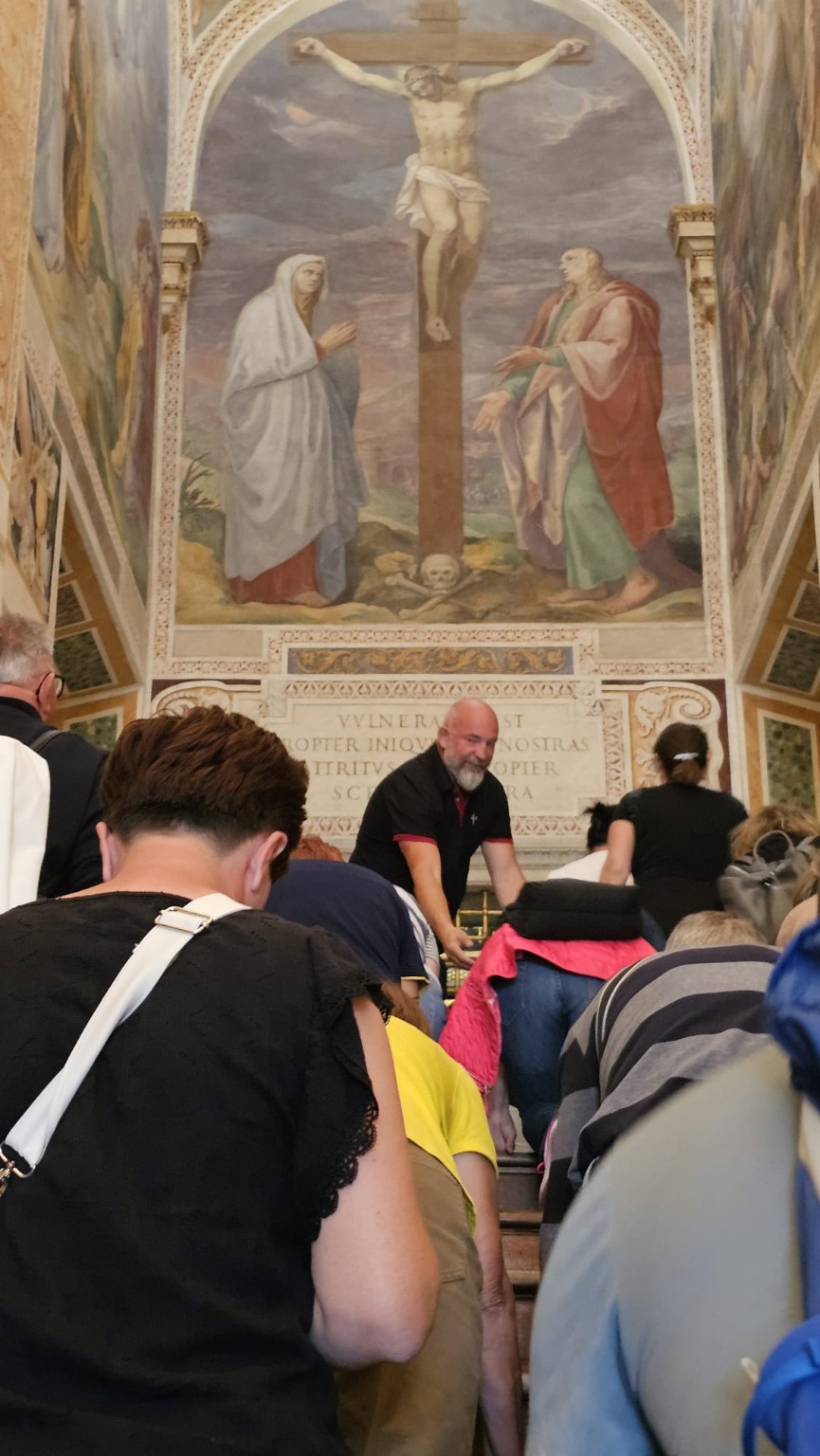
Historical caution is necessary here too. We have no contemporary sources from Helena’s lifetime confirming that she personally brought these stairs from Jerusalem. Their association with Pilate’s palace and Helena belongs to ecclesiastical tradition; the sanctuary’s historical development can be traced more securely only in later centuries.
The meaning of the Holy Stairs nevertheless extends far beyond their origin. Over centuries, they became a place of personal penance, prayer and spiritual encounter with Christ’s Passion. Martin Luther was among the many pilgrims who visited them. His early-sixteenth-century stay in Rome is associated with later reflections on faith, indulgences and justification, although details of the familiar account of his ascent derive from later testimony.
Much of the sanctuary’s present architecture dates from Pope Sixtus V, who commissioned a new complex in the late sixteenth century. At the top stands the Sancta Sanctorum, the former private papal chapel dedicated to St Lawrence. For centuries, it was one of the holiest places in the papal residence at the Lateran.
It preserves the celebrated icon of Christ the Saviour known as the Acheropita, meaning “not made by human hands”. Tradition attributes its origin to more than ordinary human painting. Historically, it is an exceptionally important work of medieval Christian art whose veneration developed over centuries.
Watching the stairs and the pilgrims slowly ascending, I thought about Helena and her journey to the Holy Land. How demanding must travel from Rome to Jerusalem have been in the fourth century? The Roman Empire had a developed network of roads, ports and sea routes, yet such a journey required serious organisation, time and resources. As empress and the ruler’s mother, Helena had opportunities unavailable to ordinary travellers, but her age and the distance still give the undertaking a special significance.
Her pilgrimage was more than a devout woman’s private journey. It took place as Christianity emerged from persecution and imperial authorities began investing heavily in churches at sites connected with Jesus’ life. Jerusalem, Bethlehem and the Mount of Olives acquired new importance within the Empire’s religious geography.
Helena became one of the most recognisable figures in that process. Later Christian art portrayed her with the Cross, often beside her son Constantine, as the woman who helped discover and exalt Christianity’s central symbol.
St John Lateran – Constantine’s Basilica and His Mother’s Legacy
Our third destination was St John Lateran, officially the Papal Archbasilica of the Most Holy Saviour and Saints John the Baptist and John the Evangelist at the Lateran. It is one of Christianity’s most important churches, although many visitors to Rome do not fully appreciate its significance.
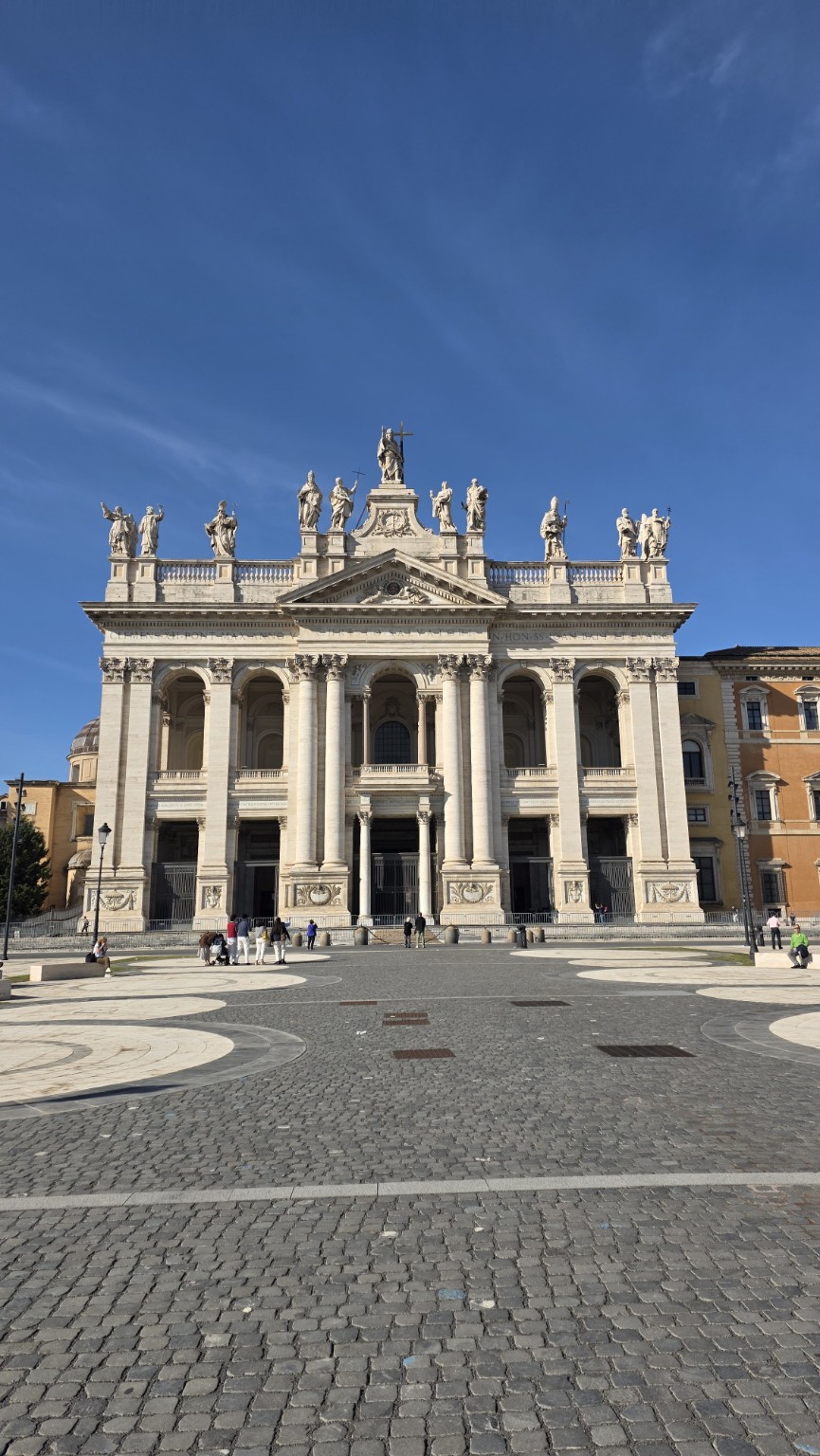
St Peter’s Basilica in the Vatican is often assumed to be the Catholic Church’s principal church. Yet the Lateran is the cathedral of the Bishop of Rome, the Pope. It bears the honorary title “mother and head of all churches in the city and the world”: Omnium urbis et orbis ecclesiarum mater et caput.
Its history is directly connected with Emperor Constantine the Great, Helena’s son.
Constantine was one of late antiquity’s most important rulers. Probably born around AD 272 in Naissus, present-day Niš, he was the son of the Roman officer Constantius Chlorus and Helena. Historical sources tell us very little about Helena’s origins. That gap gave rise to numerous local traditions, including those connecting her with our Adriatic region.
Through complex civil wars, Constantine gradually consolidated his authority over the Roman Empire. His victory over Maxentius at the Milvian Bridge in 312 was especially important. The familiar Christian tradition of Constantine seeing the sign of the Cross before battle and winning under Christ’s emblem is associated with this event.
In 313, Constantine and his fellow ruler Licinius agreed on a policy of religious toleration, traditionally associated with the Edict of Milan. Christians were granted freedom of worship and the return of confiscated property. They did not immediately become the Empire’s only or official religion, but freedom and imperial patronage profoundly changed their position.
The Lateran Basilica emerged at this historical moment.
The land belonged to an area of former imperial estates and a military complex. After Constantine’s victory over Maxentius, construction of a monumental Christian basilica began, most probably around 313. According to the traditional chronology, it was consecrated in 324 under Pope Sylvester I.
It was among the first great public churches built with a Roman emperor’s support. Its construction marked a turning point in Christian architecture. Communities that had previously gathered in house churches and more modest spaces now received a monumental building for public worship.
Constantine did not simply convert an existing pagan temple into a church. The Roman basilica, a building type used for various public and administrative functions in antiquity, was chosen for the new Christian architecture. It accommodated large congregations and processions, with a clear orientation towards the altar.
The original Lateran Basilica had a nave and four aisles, separated by rows of columns. Today’s layout preserves that basic spatial idea, although its appearance belongs to different centuries. We are looking at a building repeatedly restored, remodelled and reimagined rather than an untouched church from Constantine’s time. Its spaces trace the long life of Christian Rome: from fourth-century imperial patronage through the medieval papal residence to great Baroque interventions.
Francesco Borromini left an especially strong imprint when, on Pope Innocent X’s orders, he remodelled the interior for the Jubilee of 1650. The old basilica’s basic structure remained, while the central nave acquired a new rhythm of monumental pilasters and niches. Large statues of the twelve apostles were installed in the early eighteenth century. They give the space an almost bodily presence: our eyes encounter both architecture and the people whose witness helped shape the Church. The great façade is Alessandro Galilei’s work from the first half of the eighteenth century. What looks unified from outside is the final layer of a history spanning roughly seventeen centuries.
A statue of Constantine in the portico recalls the basilica’s imperial founder. Its presence at the entrance fits especially well with the story that brought me here. Helena stands at the centre of Santa Croce’s story; at the Lateran, her son greets us. This does not make every later Church tradition about Constantine a historically confirmed fact. We must distinguish his real patronage of church construction from later narratives that expanded his role. Researching Helena and Constantine means following their traces while carefully considering the period from which each trace comes.
The central entrance’s bronze doors belonged to the ancient Roman Curia, the Senate’s meeting house in the Forum, and were later adapted to their new purpose. Massive Roman doors became the entrance to a Christian cathedral. Within one object, senatorial and papal Rome meet almost tangibly. Above the papal altar rises a Gothic ciborium commissioned by Pope Urban V in 1368. Its upper section holds reliquaries containing remains venerated as relics of the heads of Saints Peter and Paul. Here too, several ages speak at once: ancient doors, the medieval sanctuary and the Baroque arrangement of the nave and aisles together form the building’s identity.
At the far end, our gaze leads towards the apse and Christ the Saviour. Its mosaic is associated with Jacopo Torriti’s work in the late thirteenth century, but was moved and extensively reworked when the sanctuary was enlarged in the nineteenth century. A cross occupies the centre, with water, birds, sacred figures and Christ’s face above them. After Santa Croce and the Holy Stairs, the motif appears in another form: a sign of the Passion, but also an image of life and salvation. For me, it completes the circle of three places we deliberately connected on the same Roman pilgrimage.
From Rome’s Shrines to Questions about Brač
Helena’s role should not be reduced to that of an emperor’s mother, but neither should everything built under Constantine’s patronage be attributed to her personal action. At the Lateran, the direct historical starting point is Constantine. Helena belongs to the wider story of family, faith and Christianity’s changing position. This is why I find it important to consider the sites together: Santa Croce preserves Helena’s memory and the tradition of the Cross; the Holy Stairs preserve a tradition of Christ’s Passion; and the Lateran powerfully witnesses the transformation imperial authority enabled for the Christian community.
My research into traditions of Helena’s origins on Brač is a separate question. Rome’s shrines do not themselves prove where she was born and cannot replace the sources needed for such a conclusion. They do provide a wider framework for understanding her. On Brač, we explore local memory and tradition; in Rome, we see how great a place Helena acquired in Christian memory. Between those levels remains room for research, questions and careful connections between evidence.
I will remember our Roman pilgrimage precisely for these encounters with her traces. Not because we found final answers everywhere, but because we could stand where the history of a woman, an emperor and a faith intertwined in ways that permanently changed Europe’s face.
Perhaps that is travel’s greatest value. It takes us towards places we have not seen, but sometimes also towards questions we have long carried within us, whose scale we only begin to understand on the road.
Related Research and Pilgrimage Stories
- St Helena Was from Brač! – My Research
- Rome and Assisi – A Journey through Eternity, Faith and Human Connection
- Sunday in St Peter’s Square – The Angelus with the Pope
Sources and Notes for the Historical Sections
- Santa Croce in Gerusalemme: The Basilica and Sessorium.
- Santa Croce in Gerusalemme: Relics and Church Tradition.
- Pontifical Sanctuary of the Scala Santa: Stairs, Tradition and Devotion.
- Papal Archbasilica of St John Lateran: Historical Overview.
- The Lateran Basilica: Borromini’s Renovation.
- The Lateran Basilica: Monuments and Bronze Doors.
- The Lateran Basilica: Altar, Ciborium and Relics.
- The Lateran Basilica: Apse and Mosaic.
- Francesco Bella and Carlo Azzi, 14C Dating of the Titulus Crucis, Radiocarbon 44/3 (2002), PG. 685–689.
Details about the relics and Helena’s actions are identified as Church tradition where contemporary confirmation is absent. The personal pilgrimage experiences draw on the author’s text and photographs.