A journey from Hurghada to ancient Thebes, among colossal columns, sanctuaries of ancient gods and stone monuments of one of humanity’s most magnificent civilisations.
From Hurghada to the Nile Valley
Four hours driving through the Egyptian desert may not sound like an appealing start, especially when you leave a comfortable Hurghada hotel while most tourists are still asleep. But Egypt’s most interesting places tend to lie far from hotel pools, and I learnt long ago that early starts often lead to the best travel days. Our group was in excellent spirits, alternating conversation with watching the vast Eastern Desert unfold outside. Rocky mountains, dry seasonal riverbeds, expanses of sand and stone, occasional checkpoints and a road threading through a landscape where life must choose its footholds carefully.
Then greenery appears: date palms, cultivated fields, irrigation canals, settlements and people beside the road. After the desert, the transition feels almost unbelievable. We have reached the Nile Valley, the narrow fertile strip that sustained one of history’s longest-lived civilisations. Herodotus’s description of Egypt as the Nile’s gift becomes tangible here. The river brought water and fertile silt, carried traffic, connected settlements and set the agricultural calendar. Cities and temples rose along its banks, while spaces for the dead were prepared at the valley’s edges.
Thebes, modern Luxor, held a special place among these cities: a former capital and one of Egypt’s great religious centres. Karnak and Luxor Temple developed on the east bank; royal necropolises, mortuary temples and their builders’ settlements on the west. For a visitor from Hurghada, this is another Egypt entirely: a few hours separate the Red Sea coast from a landscape where history begins to be measured in dynasties.
A Sacred City Built over Two Thousand Years
Karnak encompasses a network of temples, chapels, courtyards, monumental gateways, obelisks and processional routes. Its ancient name, Ipet-sut, is usually translated as “the Most Select of Places”. It developed over roughly two millennia, from early Theban rulers and the Middle Kingdom through the great New Kingdom pharaohs to later Egyptian dynasties and Ptolemaic rulers, with some interventions in Roman times. Almost every major New Kingdom pharaoh wanted to leave a mark here.
That makes Karnak difficult to grasp at a glance. Its parts belong to different centuries and royal ambitions. One pharaoh enlarged an entrance, another built a hall, a third moved statues or dismantled an older building to reuse its stone. Walking between these walls, we cross greater spans of time than we realise. Buildings that now seem a unified whole may have looked to their builders like monuments of remote predecessors.
That relationship with time particularly attracts me. “Ancient Egypt” easily becomes one image: a pharaoh, a pyramid, hieroglyphs and a few gods. Karnak breaks it open, revealing a civilisation that lasted long enough to have an ancient past of its own.
Amun – The Hidden Lord of Thebes
Karnak’s centre was dedicated to Amun, whose importance grew alongside Thebes’s political strength. His name means “the Hidden One”. During the second millennium BC he became one of Egypt’s foremost gods; association with the great sun god Ra produced Amun-Ra, combining creative power, the Sun and the authority of the king of the gods.
Amun’s wife Mut and their son Khonsu, a lunar deity, were also worshipped at Thebes. Together they formed the Theban Triad. Greater Karnak contained several sacred precincts: Amun’s, the largest; Mut’s to the south; and Montu’s to the north. Buildings dedicated to Aten also rose to the east. Amun’s priesthood possessed great wealth and political influence. At times, the relationship between temple and royal authority became central to governing Egypt.
A pharaoh depicted offering gifts to Amun makes an important statement about himself: his rule belongs to the divine order. Temple building, military victory and correctly performed ritual share a language of legitimacy. Recognising that gives the recurring scenes on the stone much clearer meaning.
Sphinxes, Pylons and Our First Steps through Karnak
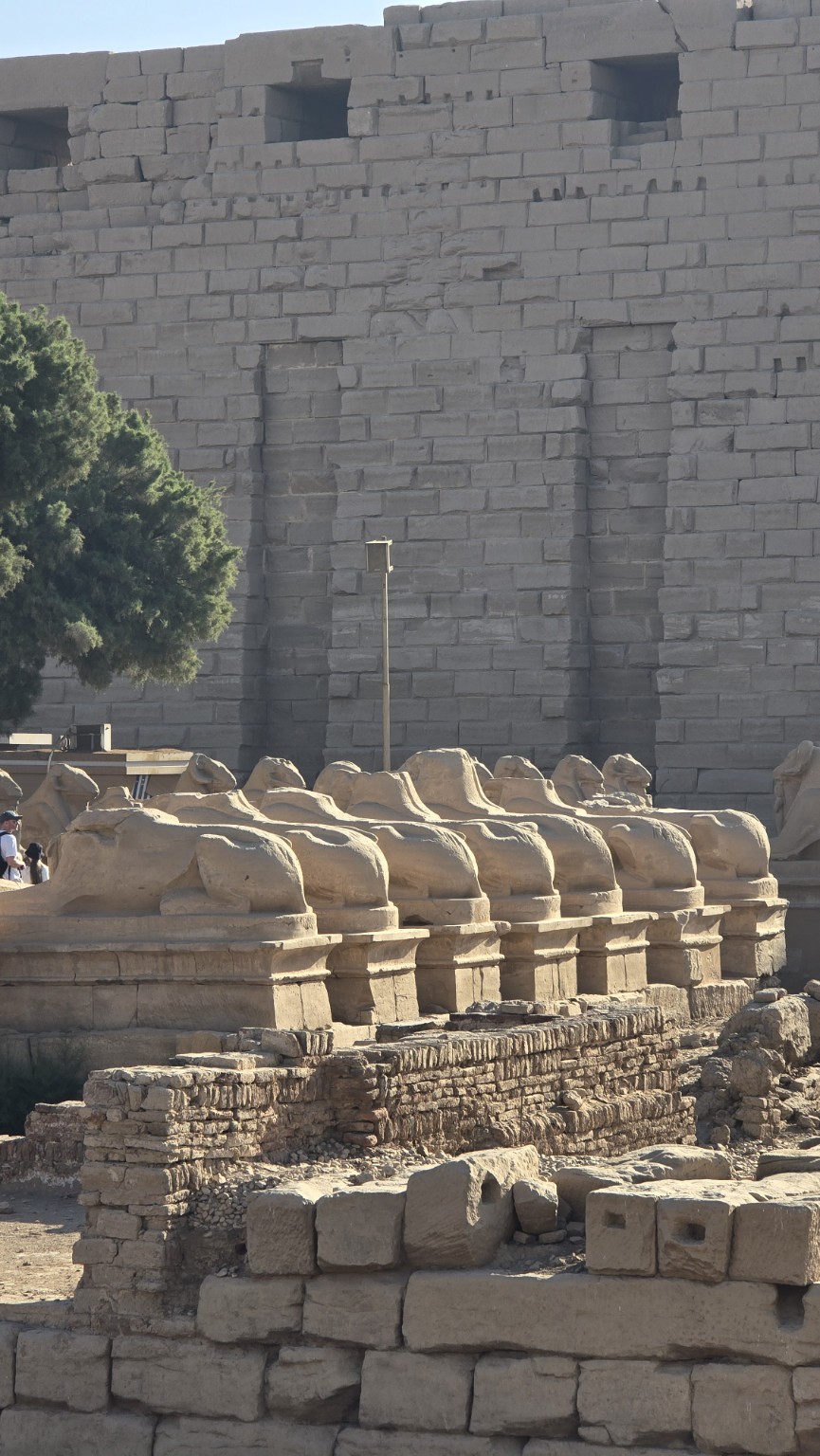
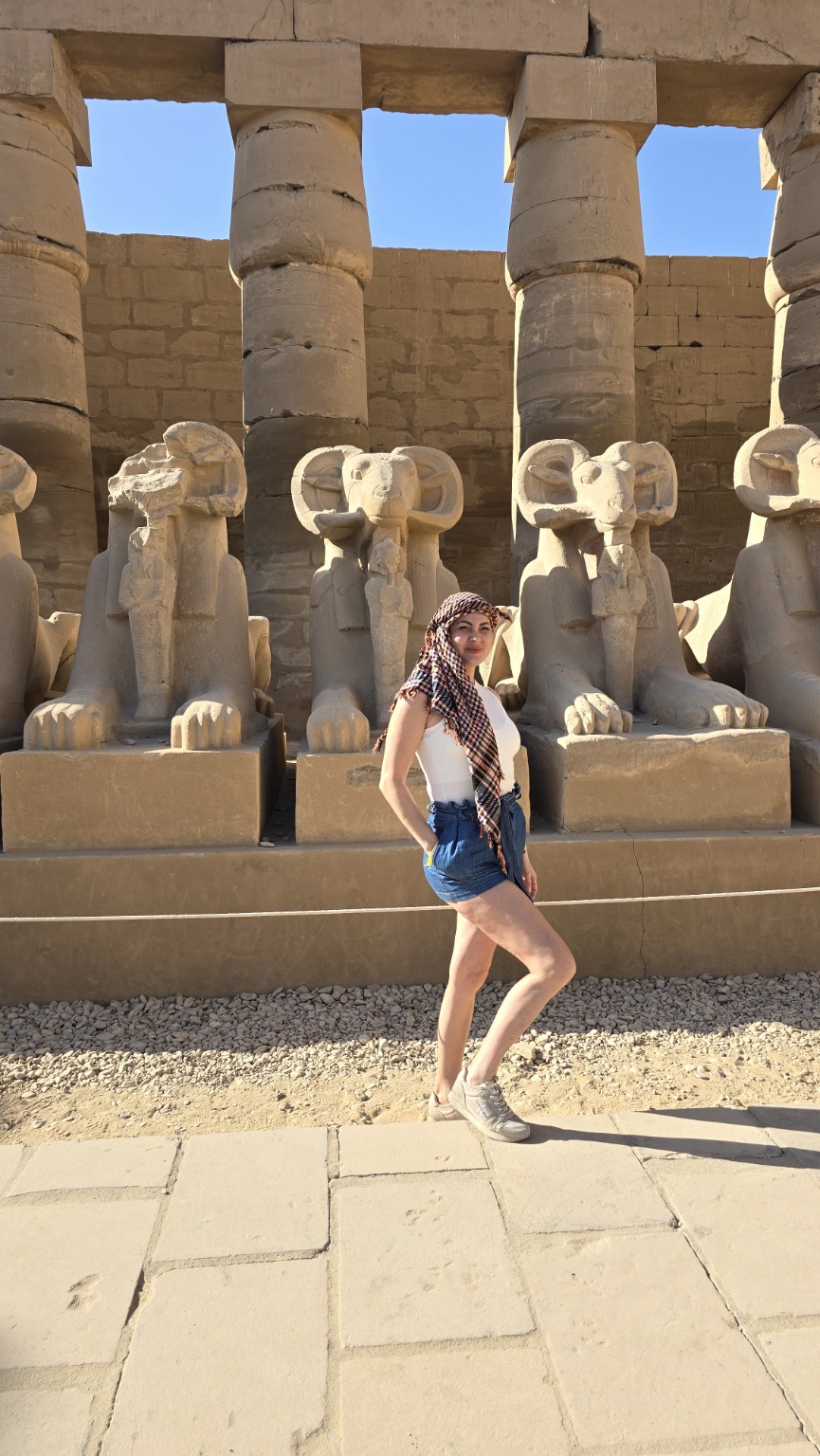
Ram-headed sphinxes mark the approach to the western entrance. The ram was associated with Amun, and small royal figures stand between the sphinxes’ front paws. Their history is more complicated than today’s orderly rows suggest: statues were moved, reinscribed with rulers’ names and adapted to new entrances. The present arrangement reflects several such interventions.
Beyond them rises the First Pylon. A pylon is a monumental gateway comprising two massive towers with a passage between them. Karnak’s First Pylon is approximately 113 metres wide but unfinished: the southern tower reaches about thirty-two metres, while the northern is lower. The intended height was around thirty-eight to forty metres. Construction is attributed to Nectanebo I, a fourth-century BC ruler of the Thirtieth Dynasty. Remains of the builders’ mud-brick ramps are still visible inside.
That detail interests me almost as much as the gateway’s size. Alongside the monumental ambition, traces of the building site survive. Suddenly you can imagine people transporting materials, raising their access ramps and positioning the next block. Behind the pharaoh’s intention appears the practical work.
The Great Court – Where the Gods Paused
The Great Court opens beyond the First Pylon, bringing together buildings from different periods. Here stands Seti II’s triple shrine for the sacred barques of Amun, Mut and Khonsu. Ramesses III’s temple is incorporated into the court, also receiving divine barques during festival journeys. These portable sacred boats carried divine images, and their movement through temples and the city formed an important part of religious life.
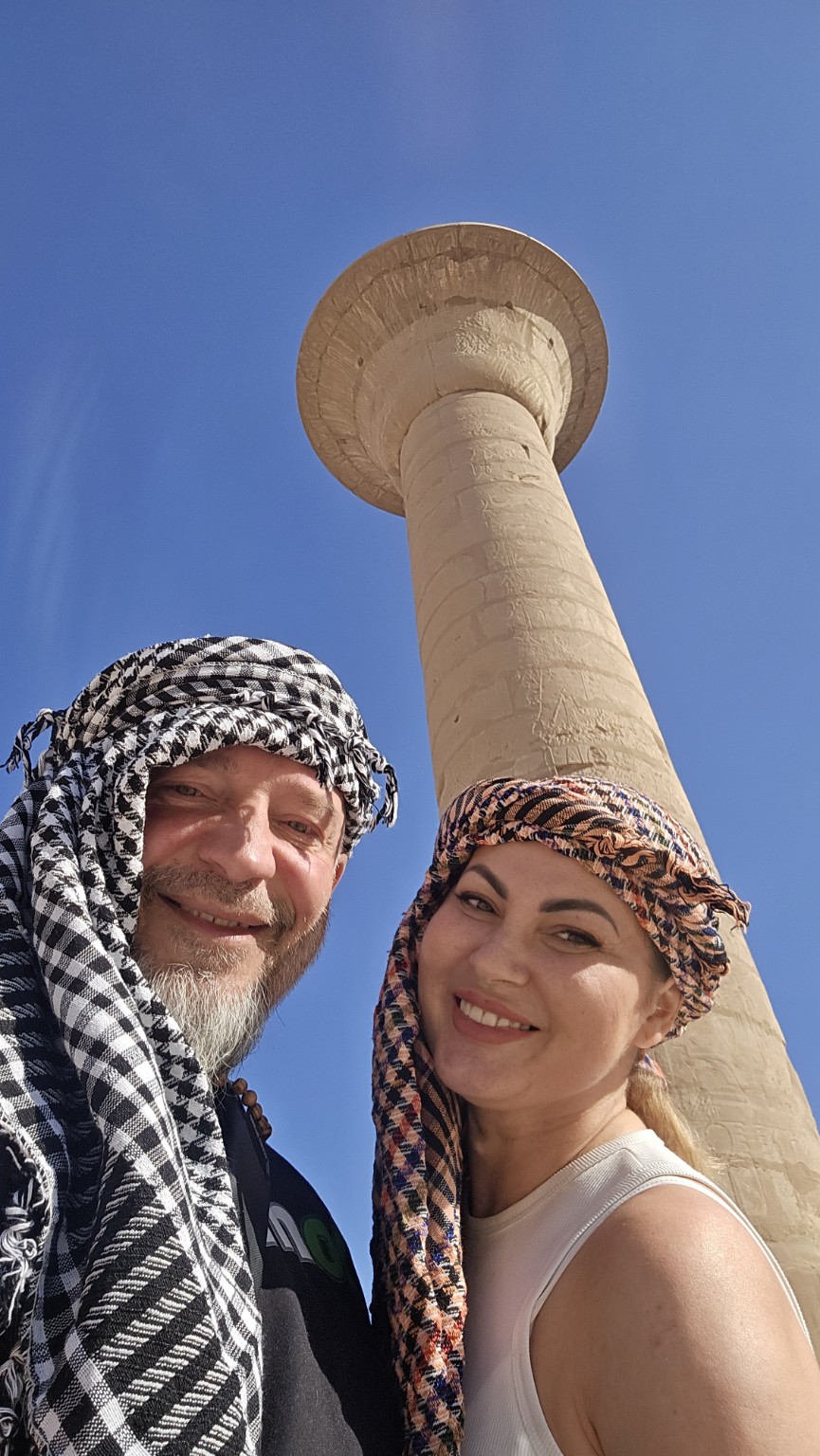
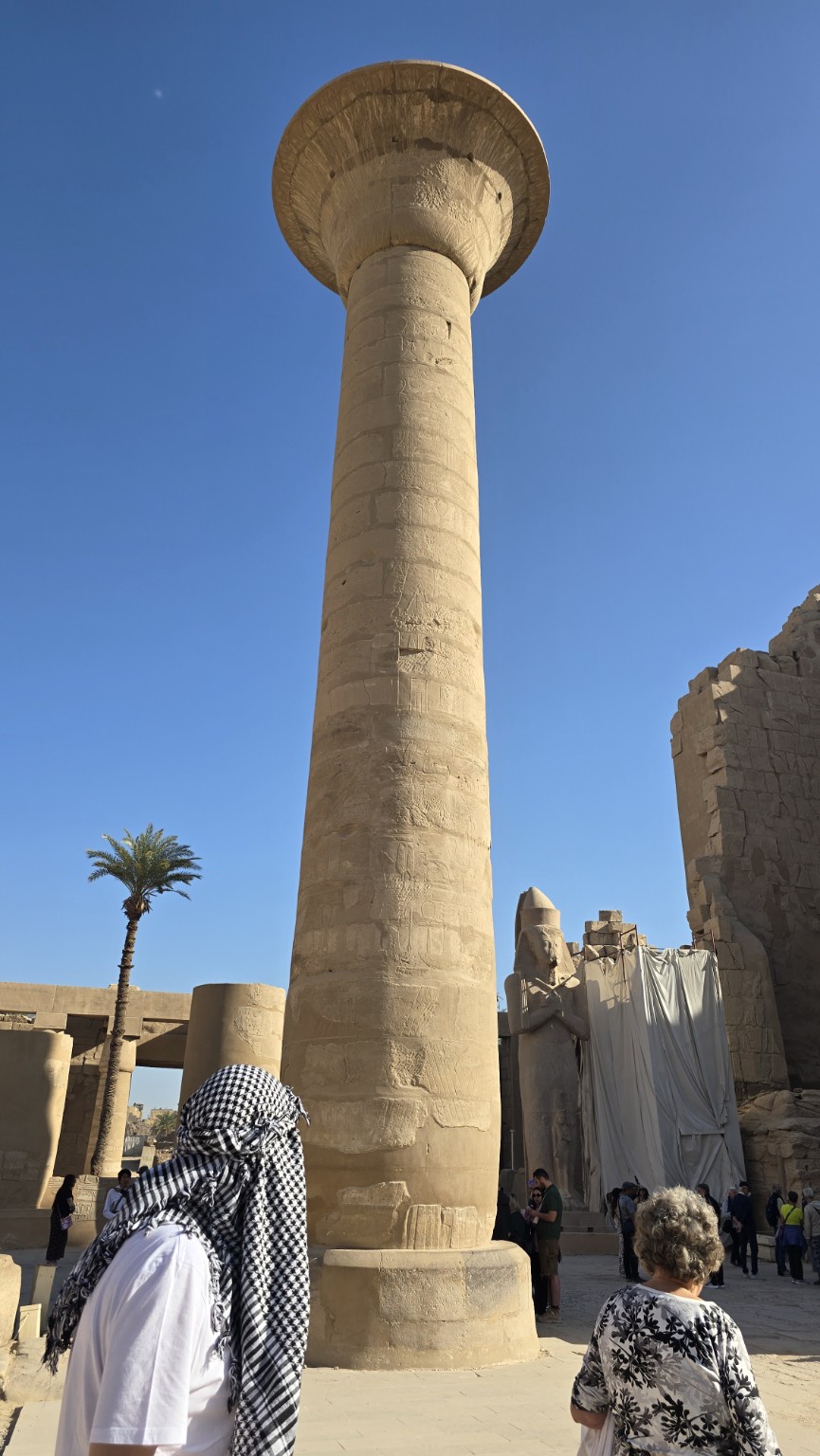
The surviving column of Taharqa’s kiosk stands out. Taharqa, a Nubian pharaoh of the Twenty-fifth Dynasty in the seventh century BC, erected a structure with ten great columns in two rows. One remains fully standing. Low walls linked the columns, and the central space was associated with placing the sacred barque. Details of its ritual use remain subject to scholarly interpretation.
Already, Karnak becomes a stone chronicle. Rulers extended, remodelled and appropriated a space where every new undertaking had to find a relationship with its predecessors. Devotion, prestige and political messaging remain intertwined in the arrangement of its buildings.
The Great Hypostyle Hall – A Forest of 134 Columns
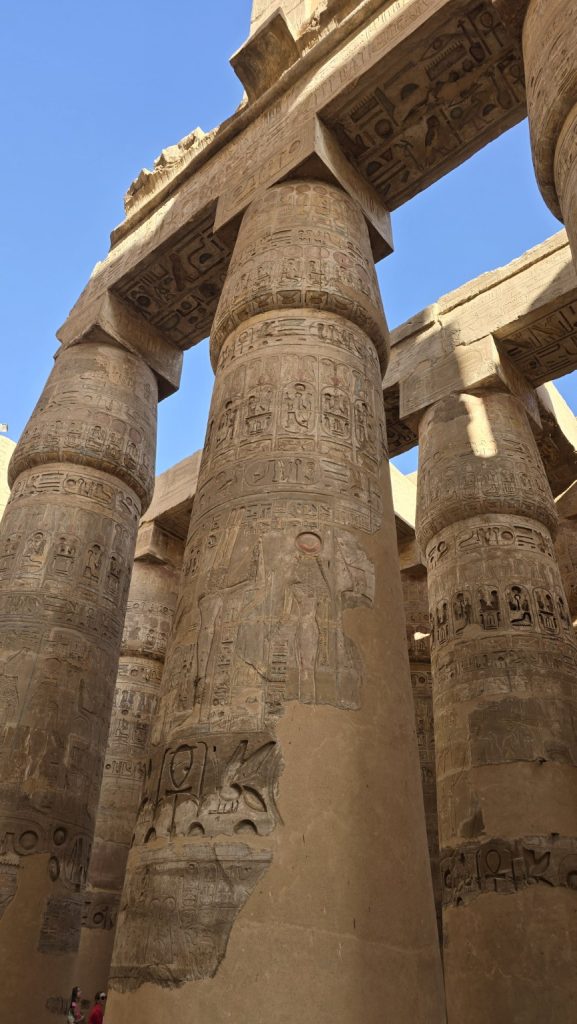
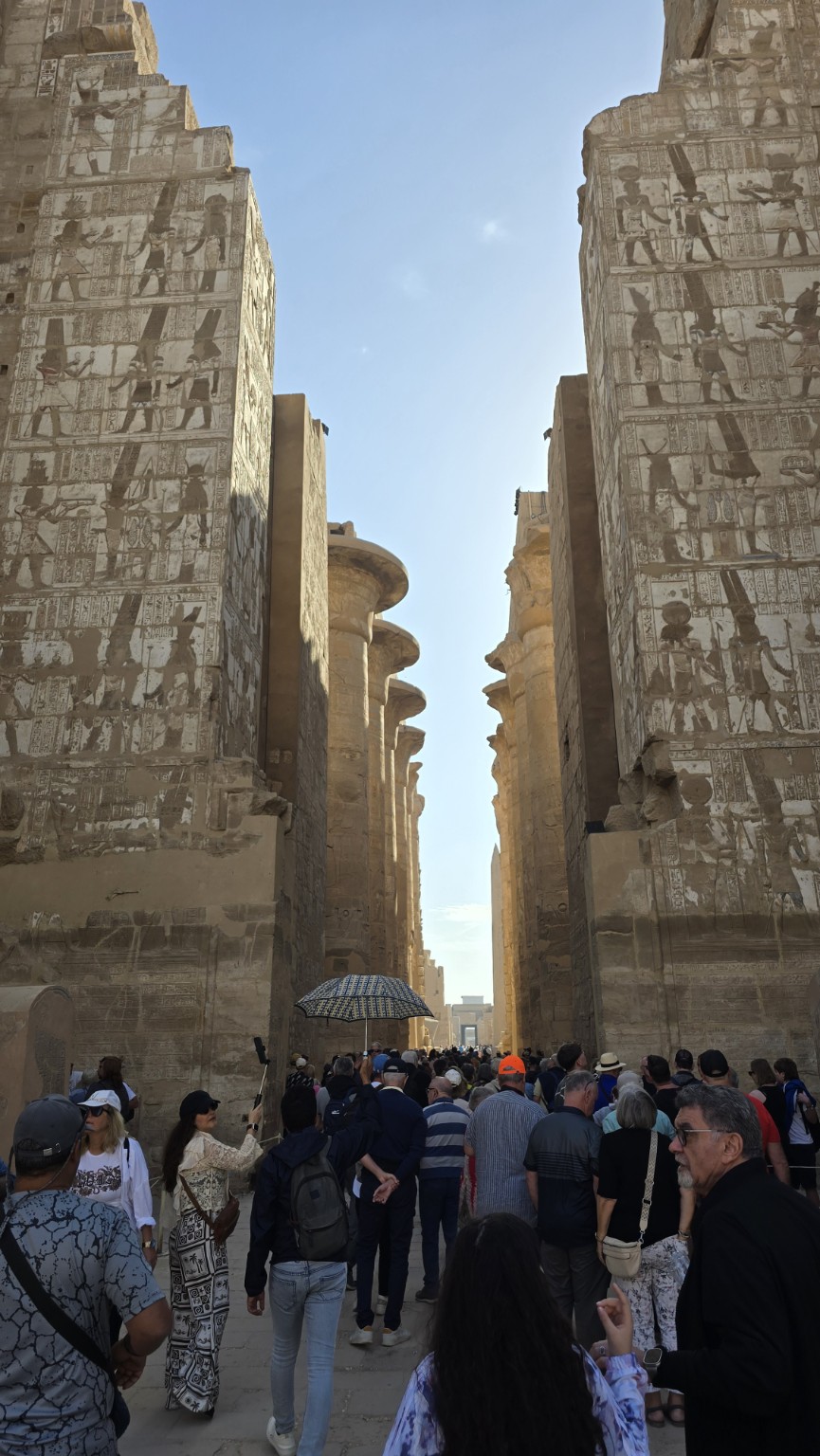
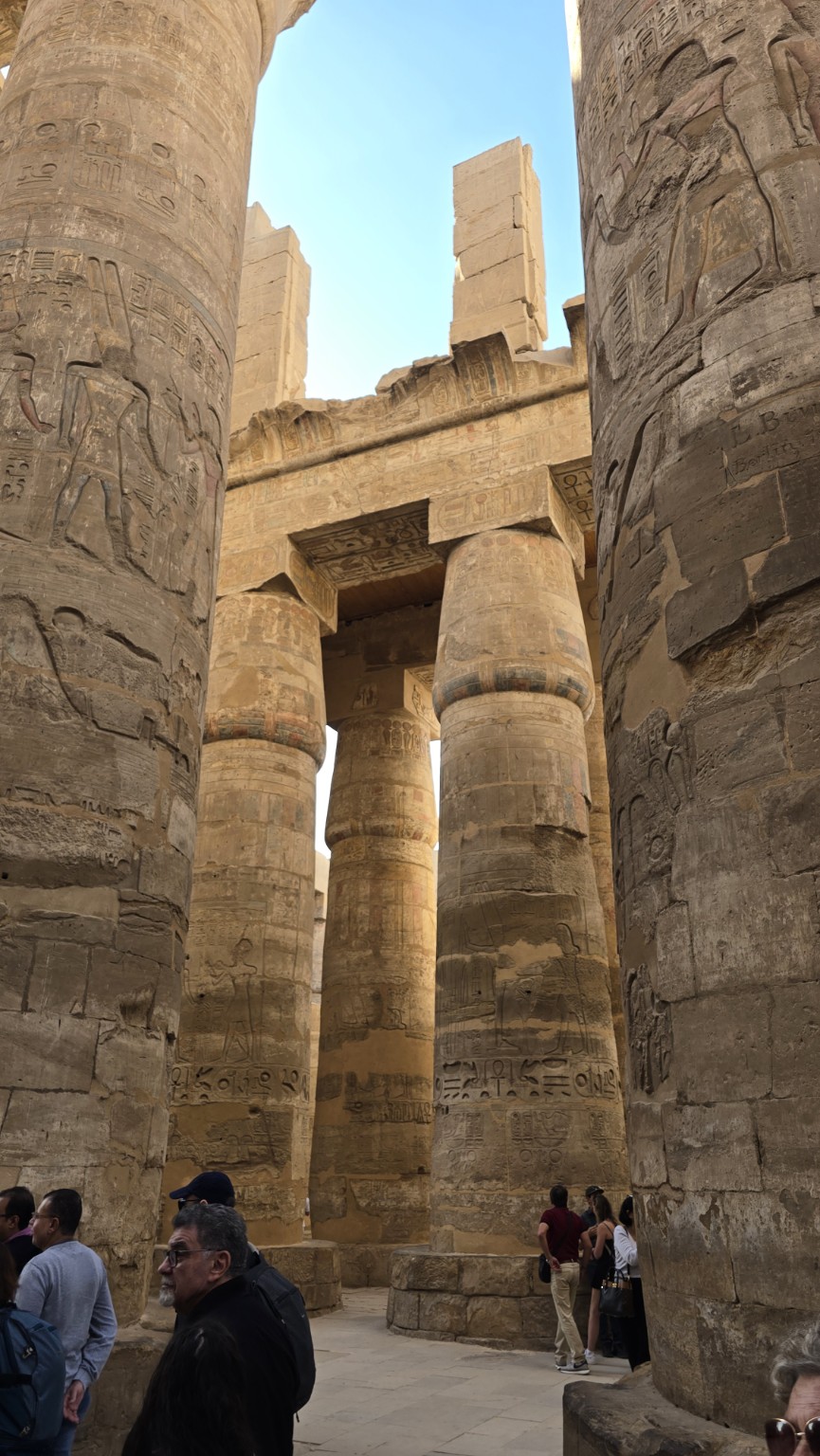
Then we reach the space that made Karnak one of the ancient world’s most recognisable monuments. The Great Hypostyle Hall stands between the Second and Third Pylons. The name means a hall whose roof rests on columns, but that dry definition scarcely prepares you. Across more than five thousand square metres stand 134 enormous stone columns. The twelve central columns are about twenty-one metres high, their open capitals approximately 5.4 metres across. The other 122 reach about fifteen metres, topped with closed papyrus-bud capitals.
The hall’s centre was higher than its sides, allowing stone window grilles to admit light below the roof. Much of that roof is gone, leaving a more open space than the ancient Egyptians knew. Imagine ceiling slabs, painted surfaces and carefully restricted shafts of light. Most construction belongs to Seti I; his son Ramesses II continued the decoration.
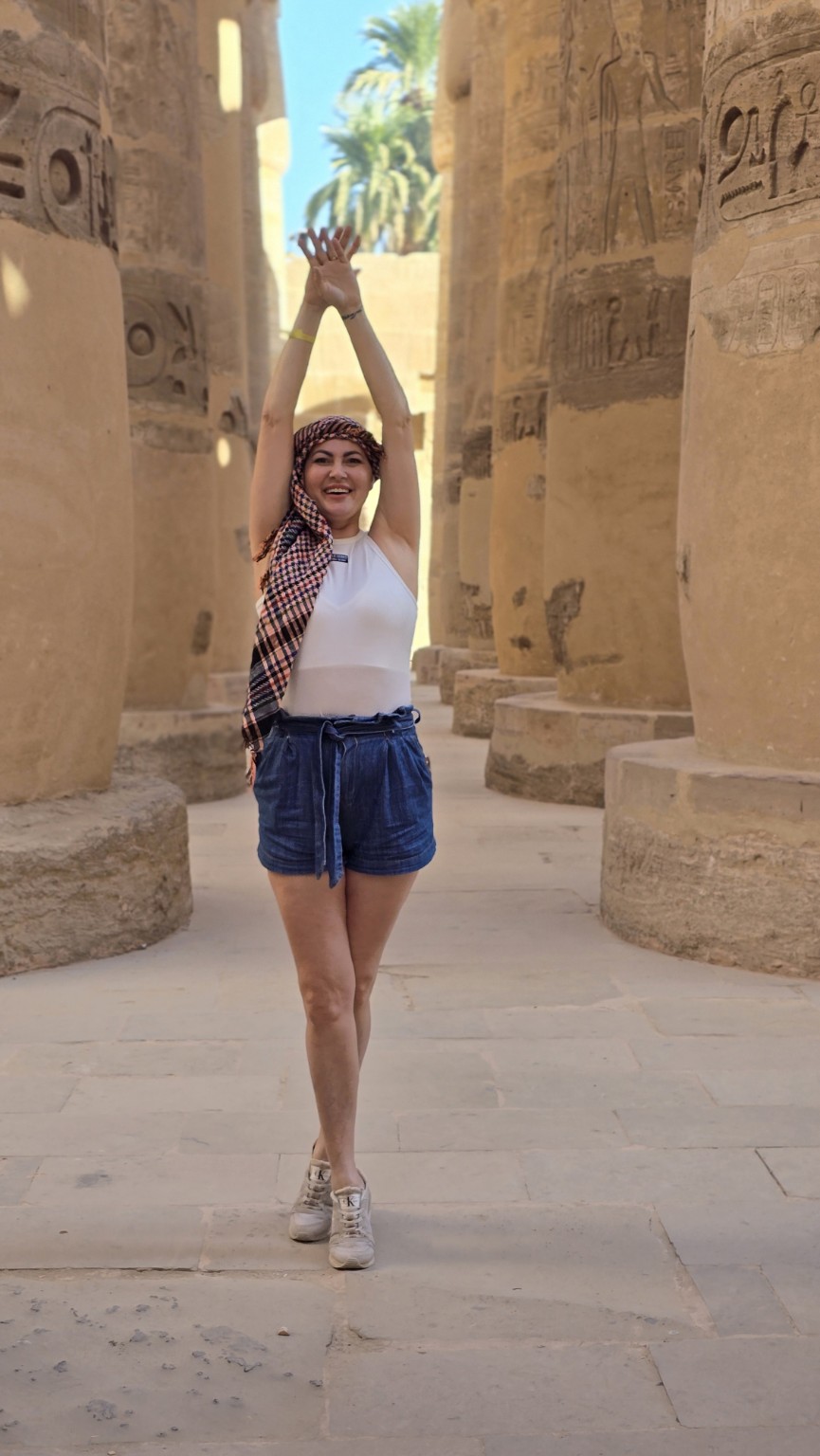
Walking among the columns is extraordinary because the scale keeps changing. From afar, they form a forest. Close up, a single column becomes an immense surface covered with hieroglyphs, divine figures, royal names and offerings. Your eyes follow a detail, then the height draws them upwards again. Even knowing the measurements, it is hard to relate them to your own body. A photograph can show a column; a person beside it reveals its size.
Wars, Inscriptions and the Pharaoh’s Self-Image
Military campaigns survive on the hall’s outer walls. Seti I and Ramesses II appear in battle scenes linking royal victory with the preservation of Egyptian order. Here we encounter the complex history of depictions of the Battle of Kadesh: some scenes were subsequently altered, and scholars study earlier compositions beneath later reliefs. Walls, like buildings, could acquire new political messages.
Ramesses’s conflicts with the Hittites eventually gave way to peace. The Egyptian–Hittite treaty is carved at Karnak on a wall beside the hall’s southern side. Images of war and the record of a diplomatic settlement thus survive in the same space.
It is worth pausing before the reliefs to ask a simple question: who is telling us history here? The king had the resources to make his version enormous, lasting and publicly visible. His opponents on these walls rarely get to explain what events looked like from their side.
Hatshepsut’s Obelisks – A Royal Name Raised towards the Sky
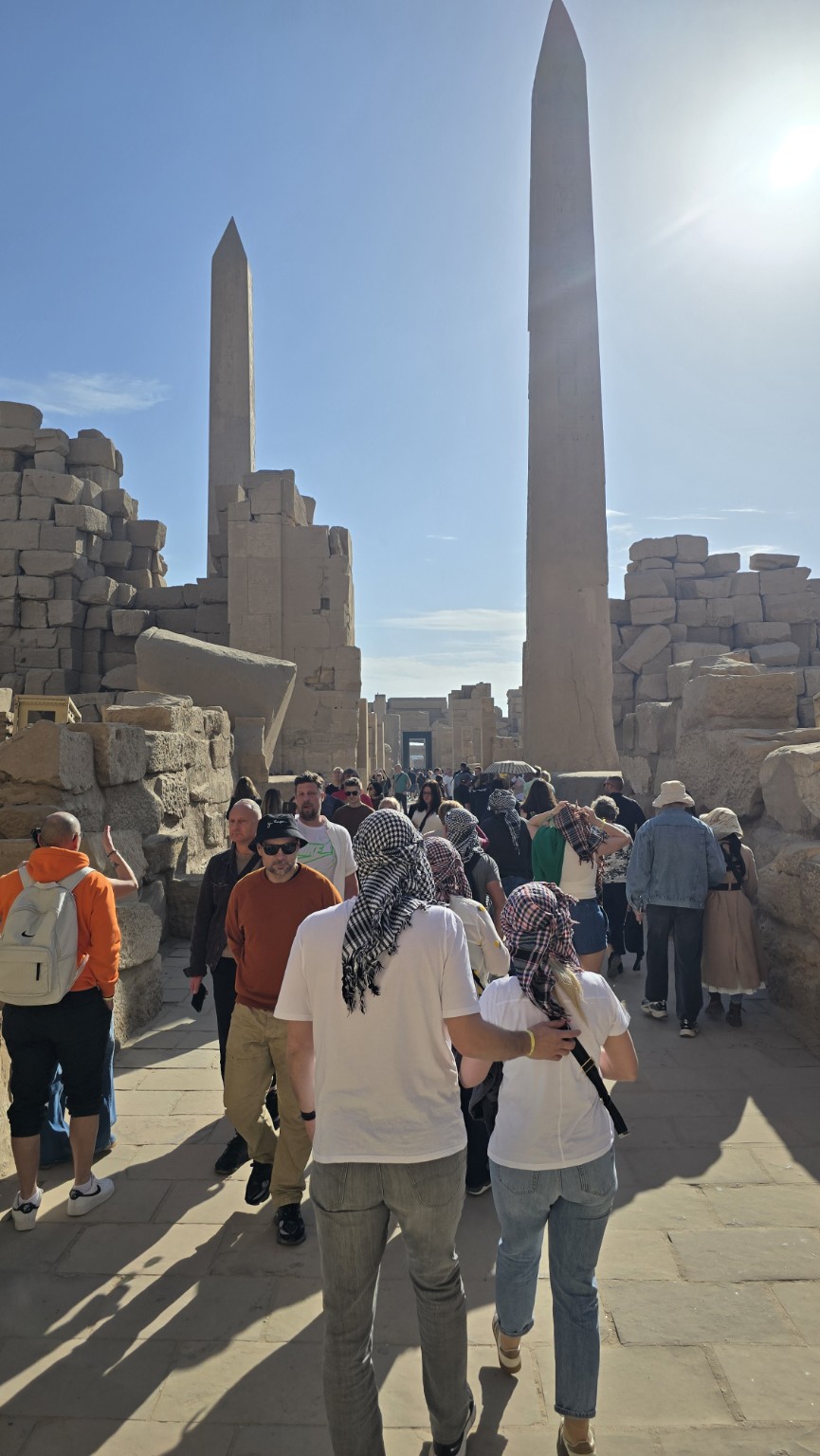
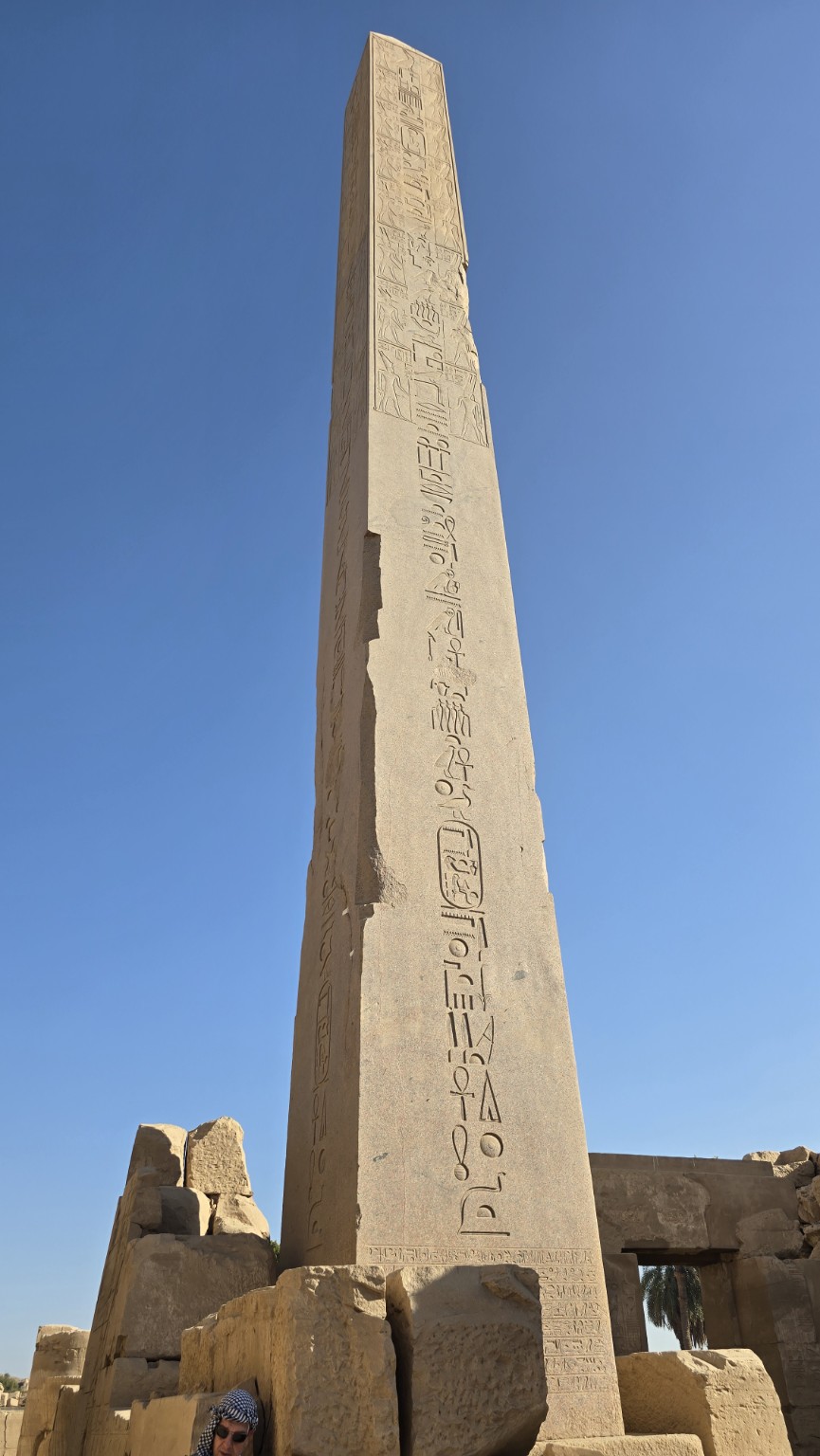
Further inside, we reach the obelisks, tall stone monoliths that became recognisable symbols of Egypt. Hatshepsut’s surviving obelisk is particularly striking: almost thirty metres high and weighing over three hundred tonnes. Made of pink granite, it originally belonged to a pair in the Wadjet Hall. The other fell; part can now be seen near the Sacred Lake. Inscriptions associate their erection with Hatshepsut’s sixteenth regnal year.
Hatshepsut is one of Egyptian history’s most fascinating figures: a woman who assumed full pharaonic power, using traditional royal titles and imagery. Her monuments connect her authority with the gods and great building projects. Later removals of some images and names reflect a complex response to her reign; a simple tale of immediate revenge by a successor cannot explain all the surviving evidence.
Looking at that upright stone, I think of the people who made its presence possible. The monolith had to be quarried, worked, transported and raised. Behind its calm, almost simple geometry lie planning, material knowledge and immense organisation. It bears a royal name, but its existence speaks of many people whose names were never recorded.
Thutmose III and the Botanical Garden in Stone
Thutmose III left a profound mark on Karnak. His Akhmenu festival temple stands in the eastern part of Amun’s precinct, associated with royal worship, deities and the veneration of earlier rulers. Its great hall has unusual columns resembling tent poles, beneath a ceiling once painted blue with yellow stars. In the room known as the Hall of Ancestors, Thutmose presents offerings to earlier kings.
The so-called Botanical Garden is particularly intriguing. Its reliefs depict plants and animals associated with lands the king encountered on campaign. “Garden” might mislead today’s visitor: nature appears here in carvings on stone walls. That is its appeal — the effort to bring unfamiliar forms from a distant world home and preserve them.
As a traveller, I understand the impulse. We return with photographs, small objects and stories to share. Thutmose had royal workshops and temple walls at his disposal. The scale differs, but the desire to preserve what surprised us remains familiar.
Inside the Sacred Core of Amun’s Temple
In the centre stands Amun’s barque sanctuary, whose present form is associated with Philip III Arrhidaeus, the Macedonian king who ruled after Alexander’s death. Built in the late fourth century BC, it replaced an earlier sanctuary of Thutmose III. This building shows how Karnak’s life transcended individual dynasties: ritual tradition continued under rulers from a different political world.
The deity’s cult statue was kept in the most sacred rooms. Daily, priests entered purified, burned incense, opened the shrine, cleaned, dressed and anointed the image, and offered food and drink. Official depictions show the pharaoh performing the ritual; authorised priests did so on his behalf in practice. Such service was believed to sustain the relationship with the god and preserve the world’s order.
Access to the inner rooms was restricted. Most people could not simply walk towards the centre as visitors do today. Their encounters with the deity came more through festivals and processions. It is worth recognising our position as we pass through: we freely view spaces once approached only through prescribed duties, preparation and rights of access.
The Sacred Lake and the Great Scarab
South of Amun’s temple core lies the Sacred Lake, a rectangular body of water approximately 128 metres long and eighty-three metres wide. Thutmose III left a record of digging a new lake, later altered. It served ritual purification and other temple needs, including certain festival activities involving sacred barques. Water belonged both to the daily maintenance of sacred space and to wider Egyptian ideas of life’s creation and renewal.
After the dense forest of columns, the lake frees the eye to wander. The same monumental architecture now forms an open view, changed by the water’s presence. Nearby stands a great stone scarab commissioned by Amenhotep III, one of Karnak’s best-known individual monuments.
Here it is easy to understand why we return to travel photographs. One shows an obelisk, another buildings reflected in water, another a stone insect. Looking at them together again, we begin to connect the different parts of the place we visited.
Chapels, Smaller Temples and Traces of Great Changes
Many important buildings lie beyond Karnak’s best-known visitor route. The open-air museum contains reconstructed chapels: Senusret I’s White Chapel, from the Middle Kingdom, and Hatshepsut’s Red Chapel. The former preserves fine jubilee reliefs and depictions of Egypt’s provinces; the latter, built of red quartzite, depicts rituals, processions and the raising of obelisks. Both were dismantled and their blocks reused. Archaeologists’ identification of those pieces allowed their reconstruction.
Khonsu’s temple lies in the south-west of Amun’s precinct, associated with Ramesses III’s building programme. Its pylon, open court, columns and inner sanctuaries make an Egyptian temple’s layout easier to understand. Nearby is the goddess Opet’s temple; Ptah’s stands in the north of Amun’s precinct. Further south lies Mut’s separate complex, known also for its Sekhmet statues.
Akhenaten, or Amenhotep IV, deserves a chapter of his own. He built sanctuaries to the solar disc Aten east of Karnak. After his reign, the buildings were dismantled and their small stone blocks, known as talatat, incorporated into other monuments. Horemheb used them as infill in some pylons. Changes in religious policy were literally walled into later buildings.
Confronted with such layers, you quickly accept the limits of a single visit. Karnak holds enough unread details for many returns.
The Route Travelled by the Gods
Processional routes and the great Opet festival linked Karnak with Luxor Temple. During the festival, Amun-Ra, Mut and Khonsu left their sanctuaries and travelled towards Luxor. Routes and transport changed over time, using both land and the Nile. The festival united the divine family, city and royal authority, turning the space between temples into the setting for a shared religious event.
I try to imagine the scene: sacred barques, a procession, people waiting for the divine image, buildings far more vividly coloured than today. Imagination cannot restore the past, but it helps us stop seeing the spaces between walls as empty. Something happened there. Someone waited, carried, prepared and watched. The temple had a rhythm, and the city knew when it changed.
Returning beneath the Sky of Ancient Thebes
We intend to return for the total solar eclipse on 2 August 2027, when the Luxor area will lie within the path of totality. In a place where the Sun held such religious and symbolic importance, this meeting of sky and history has particular appeal. I explore the event and its connection with ancient Thebes in “The Solar Eclipse and Ancient Egypt”.
Thinking of our journey from Hurghada, I am struck by the difference between the time we needed and the time Karnak needed. Roughly four hours, a cheerful group and one travel day brought us before buildings created through countless generations. We could pass beneath completed lintels, pause beside an obelisk and photograph columns. Those who began individual parts could never see what we see: all these different undertakings gathered in one place.
That is what makes Karnak so valuable as a travel experience. Its scale captures attention; its details hold it. A ramp beside a pylon, a small sign on a vast column, a reassembled chapel, someone’s name recarved in stone. Through them, pharaonic Egypt becomes closer and more understandable. Behind royal titles appear people who built, believed, served and tried to make something of their world endure.
The photographs we bring home preserve part of that encounter. The rest slowly becomes a story as we remember what we saw and why it mattered. Alongside Karnak’s stone forest remain our fellow travellers, conversations on the road and a shared day in ancient Thebes. That connection between place, knowledge and personal experience creates journeys we gladly revisit after returning home.
All My Travel Stories from Egypt →
Egypt: Among Pharaohs, Bedouins and Coral Gardens →
Sources for historical and architectural data
- Egyptian Ministry of Tourism and antiquities: Karnak
- Digital Karnak: the first pylon
- Digital Karnak: Taharkin kiosk
- Digital Karnak: Hypostyle Hall
- University of Memphis: Karnak Great Hypostyle Hall Project
- Digital Karnak: Hatshepsutini obelisks
- Digital Karnak: Akhmenu
- Digital Karnak: shrine of St. Barka
- Digital Karnak: daily ritual
- Digital Karnak: sacred lake
- Digital Karnak: White Chapel
- Digital Karnak: Red Chapel
- Digital Karnak: Temple of Honsu
- Digital Karnak: sanctuary of Aten
- Digital Karnak: processions and festivities
- NASA: eclipses of 2027.